
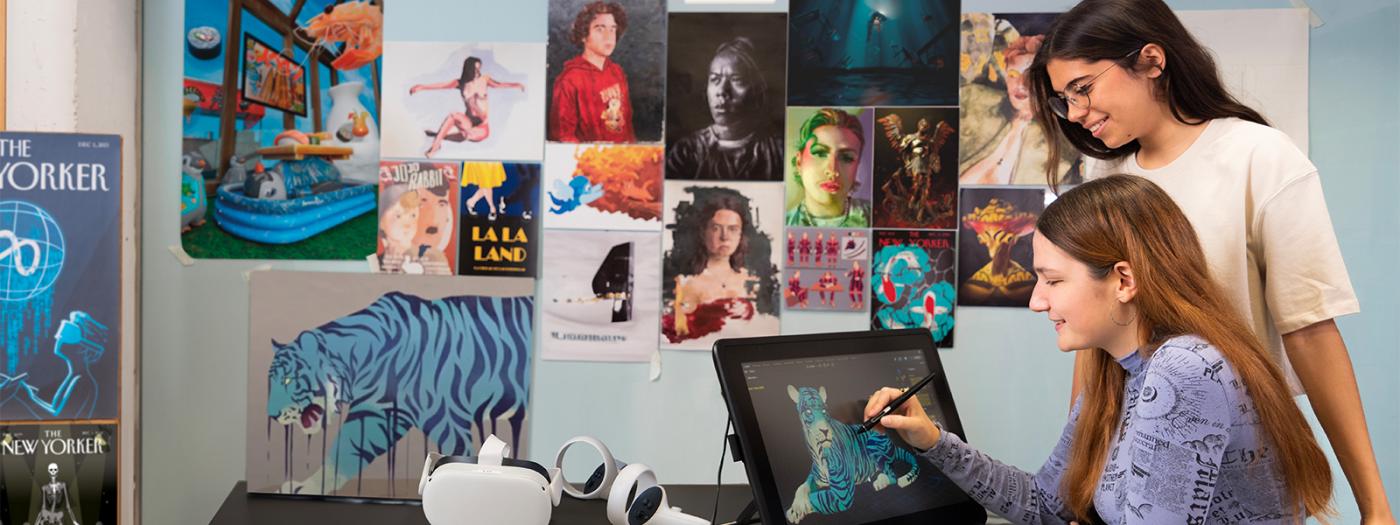
Throughout the previous semester, we analyzed, studied and interpreted the elements and techniques needed to create a 2D animation, and learned how the industry has been perfec ting the technique to this day. This semester, we will take on another challenge and expand the areas given in the previous semester, to enter more advanced 3D animation techniques.
Titular Professors
Having completed Animation I.
The course aims to introduce students to advanced 3D animation techniques, expanding on the knowledge acquired in 2D animation. Students are expected to choose the most appropriate techniques for each case and to create simple 3D content. The course also seeks to foster critical thinking and problem?solving skills by combining theory and practice. Active teaching methodologies are used to promote progressive, hands?on learning.
UNIT 1. Simple cut -out character development
UNIT 2. Introduction to body mechanics. 3D animation
UNIT 3. Character design and environment creation. 3D rigging
UNIT 4. Body Mechanics
It works through different active teaching methodologies and project- based learning. Although there are Master Classes, the demonstrative and practical ones predominate. These are carried out by the students individually with the continuous supervi sion of the teacher.
At certain moments of the syllabus, learning based on problems and exercises is applied, so that the student has to face situations that make him leave his comfort zone. In this process, the student has to think about solving more complex situations by merging various techniques and applying the theory.
At the beginning of each session, any doubts that resulted from the previous practice or session are resolved. Afterwards, the theoretical -practical part is discussed so that stude nts have the knowledge and tools necessary to develop the approaches and achieve the new goals.
Didactic activities are offered with specific audiovisual material to become familiar with the technical vocabulary and develop their professional growth thr ough practice and experience.
At the beginning of the course, the exercises that make up the continuous assessment of the entire semester and the route to follow to achieve the purpose of the subject are presented.
At the beginning of the most important practices there is a reception of preparation, and at the end, a closing to draw conclusions and learn from mistakes.
There will be 3 partial internships corresponding to each of the topics of the subject. And a final project that It will be a summary of the activities done in the subject.
In order to assess whether the student has achieved an adequate degree of the objectives pursued by the subject, they are used different activities of continuous evaluation, with an approximate frequency of monthly.
The course is assessed through three partial assignments and a final project that integrates all the competencies developed. Continuous assessment aims to ensure steady progress, value the student’s daily work, and promote an effective working method.
Williams, R., Animator's Survival Kit , Faber and Faber, Lonson 2009 Thomas,
Johnston O., Illusion of life , Hipéryon, 1997
Bendazzi, G., Cartoons. 100 años de cine de animación, Ocho y Medio, Madrid 2003 Silver
S., The Silver Way , Design Studio Press, 2017
Catmull E., Creatividad S.A, PRHGE, Barcelona 2014
“Blender 2.80 Reference Manual.”, Blender Foundation, https://docs.blender.org/manual/en/latest .Siddi, Francesco.
“Get Started: Blender fundamentals” Blender Cloud Courses, Blender Foundation,
https://cloud.blender.org/p/blender -fundamentals .
“Fresh Blender News, Every Day”, Blendernation, https://www.blendernation.com
“Home of the Blender Community”, BA: Blenderartist.org, https://blenderartists.org
In each topic, more specific bibliography and teaching material will be provided.