
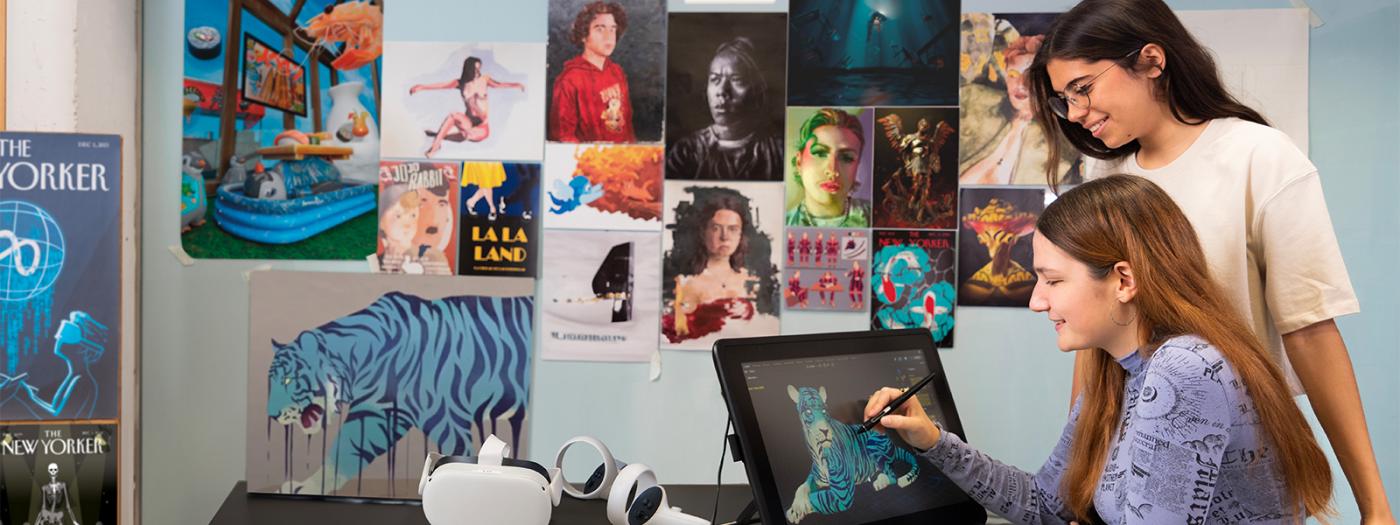
After the student has assimilated the knowledge bases of traditional painting, during the first year, he will deepen in digital painting applying this knowledge to the realization of digital works, learning to use his own software and techniques for the development of digital painting. The main goal of this course is to offer, show and practice the digital painting tools that Photoshop offers, to get the most out of it as a painting tool, as well as a better understanding of how light works on objects and characters. Basic and advanced knowledge of color theory, pictorial composition and understanding of light will also be transmitted. The ultimate goal is to create a digital background / scene for a character previously created in the subjects of Digital Drawing and / or Digital Sculpture in the first semester.
Titular Professors
Basic knowledge of drawing; volume, values, proportion, construction, among others.
The main objective of this course is to explore, demonstrate, and practice the use of digital painting tools available in Photoshop, with the aim of maximizing their potential as an artistic tool rather than as photo-editing software. Knowledge of color theory applied to painting will be provided. The ultimate goal is for students to develop skills in using digital painting tools (brushes, textures, layers, etc.), as well as in the use of color, lighting, and composition.
1. Color theory
2. Color palettes
3. Work with thumbnails
4. Interaction of light and color
5. Skin color
6. Color psychology
7. Color in the landscape
8. Material spheres
9. Daytime / nighttime lighting and color
The proposed class structure is divided into several sections:
1.Workspace preparation and initial explanation: The class will begin with an introduction and preparation of the workspace.
2.Theory: This will include the presentation of reference materials and relevant theoretical aspects for digital painting.
3.Review of previously submitted exercises: Time will be dedicated to reviewing and discussing exercises completed in previous classes, providing feedback and opportunities for continuous learning.
4.Explanation of the day’s exercise and submission deadline: The day’s exercise will be explained, either demonstrated live for students to follow or shown through clear and detailed examples. The submission deadline for the exercise will be indicated.
5.Practical session and individual feedback: During this phase, students will work on the day’s exercise while receiving individualized assistance and feedback.
Additionally, the following materials will be provided in the course:
-Presentations containing the information covered in class and the requirements for submissions
-Brush and texture packs.
-Reference materials and useful websites that students can use as additional resources outside the classroom.
Attendance 10%
Practical Component – 60%
Minimum grade for each exercise to count toward the average: >5/10.
Any assignment not submitted by the deadline will be recorded as NP (not presented).
Any incomplete assignment (as determined by the instructor) will not be graded and will receive a 1.
Failed or NP exercises must be submitted at the end of the course and will have a maximum grade of 5.
Final Project: Integration into a Background – 30%
Minimum grade to count toward the average: >5/10.
Late submissions, failures, or NP will result in not passing the regular evaluation.
Failing the final project results in failing the regular assessment, with no possibility of resubmission in this session.
Continuous Assessment
The final grade will consider: student engagement in class, submission of exercises and tasks, and the instructor’s evaluation.
Extraordinary Assessment
Students who do not pass the regular assessment may pass the course during the extraordinary evaluation session.
Evaluation Criteria for All Sessions:
If the conditions to pass the session are not met, the maximum grade will be 4. Students have the right to a grade review on the day scheduled by the instructor. During this review, the student’s grade may be increased or decreased.
Escuela de artistas: color y luz. (2023). Anaya Multimedia.
Fundamentos del arte: luz, forma, color, perspectiva, profundida, composición y anatomía (2a edición). (2021). Madrid Ediciones Anaya Multimedia.
Gurney, J. (2015). Luz y color: la guia de los profesionales del arte y la imagen. [Madrid] Oberon D.L. 2015.
Zarins, U., & Kondrats, S. (2019). Anatomy for sculptors: understanding the human figure (Third edition). Anatomy Next, Inc.
The supplementary materials will be provided in class.