
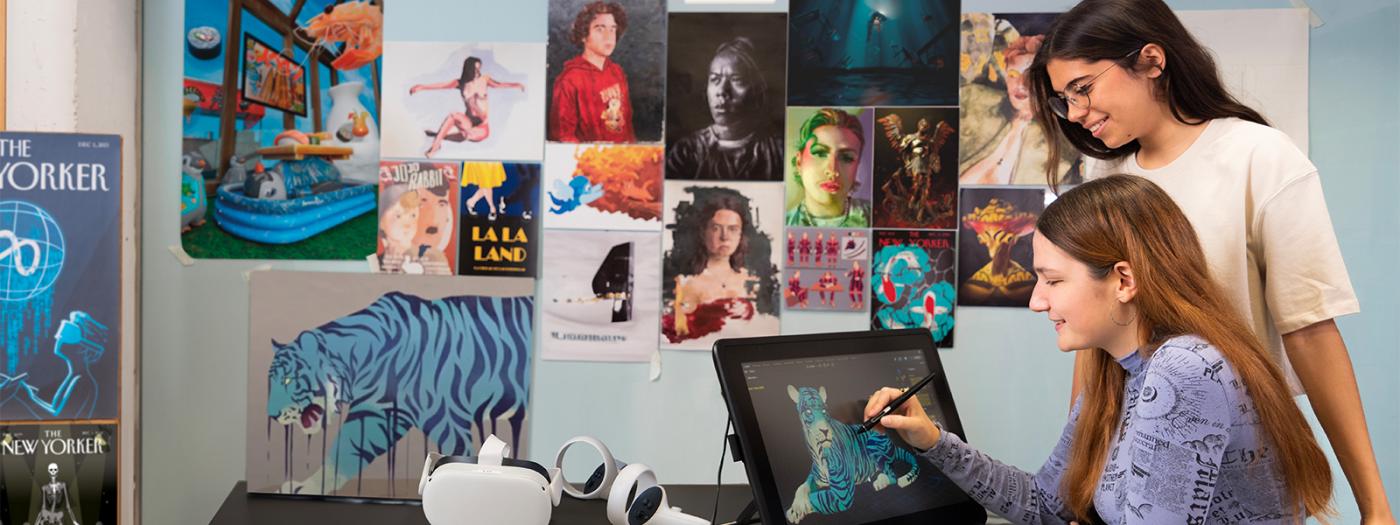
Hand drawing, from direct observation, is a main resource for artists. This course provides the foundations in drawing, as a conceptual process, a way of comprehension and graphic expression of volume and space, beginning with a detailed observation on the surround world. Students will learn how to take measurements, the study of the proportions, form and shapes, and light. They will work making a survey on different styles and techniques, as the different processes of artistic creation.
Titular Professors
No prior knowledge is required.
The course aims for students to learn to draw from direct observation, developing the ability to represent volume, space, light, and proportions through various techniques. The goal is for students to master the fundamentals of artistic drawing —construction, perspective, chiaroscuro, and volumetrics— and to be able to depict movement graphically using effective expressive resources.
Lesson 1. Still Life. Study of form and basic construction through observation and pencil drawing of a still life from nature.
Lesson 2. Perspective. Study of form, construction, and the use of perspective through observation and pencil drawing of the architecture on the La Salle campus.
Lesson 3. Human Figure Construction. Study of form and more advanced construction through observation and pencil drawing of a live human model.
Lesson 4. Human Figure Lighting. Study of form and volumetric representation in two dimensions of a live human model through observation and charcoal drawing.
Lesson 5. Portrait. Study of the form and proportions of the face (various techniques).
Lesson 6. Movement Drawing with Dry Media. Introduction to the study of the human figure in motion using dry techniques.
Lesson 7. Movement Drawing with Wet Media. Further study of the human figure in motion and introduction to expressive resources for representing it using wet techniques.
Lesson 8. Movement Drawing with Mixed Media. In-depth study using diverse materials and their combination, aiming to achieve an effective and personal representation of movement.
Lesson 9. Sketches: Model/Background. Study of the figure within an environment using a live model and free technique.
The subject will work through different teaching methodologies. At the beginning of each block there will be a master class where teacher will introduce certain basic concepts on the topic that will contextualize the student in the things to be developed during the following sessions. After these, the student will work around a series of experiential and significant exercises related to drawing from life and copying. Through the complementation of both, you will acquire the fundamentals of drawing. These activities will be complemented by an autonomous drawing exercise that will be carried out throughout the course and will be reviewed during class hours.
MD 0: Master class complemented with visual support.
MD 4: Seminar.
MD 5: Self Paced Learning.
MD 6: Learning through projects.
Throughout the course, students will complete a range of practical drawing exercises that cover the main areas of artistic representation. They will work on still?life sketches to develop direct observation, construction, and an understanding of volume, as well as outdoor perspective drawings that allow them to practice the depiction of architectural space and depth.
The course will also include human?figure sketches focused on both construction and the study of lighting from live models, with the aim of understanding structure, proportions, and the behavior of light on the body. In addition, students will produce several portraits using different techniques, exploring facial construction and proportion.
Criteria for standard and special evaluation: If the conditions are not fulfilled for passing the convocation, the maximum grade will be a 4. The student will have the option to review the exam grade (evaluation) on the day assigned by the professor. Upon these recheck the grade could be higher or lower.
Cole, Rex Vicat. 1976. Perspective for the Artist. New York: Dover. Dexter, Emma. 2005. Vitamin D: New Perspectives in Drawing. London: Phaidon Press Limited. Hale, Robert. 1964. Drawing Lessons from the Great Masters. New York: Watson-Guptill. Henri, Robert. 2007. The Art Spirit. Basic Books. Lolli, Zocchetta & Peretti. 2009. Structura Uomo. Vol. I. Neri Pozza, 2009. Speed, Harold. 1972. The Practice and Science of Drawing. New York: Dover. Vanderpoel, John. 1958. The Human Figure. New York: Dover.
It will be provided in class.