
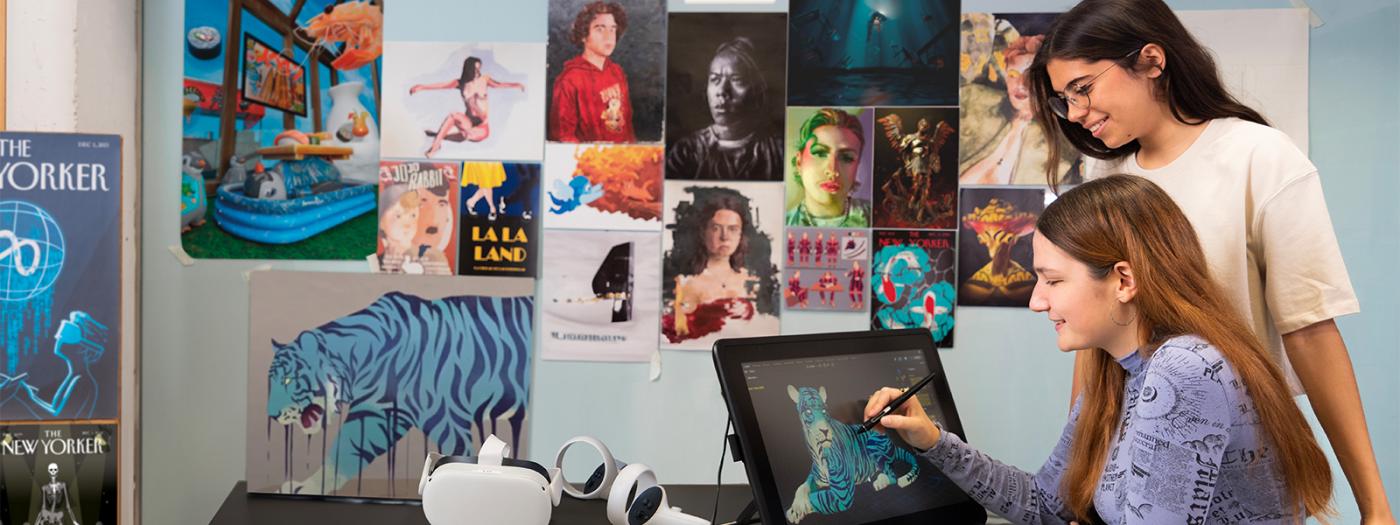
The New Media Art course aims to provide students with a critical and contextualized view of the artistic practices that emerge at the intersection of art, science, and technology. Starting with an introduction to fundamental concepts and the definition of new behaviours and aesthetics, the intention is for students to acquire tools to understand the historical evolution of the field, from the early experiences of video art, immersive installations, and animation to the most recent digital practices. The course analyses key developments in Net.Art during the 1990s, emphasizing the tensions between fascination and critique of technology (High Tech vs Low Tech), as well as the contributions of cyberfeminism and glitch art as strategies of resistance and subversion of gender, race, and sex norms. The relationship between art and politics is also addressed through hacktivism, and there is a space dedicated to exploring locative art, using maps, mobile devices, and geolocalized narratives. Finally, the course introduces art and robotics, reflecting on the limits of the body and the species in the context of posthumanism. Through this journey, the aim is for students to develop critical skills to analyse the social, cultural, and political implications of technological art, while also acquiring a solid knowledge of its historical references and most representative practices.
Titular Professors
Professors
Having previously completed Art History
Topic 1. Introduction to New Media art. Defining new behaviors and new aesthetics. Art, science, and technology. Exploration of the conceptual and aesthetic foundations of an artistic field that redefines the relationship between creativity, technology, and society.
Topic 2. The beginnings. Video art, installations, immersion, and animation. Early experiences. From the pioneering impact of video art and installations to the first forms of immersion and animation that open new perceptual spaces.
Topic 3. The 1990s: Net.Art. Mythification of technology. High Tech versus Low Tech. The emergence of art on the Internet as a laboratory for innovation, experimentation, and critique in response to technological fascination.
Topic 4. Cyberfeminism. The woman-technology binomial. From VNS Matrix to today. Subversion of gender, race, and sex norms: the Glitch as a tool of resistance. Artistic practices that question the woman-technology binomial and subvert identities through critical and poetic use of digitality.
Topic 5. Net.Art and Hacktivism: art, politics, and technology. Creative strategies that turn code, the network, and digital intervention into tools for political action and social transformation.
Topic 6. Locative art. Maps, mobile phones, and narratives. Art linked to space and movement, where maps and mobile devices generate situated narratives and collective experiences.
Topic 7. Art and robotics. Beginnings. Mechanical and computer-controlled robots. The limits of the body, the species: posthumanism. A look at practices that, from the first mechanical robots to posthumanism, rethink the limits of the body and identity.
The subject will be worked on through various teaching methodologies. At the beginning of each topic, there will be a lecture where the teacher will introduce certain basic concepts of the topic. From there, the student will have a series of audiovisual materials and didactic activities based on the following active methodologies, with which they will acquire the specific knowledge and vocabulary of the discipline.
MD 1: Lecture supported by audiovisual material.
MD 2: Seminar.
MD 3: Flipped classroom.
MD 5: Project-based learning.
MD 6: Peer Instruction.
Ordinary Assessment
In each unit, a highly significant seminar will be conducted, for which students must complete the assigned readings in advance.
In parallel, each thematic unit will require the reading of the bibliography and the viewing of audiovisual materials, and class participation will be taken into account. Based on this material, in-class assessment activities will be carried out; these activities are considered moderately significant.
At the end of the course, there will be an evaluative test consisting of a reflective activity covering all course content. This activity accounts for 20% of the final grade and is considered highly significant.
Use of AI tools: AI tools may be used in those activities indicated by the instructor. Students must include a paragraph in the activity specifying how AI was used and which prompts were employed to obtain the results. Failure to do so constitutes a violation of academic integrity policies, and the activity may be failed.
Extraordinary Assessment
Students who do not pass the ordinary assessment have the option to pass the course in the extraordinary assessment period through an exam.
Evaluation criteria for all convocations:
In case the exams, exercises or works submitted by the student do not present correct written, grammatical, and orthographic expression, the maximum grade will be a 4.
In the Seminars, students must use correct oral expression; otherwise, they will fail.
If the conditions to pass the convocation are not met, the maximum grade will be a 4.
There will be the right to review the final grade of the subject on the day set by the teacher. During this review, the student's grade can be raised or lowered.
Castells, M. La dimensión cultural de Internet. En línea:
https://www.uoc.edu/culturaxxi/esp/articles/castells0502/castells0502.html
González García, M., Pérez Sedeño, E. (2002) “Ciencia, tecnología y género”, Revista Iberoamericana de
Ciencia, Tecnología e Innovación 2. En línea: http://www. oei.es/revistactsi/numero2/varios2.htm
Lieser, W. (2009). Arte digital.
Martin Prada, J. (2015). Prácticas artísticas e internet en la época de las redes sociales.
Martin Prada, J. (2018). El ver y las imágenes en el tiempo de Internet.
Manovich, L. (2005). El lenguaje de los nuevos medios.
Montero, V. (2012). “Aportaciones feministas en la relación entre arte y tecnología”, AISTHESIS Nº 52. En línia:
Aportaciones feministas en la relación entre arte y tecnología - Valentina Montero
San Cornelio, G. (2008). "Node" Locative media i pràctica artística: exploracions sobre el terreny"." Artnodes 8.
San Cornelio, G. (2010). "Mapas, teléfonos móviles y narraciones; posibilidades y estado de la cuestión de los locative media." Anàlisi: quaderns de comunicació i cultura 40, p. 115-128.
Stallman, R. (2004). Software libre para una sociedad libre, Traficantes de Sueños,
Tribes, M., Jana, R. (2009). New Media Art.
Zafra, R.; López Pelliza, T. (2019). Ciberfeminismo: De VNS Matrix a Laboria Cuboniks.
The basic bibliography may be supplemented with other publications and materials specific to each unit, which will be provided by the instructor in class.