
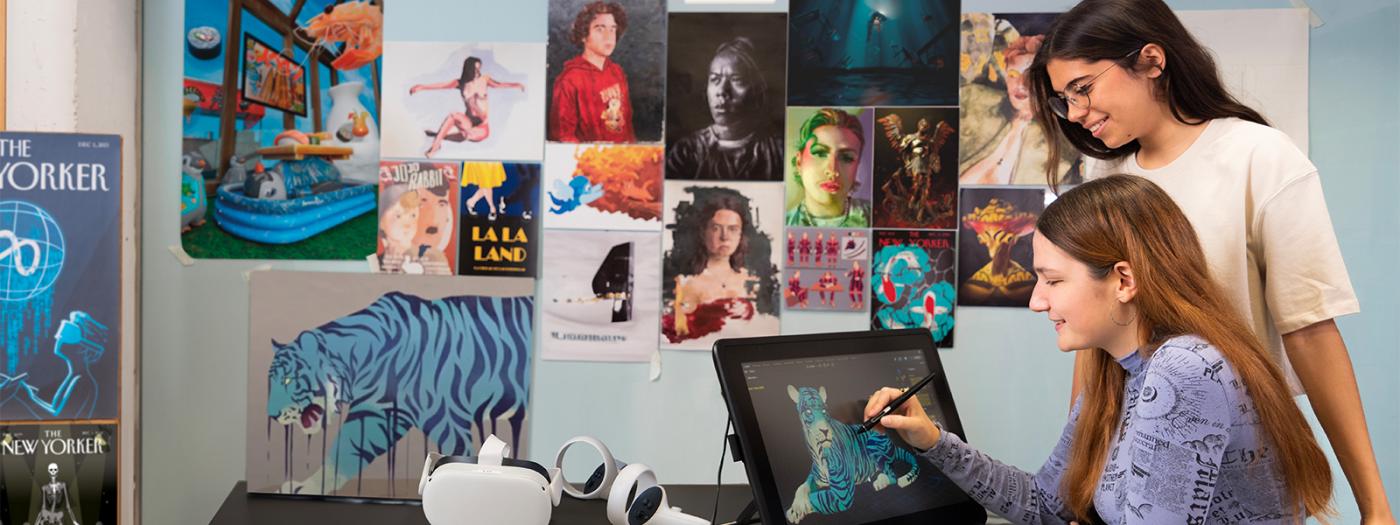
In the contemporary context—profoundly shaped by the pervasive influence of the Internet, social media, and artificial intelligence technologies—the production and circulation of images have intensified to an unprecedented degree. This course provides students with the conceptual and analytical tools necessary to understand this rapidly evolving visual ecosystem, offering a framework through which to interpret the contemporary world via its specific languages, codes, and dynamics.
The syllabus traces the historical emergence and development of visual culture up to its current digital reconfiguration, examining how web 2.0 and 3.0 platforms have transformed the ways in which images are produced, shared, and perceived. The aim is to enable students to construct a solid foundation of visual references to inform their artistic and creative practice, while cultivating a critical gaze capable of deciphering contemporary imagery and the mechanisms that govern its circulation and meaning.
Furthermore, the course incorporates the study of major actors within today’s cultural industries—artists, illustrators, designers, digital creators, visual influencers, and content developers—as well as the practices that shape emerging visual culture: digital art, streaming audiovisuals, content creation, video games, interactive advertising, expanded photography, online design, digital comics, and transmedia narratives. These practices generate hybrid codes and specific visual languages, often characterised by immediacy, virality, and interactivity, which articulate new forms of creativity and new modes of relating to images.
Within this scenario, the relationship between subject and image adopts new formats and intensities: users not only observe but continuously produce, manipulate, and recirculate images, becoming active nodes within global visual flows. The proliferation of generative AI technologies—in image, video, and text creation—introduces new ethical, epistemological, and aesthetic questions addressed in the course, particularly concerning authorship, manipulation, verification, and the automation of creative processes.
In this context, society has developed a complex visual code that functions as a true language—viral, fragmented, accelerated, and algorithmically mediated—which students must learn to recognise in its semantic structures and social implications. The course emphasises the importance of cultivating a critical understanding of contemporary visual phenomena: current artistic practices, digital productions, viral images, memes, modes of self-representation on social media, and imaginaries generated or amplified by AI. Through this approach, the course aims to foster students’ analytical and reflective capacities in relation to the visual environment within which their own creative practices unfold.
Titular Professors
Professors
The course’s main objective is to train students’ visual awareness and to develop their ability to analyse, interpret, and work critically with images. It aims to provide students with a solid understanding of the theoretical, cultural, and visual foundations that structure contemporary image culture, enabling them to integrate these insights thoughtfully and consciously into their creative projects.
Likewise, the course promotes the development of the ability to communicate discipline?specific ideas and concepts, both orally and in writing, using appropriate technical vocabulary in both the local language and English. It also encourages the rigorous reading, comprehension, and interpretation of complex theoretical texts in both languages, with the aim of fostering a deep understanding of the conceptual frameworks that shape contemporary visual culture and artistic practice.
Topic 1: Introduction to Contemporary Visual Culture. Foundational concepts and disciplinary definitions. Approaching the visual world through interdisciplinarity, social construction, and cultural situatedness of perception.
Topic 2: Theories of Signification. Iconography, the semiotics of the image, and the “pictorial turn.” What do images demand, produce, and enact within systems of meaning?
Topic 3: Perceiving through the Gaze. Relations between spectator and image (subject–object). Modes of looking, visuality as a cultural practice, and the politics of perception.
Topic 4: Visual Construction and Representation. Processes of image-making, appropriation, and visual (a)culturation. The formation, transmission, and recontextualisation of visual meaning.
Topic 5: Visual Culture in the Digital Age. The metamorphosis of the image in digital environments, the aestheticisation of contemporary life, and the rise of algorithmic culture as a structuring force in visual production and circulation.
Topic 6: The Politics of the Image. Identity, representation, and power within visual culture. Visual regimes, representational ethics, and struggles over visibility and agency.
The course will work through various teaching methodologies. At the beginning of each topic there will be a more masterful part where the teacher will introduce certain basic concepts of the topic. From here, the student will have a series of audiovisual material and didactic activities based on the active methodologies listed below, with which he will gain knowledge and the specific vocabulary of the discipline.
MD 1: Master Class with the support of audiovisual material.
MD 2: Seminar.
MD 3: Flipped classroom.
MD 4: Project-based learning.
MD 5: Peer Instruction
As outlined in the Course Syllabus, the subject combines lecture-based sessions led by the instructor with seminar and workshop formats. The lectures introduce and develop the core theoretical concepts of each topic, providing students with a structured framework for understanding the fundamental issues addressed throughout the course. In parallel, the Seminar sessions allow for a deeper engagement with these concepts through the reading and discussion of key texts by influential authors in the field, with the aim of fostering a critical and contextualised understanding of the theoretical frameworks examined.
The Workshop sessions adopt a predominantly practical orientation: students apply the concepts introduced in class through specific exercises or by producing visual materials that exemplify the theoretical questions explored. In this way, theory and practice are articulated in a complementary manner, enabling an integrated approach to the course content.
In addition, the course includes three sessions entitled “Debates from the Other Side”, designed as spaces for active student participation. In these sessions, students propose topics related to the course that align with their interests and assume responsibility for designing and leading the debate. This involves moderating the discussion, structuring its development, and preparing the necessary materials for its effective execution. This format seeks to promote autonomy, initiative, and critical capacity, while encouraging a collaborative approach to knowledge production.
Ordinary Assessment:
Final written exam at the end of the semester: 25% (highly significant).
A written reflective exam based on the seminars and the readings completed throughout the semester.
Seminars: 50% (highly significant)
Workshops: 25% (highly significant)
“Debates from the Other Side”: extra 10% for those students who actively participate in their delivery.
Extraordinary Assessment:
Students who do not pass the ordinary assessment have the option to pass the course through the extraordinary assessment call.
In the case that the exams, exercises or papers to be handed in by the students do not present a correct written, grammatical and spelling expression, the maximum grade will be a 3.
If the conditions for passing the exam are not met, the maximum grade will be a 4.
The student will have the right to review the grade of the exam on the day proposed by the teacher. In this review the student's grade can be raised or lowered.
In some of the workshops, students may work with AI tools; in fact, in certain cases the practical exercise will consist specifically of using them. For each assessed activity, a rubric will be provided detailing the restrictions regarding the use of AI tools in the development of the assignment.
Baudrillard, J. (1994). Simulacra and Simulation. University of Michigan Press.
Brea, J. L. (2018). Las tres eras de la imagen, Akal, Madrid.
Butler, J. (1993). Bodies that Matter: on the Discursive Limits of Sex, Routlege Ed.
Martín Prada, J. (2018). El ver y las imágenes en el tiempo de internet, Akal, Madrid, 2018.
Mitchell, W. J. T. (1994). Picture Theory: Essays on Verbal and Visual Representation. University of Chicago Press.
Mirzoeff, N. (2015). How to See the World. Pelican Books.
More specific bibliography will be provided at each session.