
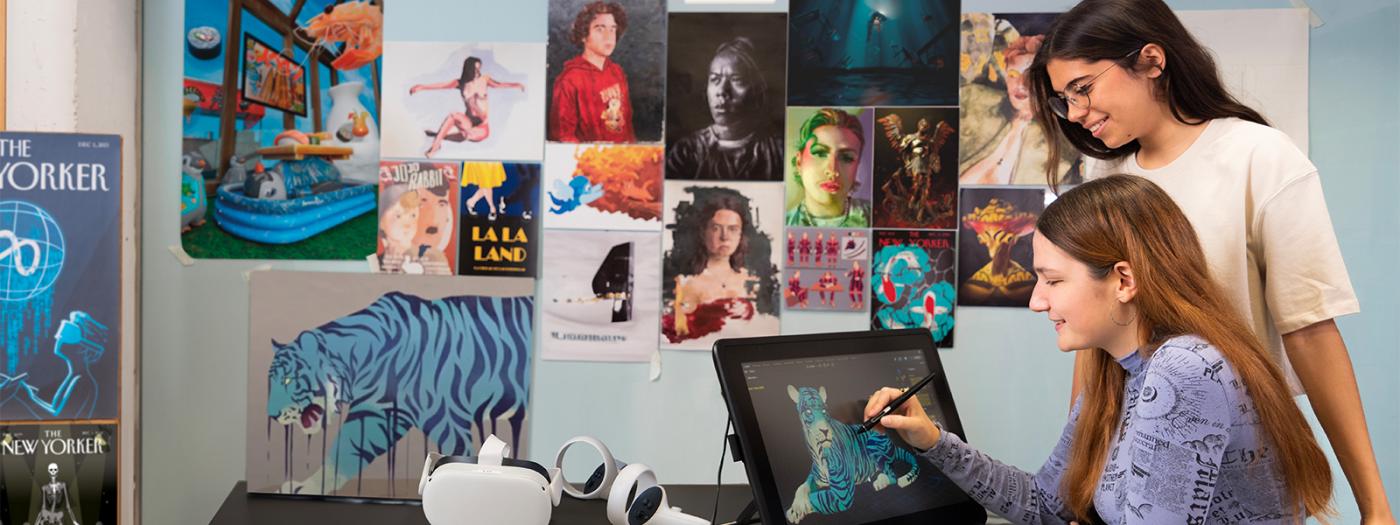
The course will provide students with digital tools that will allow them to express themselves through the creation of three dimensional elements. An introductory overview of the different tools found in Blender and Substance Painter will allow students to become familiar with basic concepts related to hard-surface and organic modeling, UVs, shading, texturing, and lighting fundamentals. This establishes the groundwork for applying more advanced techniques later on.
Titular Professors
No prior knowledge is required.
The aim of the course is to introduce students to the basic digital tools needed to create and represent three?dimensional elements using Blender. Students are expected to gain autonomy in fundamental concepts of hard?surface and organic modeling, UVs, shading, texturing, and basic lighting principles. Through guided practice, students will develop an initial critical and technical understanding of the 3D production process. Finally, the course will establish the necessary foundation for approaching more advanced techniques in subsequent subjects.
Topic 1. Introduction and basics of Blender
Topic 2. Hard-surface modeling
Topic 3. Hard-surface UVs
Topic 4. Organic modeling
Topic 5. Organic UVs
Topic 6. Shading
Topic 7. Texturing
Topic 8. Lighting, rendering and post?production
The course uses various active teaching methodologies, mainly project?based learning. Although there are lecture?style classes, demonstrative and practical sessions predominate, with the latter carried out individually by students under continuous supervision and feedback from the instructor.
At certain points in the course, problem?based learning is applied so that students must face situations that take them out of their comfort zone. In this process, they must solve more complex tasks by combining different techniques and applying theoretical knowledge.
At the beginning of each session, pending questions from the previous class or practical exercise are resolved. The theoretical?practical component is then addressed so that students acquire the knowledge and tools needed to develop their projects and achieve new objectives.
Specific audiovisual materials and didactic activities are provided to help students become familiar with technical vocabulary and develop professional growth through practice and experience.
At the start of the course, the exercises that make up the continuous assessment are presented, along with the learning path required to achieve the course objectives.
Before major practical assignments, an introductory briefing is given; afterwards, a closing session is held to draw conclusions and learn from mistakes.
Throughout the course, students receive individual and group feedback to progress, correct, improve their work, and ensure consistent learning development.
Several partial practical assignments will be completed, corresponding to the different course topics, along with a final project. To evaluate whether students have achieved an adequate level of the learning objectives, continuous?assessment activities are used, approximately weekly.
Submissions must meet the established rules and deadlines.
To be averaged, each submission must receive a minimum grade of 4.
If a student does not pass the regular assessment period, they are entitled to an Extraordinary Examination Session in July.
If a student fails to complete an assignment or assessment and it is proven that the work was done by another student, this is considered a Very Serious Offence with Premeditation under academic integrity regulations.
“Blender 2.80 Reference Manual.”, Blender Foundation, https://docs.blender.org/manual/en/latest.Siddi, Francesco.
“Get Started: Blender fundamentals” Blender Cloud Courses, Blender Foundation,
https://cloud.blender.org/p/blender-fundamentals.
“Fresh Blender News, Every Day”, Blendernation, https://www.blendernation.com
“Home of the Blender Community”, BA: Blenderartist.org, https://blenderartists.org
Official web page Substance Painter: https://docs.substance3d.com/spdoc/
Community and Learning Substance Painter: https://www.adobe.com/es/creativecloud/3d-ar.html /
https://helpx.adobe.com/es/substance-3d-painter/tutorials.html
Forum Substance Painter: https://community.adobe.com/t5/substance-3d-painter/ct-p/ct-substance
3dpainter?page=1&sort=latest_replies&lang=all&tabid=all
Additional bibliography or specific complementary material will be provided for each topic when appropriate.