
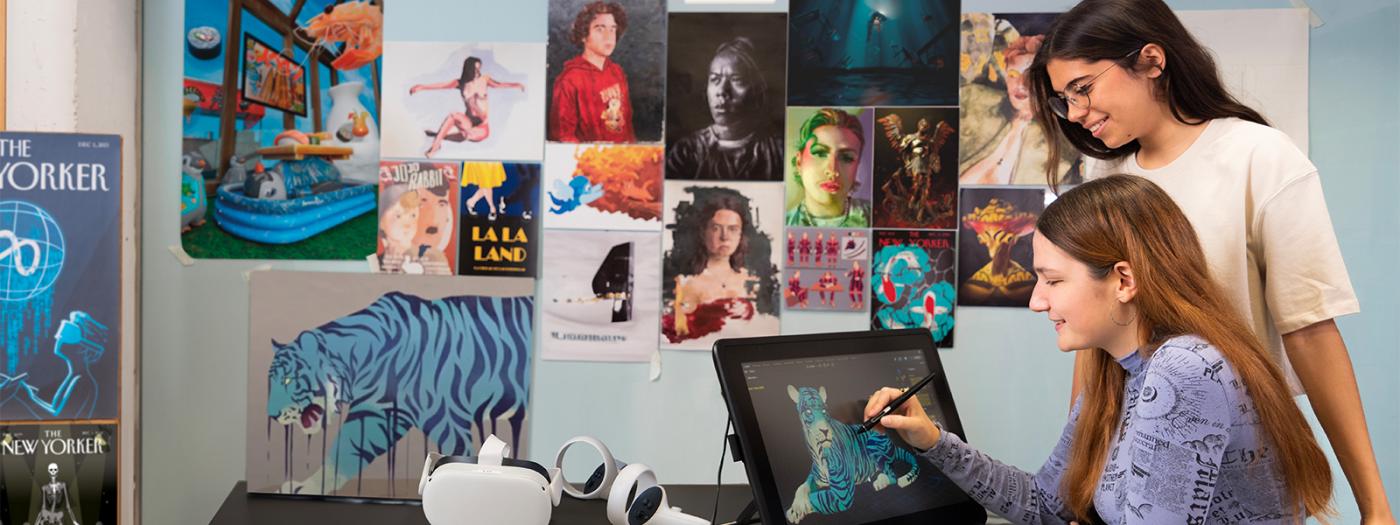
Experimental Animation is a specialisation course that explores the boundaries of the animated language from a creative, conceptual and technological perspective. The course is built on the premise that any cultural manifestation — including animation — is a convention that can be followed or broken. It works from expressive freedom, the experimentation of new visual and narrative languages, and the exploration of creative possibilities offered by contemporary technologies, including generative artificial intelligence. The course combines theory, practice and personal research to accompany each student in building their own creative universe.
Titular Professors
Animation
- Understand the concept of experimental animation and situate it within the context of contemporary art and the history of animation.
- Develop a permanent creative attitude, open to experimentation and the discovery of new uses of technology.
- Explore new visual and narrative languages beyond established conventions.
- Foster the capacity to take creative risks at narrative, formal, conceptual and technical levels.
- Reflect critically on one's own creative process and contextualise it within the contemporary cultural landscape.
- Experiment with the creative possibilities of generative AI applied to animation.
- Build a personal, recognisable and distinctive creative universe.
Theory Block — Theoretical Capsules
- Introduction to experimental animation: definitions, boundaries and conventions.
- The evolution of contemporary art and its relationship with animation.
- Historical examples of alternative and avant-garde animation.
- Creativity applied to animation: creative tools and processes.
- Philosophical, sociological and anthropological reflections on creation and technology.
- Generative AI as a creative tool: possibilities and ethical implications.
Practical Block — The Experiment
- Experiment embryo: first idea and initial exploration.
- Presentation 1 — Initial Embryo: first proposal with development potential.
- Presentation 2 — Final Embryo: definition of the experiment to be developed.
- Progressive development of the experiment with individualised tutorials.
- Periodic WIP (Work in Progress) presentations every three weeks.
- Final delivery: presentation of the completed experiment and written report.
Classes will be predominantly practical, though theoretical content will also be included to encourage reflection and critical thinking around creativity and animation. The course is structured in two main phases: a first phase of experiment definition, where each student or team conceives and presents their idea; and a second phase of development, with individualised tutorials and periodic WIP presentations. The teacher maintains personalised accompaniment with each student or team to provide continuous feedback and help guide the creative process. Diversity of formats, techniques and approaches is actively encouraged, promoting hybridisation between media and the integration of AI as an expressive tool.
Assessment is continuous and formative. Special emphasis is placed on the quality of the creative process and the student's ability to explore, take risks and grow as an author. The final grade is derived from the weighted sum of submissions and presentations made throughout the semester.
- Originality and creative ambition of the project.
- Quality and coherence of the experimentation and research process.
- Ability to take creative risks and explore new territories.
- Conceptual solidity and cultural contextualisation of the project.
- Technical and expressive quality of the final result in relation to the initial proposal.
- Clarity and depth of the written report.
- Evolution and growth demonstrated throughout the course.
- Active participation in class presentations and discussions.
- Manovich, L. (2001). The Language of New Media. MIT Press.
- McLuhan, M. (1964). Understanding Media: The Extensions of Man. McGraw-Hill.
- Duchamp, M. and various authors — references on the readymade and early 20th-century avant-garde art.
- Selection of experimental animation and film references provided by the teacher throughout the course.
.