
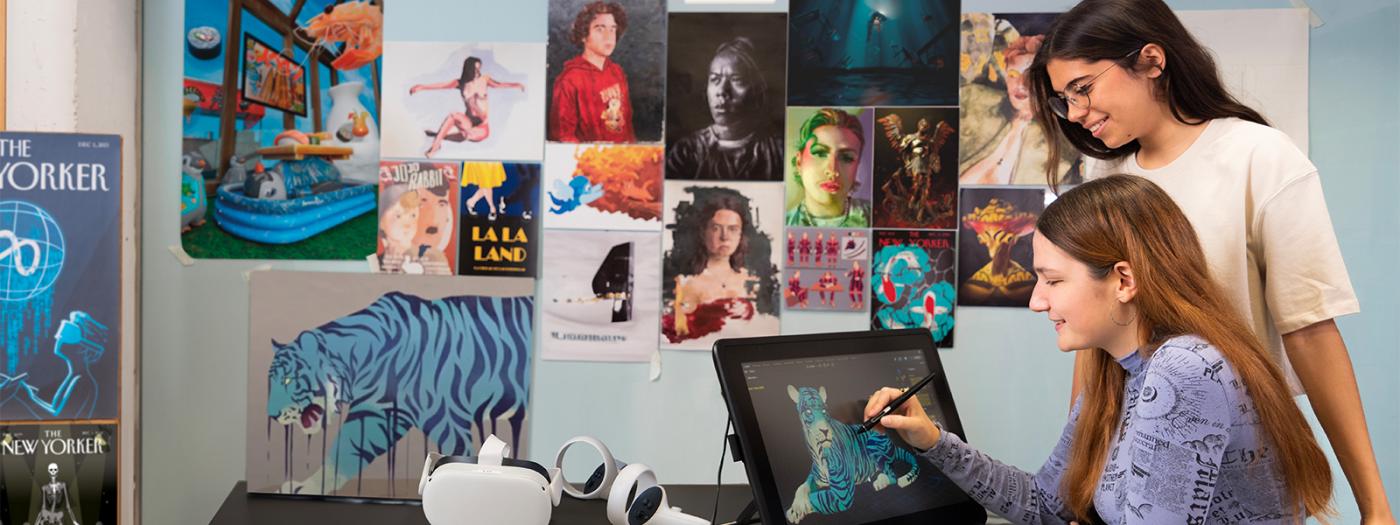
The Projects II course focuses on the development of an artistic project throughout the semester, in which students research, experiment, and produce their own work within the field of digital arts. Starting from a common theme, each student constructs a solid conceptual framework that guides their creative process, fostering critical reflection and discursive coherence. The use of digital technologies is fundamental to both the ideation and the materialization of the project, promoting the exploration of digital tools and hybrid media. The course emphasizes process, autonomy, and the ability to articulate ideas, culminating in a final proposal that integrates thought, technique, and artistic expression.
Titular Professors
Project I course must be completed.
Develop an original artistic project in the field of digital arts, independently managing all its phases: research, ideation, production, exhibition, and final presentation.
Build a solid conceptual framework, based on critical reflection on a common issue, that provides a foundation and coherence to the creative process and the final result.
Apply and explore contemporary digital technologies as tools for creation, experimentation, and expression, integrating them appropriately into the project's development.
What research means: theory and practice
Building a conceptual framework: research, references, and articulation of discourse
Working methodologies in digital arts: processes, iteration, and decision-making
Using digital technologies in artistic creation: tools, formats, and media
Experimenting with digital languages ??and formats (image, video, interactive, etc.)
Relationship between concept, technique, and final result
Documenting the creative process: recording, analysis, and critical reflection
Strategies for finding references and contextualizing the project
Presenting and communicating the project: oral, visual, and written discourse
Designing and formalizing the final piece according to the exhibition context
Collective monitoring and mentoring: feedback, review, and continuous improvement
Workshops, presentations, group critiques, and complementary activities
Preparing the project report: structure, writing, and coherence
The course is structured around the development of an individual project throughout the semester, which will be worked on continuously through classroom sessions, tutorials, and independent work. The project is divided into different phases—research, conceptualization, experimentation, production, and presentation—which will be addressed progressively, with partial submissions and periodic reviews. At the end of the semester, students will present their project orally, visually, and in writing, including a report that summarizes both the process and the final result. The following will be implemented:
- Progressive project development with partial revisions
- Tutorials and personalized monitoring of the creative process
- Periodic presentations of the work in progress
- Analysis and discussion in class
- Readings and support materials for building the conceptual framework
- Preparation of a final project report
- Workshops, practical activities, and classroom sessions
- Oral presentations and exhibition of the work
Continuous assessment based on project development, the strength of the conceptual framework, the use of digital technologies, the work process, documentation and final presentation, as well as active participation in the classroom.
Project development (process and final result): level of resolution, internal coherence, and artistic quality of the proposal.
Conceptual framework: clarity, depth, and relevance in the construction of the theoretical discourse that underpins the project.
Use of digital technologies: suitability, experimentation, and mastery of the tools used in relation to the proposal.
Work process: involvement, autonomy, capacity for iteration, and evolution throughout the course.
Research and references: quality and relevance of the search, analysis, and integration of references into the project.
Documentation of the process: recording, critical reflection, and ability to analyze one's own work.
Project presentation: clarity and effectiveness in oral, visual, and written communication (including the written report).
Participation and attitude: attendance, involvement in classroom activities, and contribution to collective critiques.
Agamben, G. (2008). ¿Qué es lo contemporáneo? In Desnudez (1st ed., pp. 17–30). Adriana Hidalgo Editora. https://kupdf.net/download/agamben-giorgio-desnudez_59f29323e2b6f51b311d1e76_pdf
Castro, F. (2017). Estética a golpe de like: Post-comentarios intempestivos sobre la cultura actual?: sin notas a pie de página (1 Ed.). Newcastle Ediciones.
Goldsmith, K. (2016). Wasting time on the Internet (First edition). Harper Perennial.
Groys, B. (2010). Volverse Público: Las transformaciones del arte en el ágora contemporánea (P. Cortés, Trans.; Reimpresión 2014). Caja Negra Editora.
Groys, B. (2016). Arte en flujo: Ensayos sobre la evanescencia del presente (P. Cortés, Trans.). Caja Negra.
Haraway, D. J. (1991). Ciencia, cyborgs y mujeres. La reinvención de la naturaleza (M. Talens, Trans.). Ediciones Cátedra.
McLuhan, M. (1967). The medium is the massage: An inventory of effects (Reimpresión 2001). Gingko Press.
McLuhan, M., & McLuhan, E. (1999). Laws of media: The new science. Univ. of Toronto Press.
Navas, E. (2012). Remix theory: The aesthetics of sampling. Springer. https://autoriaemrede.files.wordpress.com/2016/03/remix-theory-eduardo-navas.pdf
Quaranta, D. (2013). Beyond New Media art (A. Carruthers, Trans.). LINK Editions.
Depending on the needs of each proposal, the teaching staff will provide relevant theoretical, artistic and technical references that contribute to the construction of the conceptual framework and the development of the project.