
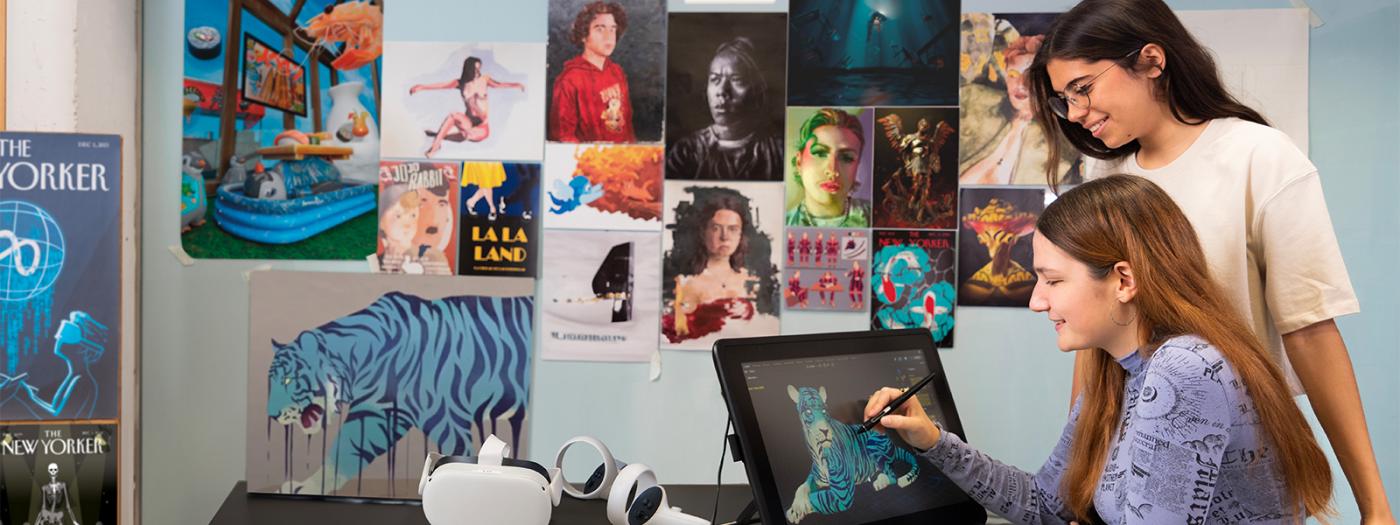
The aim of the course is to enable students to strengthen their ability to put into practice strategies oriented towards the development of artistic projects in which they experiment and investigate the cohesion of a degree of complexity and specificity, from a direct reality to another artistic reality. The function of this subject is to initiate the student in the double task of generating artistic work and thought, laying the foundations of their performance in art through their own creative process, understanding it as an accumulation of decisions and choices on the basis of which it is necessary to project, execute and evaluate.
Titular Professors
Not required.
The purpose of the course Project I is to introduce students to the methodological practice of artistic projects. The objectives pursued with the development of the project are as follows:
- Encourage reflection on what Art is.
- Strengthen analytical skills, critical thinking, and observation.
- Introduce local and international artists and artistic references.
- Introduce exhibitions, artist residencies, and other related spaces.
- Understand and internalize the phases and processes of an artistic project.
- Experiment with methods of artistic research.
- Enhance expressive and communicative abilities by developing artistic projects through the use and application of artistic languages.
- Apply materials and techniques learned during the academic year in other subjects.
-Existential crisis vs. artistic attitude: how do I position myself in relation to what I do not understand?
-Artistic language.
-Art is not universal.
-Aesthetic categories.
-How to write and cite? Formal aspects.
-Writing as an artistic practice.
-What is subjectivity (vs. autobiography).
-Artist’s notebook: awakening sensitivity and valuing personal experience.
-Activity: “we are what we eat.”
-How to search for references on the internet?
-What is methodology (artistic); materials, techniques, and the process of artistic work.
-Project layout using InDesign.
-Exhibition space design in a real environment.
-Workshops, events, talks, class exercises.
Two projects will be completed during the year (one per semester):
From September 15 to January 23 (14 classes of 2h, 2.5 weeks of project).
From February 3 to March 19 (13 classes of 2h, 2 weeks of project).
Students will work on two group projects throughout the year, to be presented both orally and in writing at the end of each semester. These projects will address aspects of art theory, the artist’s image, and the artwork. They will also include research into references, methodologies, technical resolution of the proposal, and production. In the exhibition component, students will present their projects and design the exhibition space, specifically in the Digital Arts Project Exhibition, la Mostra (June 11–17, 2026).
The course will employ a variety of teaching methodologies. Topics will begin with lectures introducing key concepts useful for project development. Audiovisual material will be provided, and active learning methodologies will be applied through didactic activities, progressively integrating knowledge and the specific vocabulary of the discipline.
-Explanation of artistic concepts through analysis of references in class.
-Assigned readings in class.
-Exams in class (personal commentary on a topic covered).
-Project-based group learning.
-Weekly group presentations.
-Peer instruction.
-Project supervision and tutoring.
-Mandatory visits to spaces (with written test afterwards).
-Workshops.
-Studio classroom activities.
Assignments
Any assignment not submitted by the deadline will be recorded as NP (Not Presented).
Any incomplete assignment (as determined by the instructor) will not be graded and will receive a grade of 1.
Written tests
Failure to attend an exam will result in NP (Not Presented).
Students may enter the exam up to 10 minutes after the official start time. Lost time cannot be recovered, and no extra time will be given.
After the 10-minute limit, access will not be allowed, and the test will be graded as NP.
Semester projects
Weight: 50% of the final grade (25% semester 1 + 25% semester 2).
Minimum grade for Project 2 (second semester) to calculate the average: > 5/10.
Failure in Project 2 will result in failing the ordinary assessment, regardless of other grades.
Final exhibition (Mostra), within Activities
The end-of-year exhibition is considered an integrated activity within the project weeks.
Failure to remove displayed materials within the established deadline will result in a penalty, which may include failing the course.
If conditions for passing are not met, the maximum grade will be 4.
Students have the right to review their grade on the date set by the instructor. In this review, the grade may be raised or lowered.
Contemporary Art Theory
- Arte en flujo (2016), Boris Groys
- Después del fin del Arte (1997), Arthur C. Danto
- ¿Qué es el arte? (2013), Arthur C. Danto
- Teoría del arte y cultura digital (2023), Juan Martín Prada
- La salvación de lo bello (2015), Byung-Chul Han
- Mira lo que te pierdes (2021), Will Gompertz
Methodologies
- Fantasía (1977), Bruno Munari
- The creative reflective practitioner (2019), Linda Candy
- Art thinking (2017), María Acaso y Clara Mejías
- Escritura no-creativa (2011), Kenneth Goldsmith
The supplementary materials will be provided in class.