
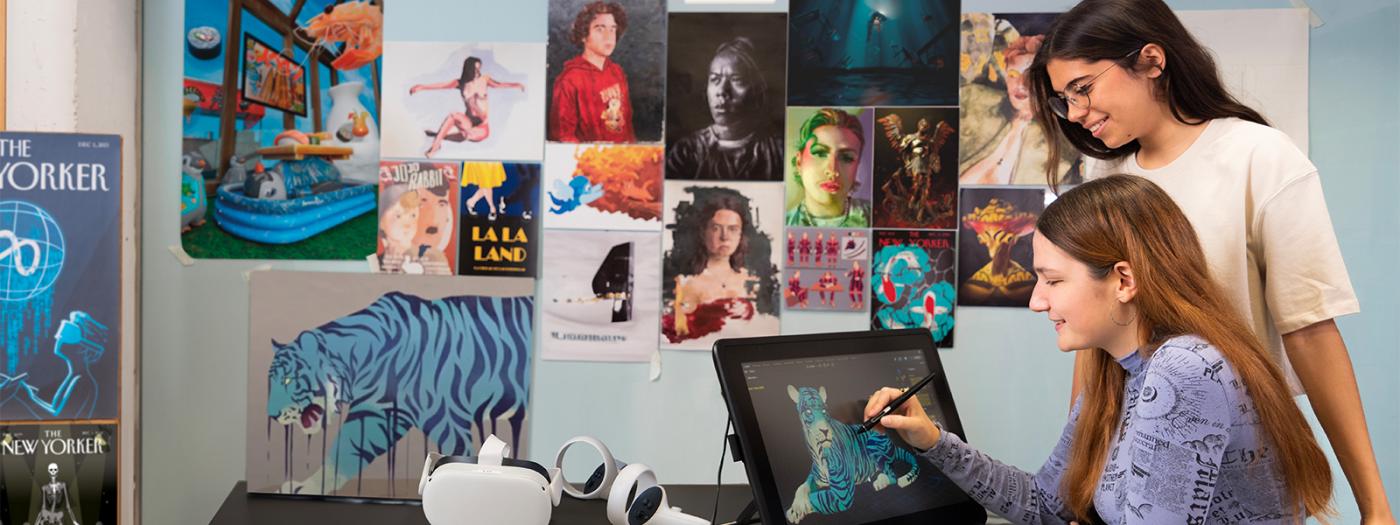
The Virtual Concept Art course introduces students to the design and development of characters, props, and environments using contemporary virtual reality modeling and creation tools. It is based on the premise that VR not only complements the work of the concept artist but also expands their expressive possibilities by enabling more agile, immersive, and intuitive processes. Throughout the course, students acquire a solid foundation in the workflows involved in artistic creation within virtual environments, exploring how three?dimensionality, real?world scale, and spatial interaction can transform the conceptual phase of a visual project.
Titular Professors
It is recommended to have basic knowledge of 3D.
The course aims to enable students to design and develop characters, props, and environments using virtual reality tools, gaining proficiency in Adobe Medium and Gravity Sketch to model, explore volumes, and work on composition within an immersive three?dimensional space; the goal is for students to integrate these tools with conventional digital software, understand the hybrid workflows characteristic of contemporary concept art, and make effective use of VR to accelerate iteration, enhance formal experimentation, and enrich the creative process from the conceptual phase to the visual definition of ideas.
Topic 1: Fundamentals of digital sculpting in VR with Adobe Medium. Basic tools (brushes, deformers, layers, lights, stamps, symmetries) and introductory sculpting exercises with simple objects to develop technical fluency and volume control.
Topic 2: Character modeling and body expressiveness. Sculpting static humanoid figures focusing on anatomy and proportions, followed by posing, gesture studies, and schematic construction to enhance expressiveness.
Topic 3: Composition and environment design in VR. Application of composition principles through spatial blockings, creation of buildings and architectural elements, construction of terrains and natural landscapes, and integration of all components into cohesive environments.
Topic 4: Introduction and practice with Gravity Sketch. Use of sketching, editing, deformation, selection, and transformation tools to model smooth?surface objects, progressing from simple forms to more complex and precise models.
Topic 5: Development of the final VR project. Planning and sketching the proposal, creating individual assets (characters, props, buildings, terrains), assembling and composing the final virtual scene, and presenting the process and outcomes.
The methodology combines practical VR modeling exercises with introductory sessions that help students understand each content block. At the beginning of every topic, a lecture is given in which the instructor presents the key concepts and provides context for the work that will be developed in the following sessions. From there, students carry out a series of exercises in Adobe Medium and Gravity Sketch to learn how to create organic forms and smooth surfaces, progressing gradually in difficulty and execution time. This approach helps them gain precision, fluency, and confidence in the use of VR tools. Throughout the course, the strengths and limitations of each program are also analyzed so that students understand which tool is best suited for each type of creation. In the final phase, all this learning is applied to a small project that simulates a professional concept art assignment, where students must select the appropriate tools, plan their workflow, and justify their creative decisions.
Throughout the course, students will develop a series of practical exercises aimed at understanding and applying the fundamental principles of virtual concept art through 2D, 3D, and immersive design processes. They will work on the creation of characters, creatures, and props starting from initial sketches, exploring silhouettes, proportions, visual language, and design variations before moving on to volumetric models using VR tools such as Adobe Medium or Gravity Sketch. The course will also include environment studies involving composition, visual readability, architectural design, and the construction of atmospheres through light and color, combining digital painting techniques with quick three?dimensional mock?ups to define believable and functional spaces. Additional exercises will focus on hard?surface and technical modeling, where students will learn to design objects and vehicles with structural logic, applying principles of industrial design and exploring hybrid workflows between drawing and digital sculpting. Finally, students will produce complete concept art pieces integrating characters, environments, and visual storytelling, applying the use of references, stylistic coherence, and professional presentation of ideas.
Criteria for standard and special evaluation: If the conditions are not fulfilled for passing the convocation, the maximum grade will be a 4. The student will have the option to review the exam grade (evaluation) on the day assigned by the professor. Upon these recheck the grade could be higher or lower.
Color and Light (James Gurney), How to Draw (Scott Robertson), How to Render (Scott Robertson), Digital Painting Techniques (3DTotal), Science of Creature Design (Terryl Whitlatch), Beginner’s Guide to Digital Painting in Photoshop (3DTotal).
Additional bibliography will be provided for each topic.