
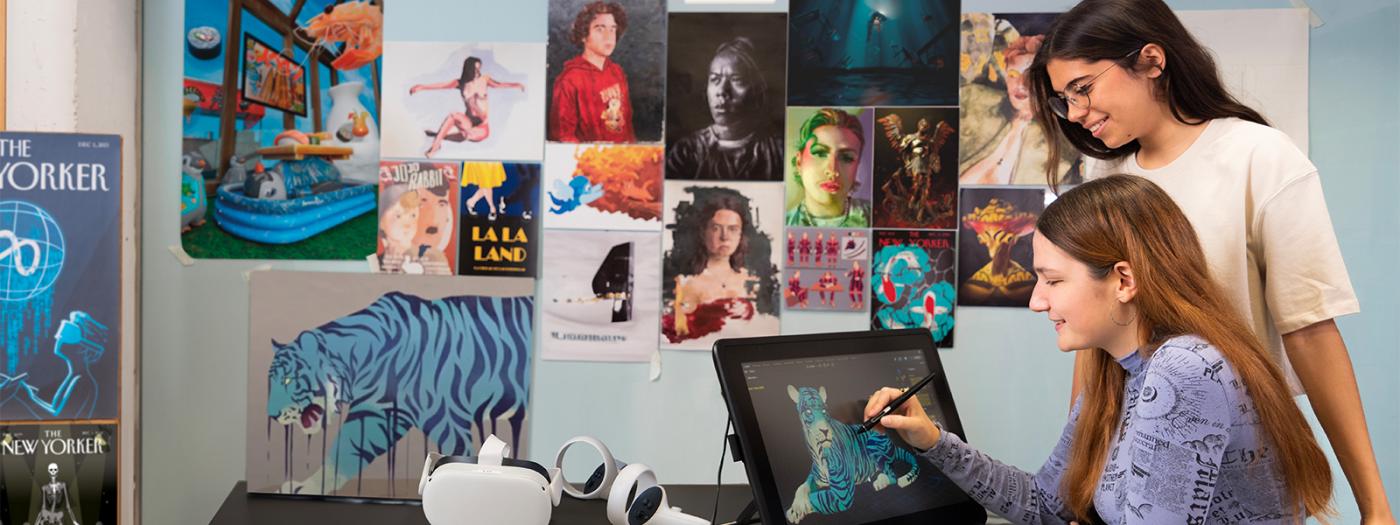
The course introduces students to the world of Motion Graphics. Students will acquire the methodology needed to develop creative projects through animation, using knowledge of composition, typography, graphic design, and illustration. They will master the techniques required to incorporate graphic elements into their productions using vector design, video, and bitmap tools. At the end of the course, students will submit a final project applying the techniques learned in class.
Titular Professors
Prior knowledge of After Effects is recommended.
The objectives of this course focus on developing students’ ability to understand and master the technical and creative foundations of After Effects and Motion Graphics, enhancing both their proficiency with tools (layers, masks, text, shapes, 3D, rotoscoping, expressions…) and their ability to analyze references, create coherent and professional animations, integrate vector and traditional graphics, and apply transitions, 3D techniques, and advanced processes that enable them to design visual pieces that are solid, expressive, and technically sound, preparing them to tackle contemporary audiovisual projects with judgment, creativity, and autonomy.
Topic 1. General review of After Effects. Interface, tools, and key concepts (layers, masks, filters, compositions...). Study and analysis of key pieces in the history of Motion Graphics.
Topic 2. Shape layers and text layers: examples of contemporary geometric and typographic animation. In-depth study of text and shape animation capabilities in After Effects.
Topic 3. Vector graphics. Importing from Illustrator and Photoshop into After Effects. Learning essential techniques for graphic creation.
Topic 4. Exploration of After Effects’ three?dimensional capabilities through the use of 3D layers, lights, and cameras to create depth and realism. Introduction to Null objects as key tools for controlling animation and movement in 3D spaces.
Topic 5. Creation of an animated character in After Effects using keyframes and various animation techniques.
Topic 6. Design and application of visually impactful transitions to give dynamism and fluidity to Motion Graphics projects.
Topic 7. Track mask. Creation of textures and patterns.
Topic 8. Rotoscoping and integration of traditional animation in After Effects to add visual richness to animations.
Topic 9. Beyond After Effects: expressions, scripts, and plugins to expand creative possibilities. Alternatives to After Effects (Cavalry, DaVinci Resolve Fusion…).
In the Motion Graphics subject, students will work through various teaching methodologies. At the beginning of each class, the corresponding concepts and theory will be explained along with practical exercises. In the second part of each class, students will work on the development of a final Motion Graphics project addressing the different production processes. MD 0: Master class complemented with visual support. MD5: Self Paced Learning MD6: Learning through projects.
The assessment of the course will be based on the students’ continuous work, evaluating both the exercises developed in class —which demonstrate understanding of the content and technical progress— and the different phases of the final project, from the moodboard to the completed piece. Each submission will be assessed based on creativity, visual and conceptual coherence, and mastery of Motion Graphics tools.
Criteria for standard and special evaluation: If the conditions to pass the call are not met, the maximum grade will be 4. The student will have the right to review the grade during the day stipulated by the teacher. In the review, the student's grade can be increased or reduced.
The Animators Survival Kit (Richard E. Williams)
Design for Motion: Fundamentals and Techniques of Motion Design (Austin Shaw)
The Freelance Manifesto: A Field Guide for the Modern Motion Designer (Joey Korenman)
The Male and Female Figure in Motion (Edward Muybridge)
Framed Ink: Drawing and composition for Visual Storytellers (Marcos Mateu-Mestre)
After Effects: The Power of Expression (François Lefebvre)
Typography for screen / Type in Motion (Wang Shaoqiang)
El diseño como Storytelling (Ellen Lupton)
Manual de tipografía (John Kane)
It will be provided in class.