
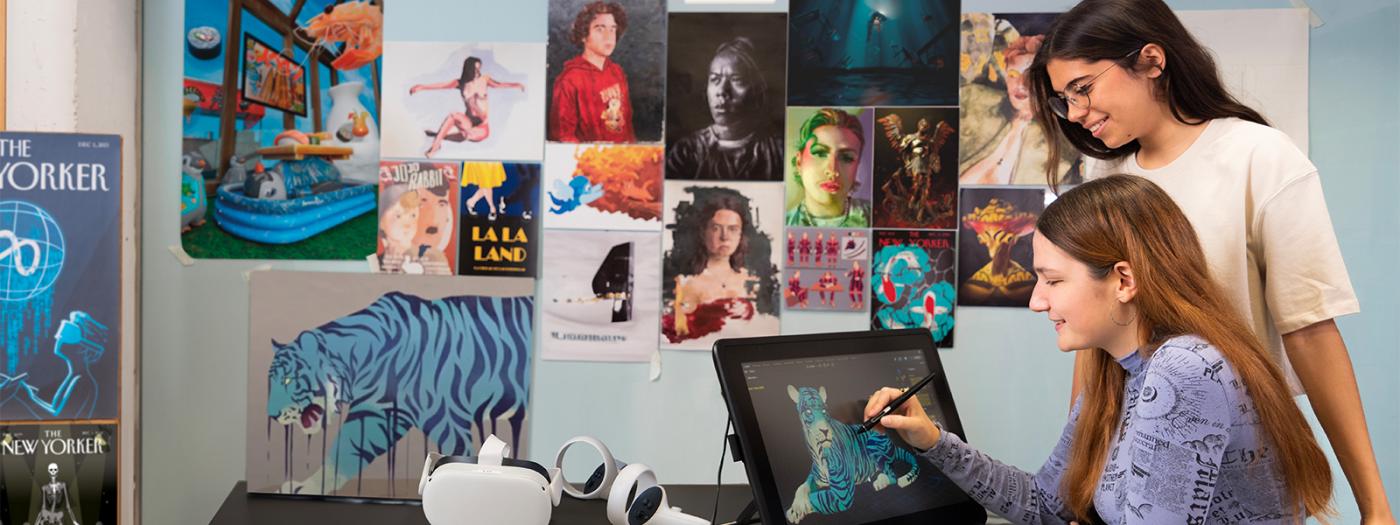
The course offers an overview of graphic design working from different points of view. Students will learn about the evolution of typography and typographic composition from the practice of calligraphy to how to compose a text digitally. How to apply different tools to be able to express themselves graphically and how to communicate through materials. Understanding the different aspects of design today, from a more social, sustainable and even speculative point of view.
Titular Professors
No prior knowledge required
The course aims to introduce students to a global vision of graphic design, delving into the evolution of typography and its contemporary applications, from calligraphy to digital composition. The objective is for students to acquire basic yet solid knowledge of visual language and materials, developing the ability to express themselves graphically through different tools. The course also seeks to foster creativity applied to interface design and communication elements, as well as the ability to identify and solve usability problems in diverse contexts. Finally, the course encourages an understanding of the social, sustainable, and speculative dimensions of design in its current role.
Topic 1. Introduction to design. Calligraphic practice. Typography and typographic composition. Fundamentals of design. Discussion on the concept of design. Practice of the Neuland alphabet. Understanding the basics of drawing a good alphabet. How it is translated into digital typography. Understanding typographic composition and microtypography. Layout of a magazine. Creating your personal brand.
Topic 2. Graphic expression techniques. Briefing (BI) for a designer. Communicating through materials. Images, texts and textures to create new compositions. How to make a BI to commission a project to a designer. Application of different methodologies to understand materials and how to communicate through them.
Topic 3. Speculative design. Understanding speculative design. Making the narrative from the 'futures thinking' methodology.
Topic 4. Social design. Sustainable design. To understand the new concepts of social design and sustainability. Conceptualise a project through the creation of an ink.
The course consists of a theoretical part, with lectures, to provide students with the knowledge they need, but above all a practical part to familiarise them with new content, tools and materials. Even the creation of their own tools and materials will allow them to understand the origin of raw materials and provide a more sustainable and circular vision. Each week there will be a review of work, which means that the students will be able to share their work together, which will provide an analytical view of everyone.
MD0 Master class
MD1 Problem classes and exercises
MD4 Seminar
MD6 Project-based learning
MD11 Challenge-based learning
Ordinary call evaluation:
Continuous assessment: 30%.
Contribution by the student of the weekly exercises to demonstrate that he/she has understood the contents given in the previous week. Active participation in class.
Dossier of the exercises carried out during the course: 70%.
The final delivery of the dossier, experimenting with new formats, layout and materials will be valued. Impeccable
presentation of each exercise. Demonstrate an attitude of curiosity and risk-taking in experimentation.
Extraordinary evaluation:
The student who does not pass the ordinary assessment has the option of passing the subject in the call for extraordinary assessment.
The assessment will be based primarily on the quality and coherence of the practical projects, evaluating the student’s ability to apply the fundamentals of design, typography, and creativity in visual proposals. The work process, the ability to solve usability problems, and active participation in class will also be taken into account. Finally, the presentation and justification of the projects will be considered, as well as the progress and autonomy demonstrated throughout the course.
Use of AI tools: If AI tools are used in any activity, a paragraph should be indicated stating what AI was used for and what indications were used to obtain the results. Failure to do so is a violation of academic honesty policies.
Aicher, Otl. El mundo como proyecto. Barcelona: GG, 2005
Dunne, Anthony & Raby, Fiona. Speculative Everything: design, fiction, and social dreaming.
Massachusetts: MIT. 2013
Hochuli, Jost. El detalle en la tipografía. Valencia: Campgràfic Editors, 1987
Jardí, Enric. Pensar con imágenes. Barcelona: GG, 2012
Manzini, Ezio. Cuando todos diseñan. Una introducción al diseño para la innovación social. Madrid:
Experimenta Theoria, 2015
Mediavilla, Claude. Caligrafía. València: Campgràfic, 2005
Müller-Brockmann, J. Sistemas de retículas. Barcelona: Gustavo Gili, 1982
In each unit, additional bibliography and learning materials will be provided if necessary.