
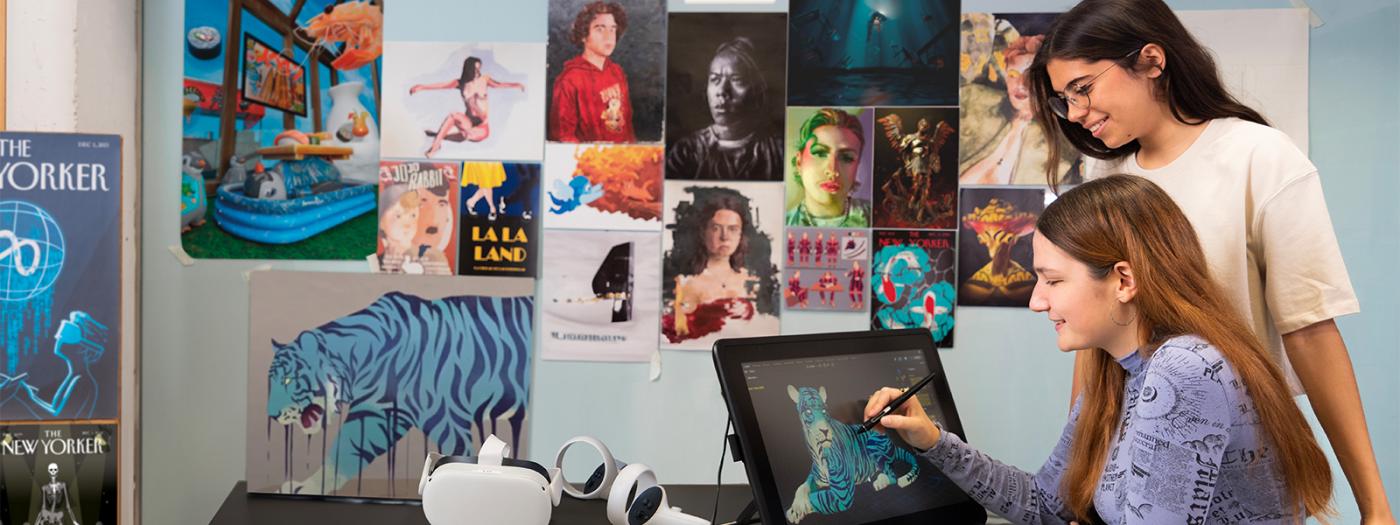
Creature Design course teaches students how to design and create creatures and characters for various media, including film, animation, video games, and comics. The course covers anatomy, movement, and the creation of believable creatures. Students learn to use traditional and digital techniques to create and refine their designs. The course may include lectures, hands-on workshops, and group projects. The goal is to equip students with the skills and knowledge necessary to design creatures that are imaginative and to bring them to life in various forms of media.
It is recommended that students have a good level of drawing skills as well as experience working with digital painting tools. Fundamental knowledge of character design is also recommended.
Throughout the course, students will explore the principles of character design, creative anatomy, and visual storytelling to bring unique and fantastic beings to life. Through reference studies, sketching techniques, and digital tools, students will develop the skills to create creatures that express emotions, personality, and a sense of realism in fictional environments. The main objective is for each student to master the fundamentals of creature design and expand their conceptualization skills in the field of visual arts and digital design.
Week 1: Introduction to creature design
Definition and roles of creatures in various media (cinema, video games, literature, etc.). Study of the relationship between function and form in design. Cultural and mythological references in the creation of creatures.
Exercise: Make a design of a creature based on a description given in class.
Week 2: Basic and comparative anatomy
Human and animal anatomy as a basis for the design of creatures. Biomechanics: analysis of movement and functionality. Skeletons and musculature in fictitious creatures.
Exercise: Carry out a study of an existing animal.
Week 3: Shapes and silhouettes
Generation of silhouettes: importance of form in the identity of the child. Experimentation with geometric and organic forms. Use of contrast and repetition to create memorable silhouettes.
Exercise: Design a creature from an existing quadrupedal creature.
Week 4: Humanoid creatures
Design of hybrids between humans and animals. Fantastic Anatomy: Creation of Humanoid Races. Design of iconic characters (villains, heroes and secondary characters).
Exercise: Carry out a study of an existing winged creature.
Week 5: Animal creatures and beasts
Design of creatures based on real zoology. Combination of characteristics of real animals to create unique creatures. Study of mythological creatures and their adaptation to new contexts.
Exercise: Create a new design combining two existing winged animals.
Week 6: Alien and extraterrestrial creatures
Exploration of forms of life not based on terrestrial biology. Conceptual design of alien species and ecosystems. How to imagine creatures in extreme environments or fictitious planets.
Exercise: Start an illustration with the two previously designed creatures.
Week 7: Creatures of terror
Creature design for horror and dark fantasy genres. I study the grotesque and the monstrous in the creation of creatures. Psychology of fear: how to generate visual and emotional impact.
Exercise: Finish the illustration of the two creatures.
Week 8: Textures and surfaces
Design of skins, scales, feathers and other complex textures. Materials and surfaces: combination of textures to achieve realism. Coloring and color theory applied to creature design.
Exercise: Apply different textures to a basic creature.
Week 9: Narrative contextualization
How to integrate the design of the creature within its narrative environment. Relationship between the creature and the world it inhabits. Creation of background stories: origins, habitats and behaviors.
Exercise: Develop the idea of ??the creature for the final personal project.
Week 10: Lighting and atmosphere in the design of creatures
How lighting affects a creature's perception. Use of light and shadows to create drama and depth. Visual composition and atmospheric scenarios.
Exercise: Make the first sketches and thumbnails of the creature of the final project.
Week 11: Iteration and refinement processes
Sketching and development of initial ideas. Refinement of concepts over multiple iterations. Evaluation of designs and adjustments based on feedback.
Exercise: Concept art of the final project creature.
Week 12: Portfolio creation
Organization of the work carried out during the course. Effective presentation of a professional portfolio. How to select and structure projects to show versatility and ability.
Exercise: Development of the final project creature.
Week 13: Work on the final project and presentation.
Note: One of the weeks there will be a visit to the zoo to study the anatomy of the animals in vivo and make natural drawings (date to be determined).
The subject methodology is based on a theoretical-practical approach that combines lectures with applied activities and creative projects. Active, participatory and collaborative learning will be encouraged throughout the course, integrating different pedagogical strategies that allow students to develop both conceptual skills and techniques related to creature design.
Theoretical classes will introduce the essential foundations of the discipline, addressing aspects such as anatomy, biomechanics, color theory and the principles of visual conceptualization. These sessions will be accompanied by analyses of references from popular culture, cinema, video games and literature, with the aim of expanding the students' visual repertoire and stimulating their critical and creative capacity.
At the same time, the teaching staff will carry out live demonstrations of digital illustration programs such as Photoshop and Procreate, showing professional work processes and specific techniques applied to creature design. These demonstrations will serve as the basis for practical workshops, in which students will explore techniques for generating ideas, creating silhouettes and experimenting with abstract shapes. The work will be carried out both individually and in small groups, always with the support and guidance of the teaching staff.
Weekly exercises and projects will be proposed throughout the semester that will allow students to apply the content worked on in class and gradually build a solid portfolio. These activities will include the creation of creatures based on specific themes, such as mythological beings, aliens or horror creatures, with the aim of consolidating knowledge and stimulating creative versatility.
Group critique sessions will play a central role in the learning process. In these meetings, students will present their work and receive feedback from both the teaching staff and their peers, fostering an environment of reflection, continuous improvement and professional development. These dynamics will be complemented by individual review sessions, in which each student will be able to discuss their progress, resolve doubts and receive personalized guidance.
Towards the end of the course, each student will develop a final project that will consist of the complete design of a creature, including its narrative, anatomical and functional context. This project will be evaluated comprehensively, assessing creativity, conceptual coherence and the appropriate use of digital tools. Finally, students will present a digital portfolio that will collect the work carried out during the semester and will show the evolution of their creative and technical process.
Final project: 50%
Weekly exercises submission: 25% (minimum 75% submission required)
Continuous assessment: 25% (participation, attendance, behavior, commitment, professionalism)
Evaluation criteria for all calls: If the conditions for passing the call are not met, the maximum grade will be 4. The student will have the right to review the grade during the day stipulated by the teacher. During the review, the student's grade may be increased or reduced.
Gurney, J. (2010). Imaginative Realism: How to Paint What Doesn't Exist. Andrews McMeel Publishing.
Jones, T. (2011). Designing Creatures and Characters: How to Build an Artist’s Portfolio for Video Games, Film, Animation and More. Watson-Guptill.
Whitlatch, T. (2015). Principles of Creature Design: Creating Imaginary Animals. Design Studio Press.
Froud, B., & Lee, A. (2005). The Goblins of Labyrinth. Pavilion Books.
Zimmermann, F., & Ling, K. (2017). Sketching from the Imagination: Creatures & Monsters. 3DTotal Publishing.