
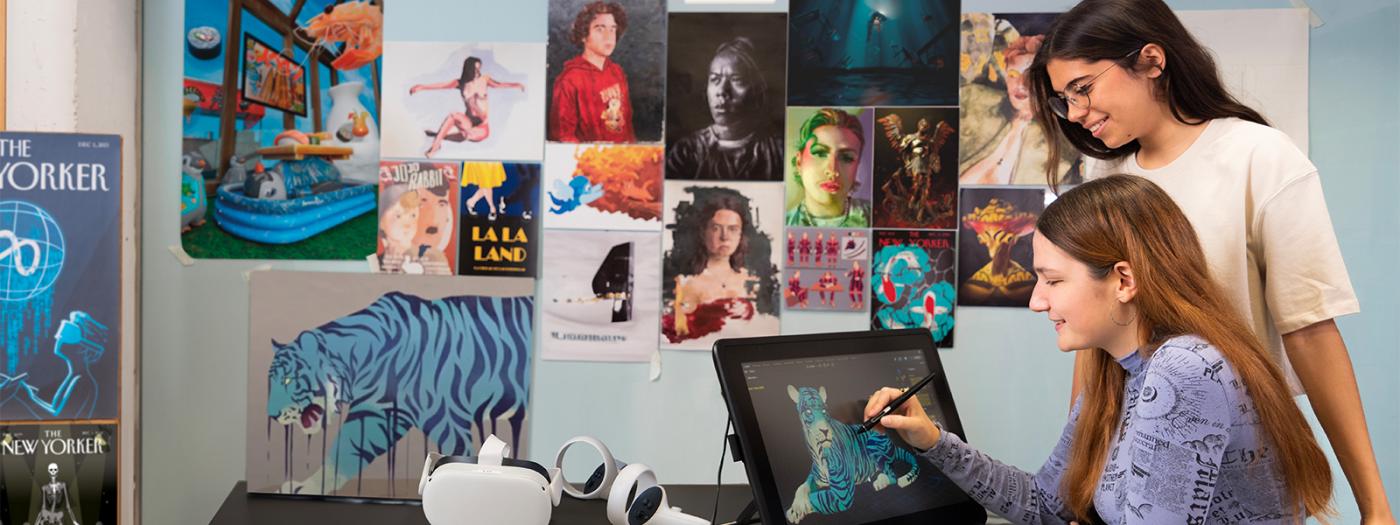
The approach of this course is based on the organic integration of digital drawing software into the students’ creative and technical processes, starting with a reflection on the differences between traditional and digital drawing. Far from conceiving the digital tool as a simple substitute for pencil or paper, the course proposes to explore its technical, operational, and expressive specificities. Throughout the semester, we will work with the unique possibilities of digital drawing—such as the use of layers, effects, custom brushes, non-destructive transformations, or access to iterative processes—with the goal of discovering and enhancing what digital drawing can do that physical drawing cannot. The aim is not to oppose both languages but to understand their difference as an opportunity to expand the students’ creative, technical, and expressive resources.
Titular Professors
Basic knowledge of drawing; volume, values, proportion, construction (blocking-in), among others.
OBJECTIVES
Master the fundamentals of drawing (structure, proportion, anatomy, form, volume, perspective, light, composition).
Reinforce active observation and the collection of visual stimuli (creative inputs) to nourish the artistic process through perception, experience, and visual research.
Explore and leverage the creative possibilities of digital drawing software, integrating it organically into the production process.
Conceive and develop a hybrid physical-digital project that incorporates digital drawing techniques and is materialized in a physical presentation format.
- Encourage the ability to analyze forms in grayscale, prioritizing the understanding of structure, volume, and spatial relationships over mere image replication.
- Learn to apply formal deformations as an expressive resource, foster processes of abstraction, generate visually dynamic images, and develop the ability to build dynamic compositions by identifying key elements of an image and organizing them with intent to achieve rhythm and visual hierarchy.
- Understand the behavior of light and how to use it as an expressive resource to model volume, generate depth, and direct attention within the composition.
Exploration of non-typographic forms
Non-typographic forms in flowers
Anatomical analysis
Compositional deformation
Light topography on geometry
Light topography on bodies
Form essay: From archive to surface
Theory + practice
Digital drawing tools
The content of the classes will be both theoretical and practical. In each session, a brief amount of time will be dedicated to creativity exercises. The teacher will cover the syllabus during the theoretical portion, and in the practical part, the students will carry out related exercises. The distribution of time between theory and practice will depend on the content load of each, with theory being the most determining factor in defining the time allocated to practical work in the classroom. The theory explained by the teacher will later be applied to the evaluative exercises. These tasks will be mandatory, and some of them will be reviewed in class so that all students can learn together. Throughout the course, specific vocabulary and digital media techniques will be taught and applied to the exercises. The final classes will be dedicated to the development of the final project, in which the concepts learned during the course must be reflected.
Assistance 10%
Practical work (60%)
Minimum grade for each test to average: >5/10.
Any submission not delivered by the deadline will be marked as NP (not presented).
Any unfinished submission (as judged by the instructor) will not be graded and will receive a 1.
Failed or not presented exercises (NP) must be resubmitted at the end of the course and will receive a maximum grade of 5.
Project (30%)
Minimum grade to average: >5/10.
Late or failed submissions imply not passing the ordinary assessment.
Assessment criteria for all calls:
If passing conditions are not met, the maximum grade will be a 4. Students have the right to request a grade review on the date set by the instructor. In this review, the grade may go up or down
John Berger, About Drawing
Josef Albers, Interaction of Color
The supplementary materials will be provided in class.