
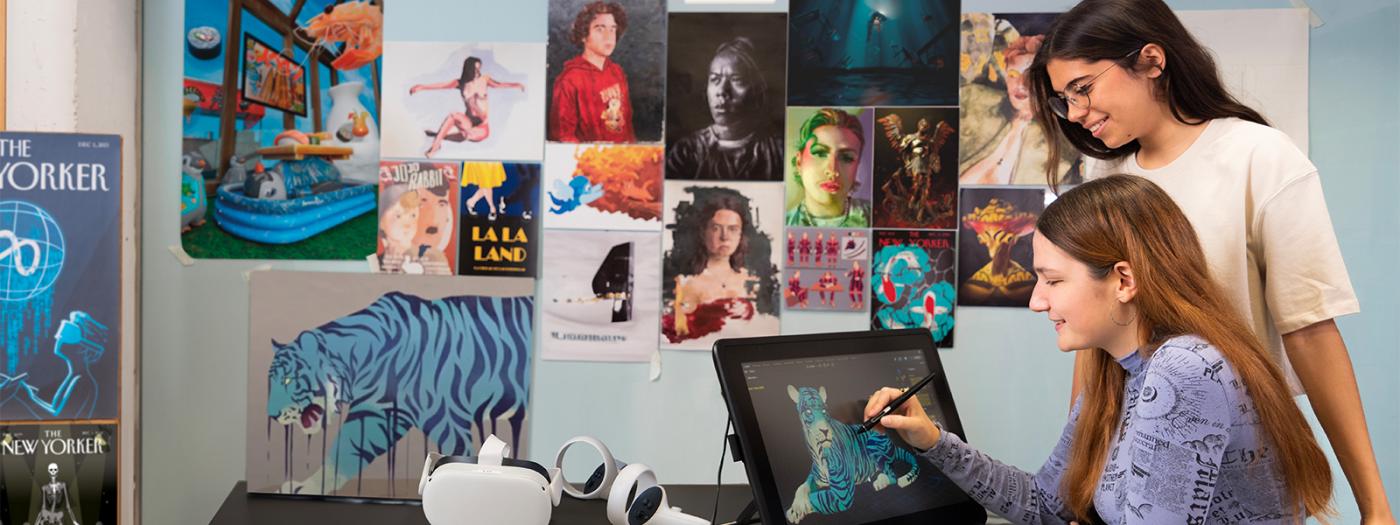
This subject proposes human anatomy as a method of approaching to drawing and a way of knowledge for the formal structure of the human body. Learning the bones and muscles should serve the student to understand a total and harmonic sense of the body and movement of the human figure.
Titular Professors
Basis of drawing
Learning the anatomical structure of the body.
Ability to scientifically represent bones and muscles.
Improving representational skills in drawing the human figure.
Developing a personal project based on anatomical knowledge.
Lesson 1. Introduction to Anatomy Introduction to anatomy. The artistic anatomy as art. Anatomy as an artistic proposal.
Lesson 2. Human Skeleton Basic structure of the human skeleton. The bones and their shapes, Structure and rhythm
Lesson 3. Compared Anatomy Study of the structures of man compared to that of other mammals.
Lesson 4. Human Myology. Study of the muscles of the torso. Study of the muscles of the upper extremities. Study of the muscles of the lower extremities.
Lesson 5. Personal Project. Application of anatomical study to a personal project. The anatomy and study of facial expression.
In the subject will work through different teaching methodologies. At the beginning of each unit there will be a master class where the teacher will introduce certain basic concepts and contextualize the student in the historical-artistic moment. From here, the student will have a series of audiovisual material and didactic activities based on the active methodologies with which he will acquire the knowledge of the different stylistic periods and the specific vocabulary of the discipline. From the beginning of the course the student will be presented with a group project to develop throughout the course and to present orally and in writing at the end of the course.
MD 1: Master Class with the support of audiovisual material.
MD 2: Seminar. MD 3: Flipped classroom.
MD 4: Real events.
MD 5: Project-based learning.
MD 6: Peer Instruction
Standard evaluation:
Theoretical basis: 30% Assestment of the theoretical basis of the subject through: A test at the end of Lesson 2 and a test at the end of Lesson 4
Seminars/Workshops: 40% Pesentation of Drawings on Lessons 2, 3, 4
Presentation of the personal project: 30% Lesson 5
Minimum grade required to arise average >4/10. Late deliveries will be penalized with -2 points
Continuous evaluation: Final mark will consider: Involvement of the student in the classes, delivery of the exercises and criteria of the teacher.
Special evaluation: In case standard evaluation is failed, students have the option to pass the subject by passing a special evaluation exam.
Criteria for standard and special evaluation: In the event that the exams, exercises or works to be delivered by the student do not present a correct written, grammatical and orthographic expression, the maximum grade will be a 4. If the conditions are not fulfilled for passing the convocation, the maximum grade will be a 4. The student will have the right to review the exam grade (evaluation) on the day assigned by the professors. Upon this revision, the student?s grade may improve or decline.
Moreaux, A. (1988). Anatomía artística del Hombre. Madrid. Norma Ediciones Legaspi, Chris. (2017). Anatomy for 3D Artists: The Essential Guide for Cg Professionals. Uk. 3dTotalpublishing Zarnis, U., Kondrats, S. (2018). Anatomy For Sculptors, Understanding the Human Figure. Exonicus Llc.
Further bibliography will be done if necessary