
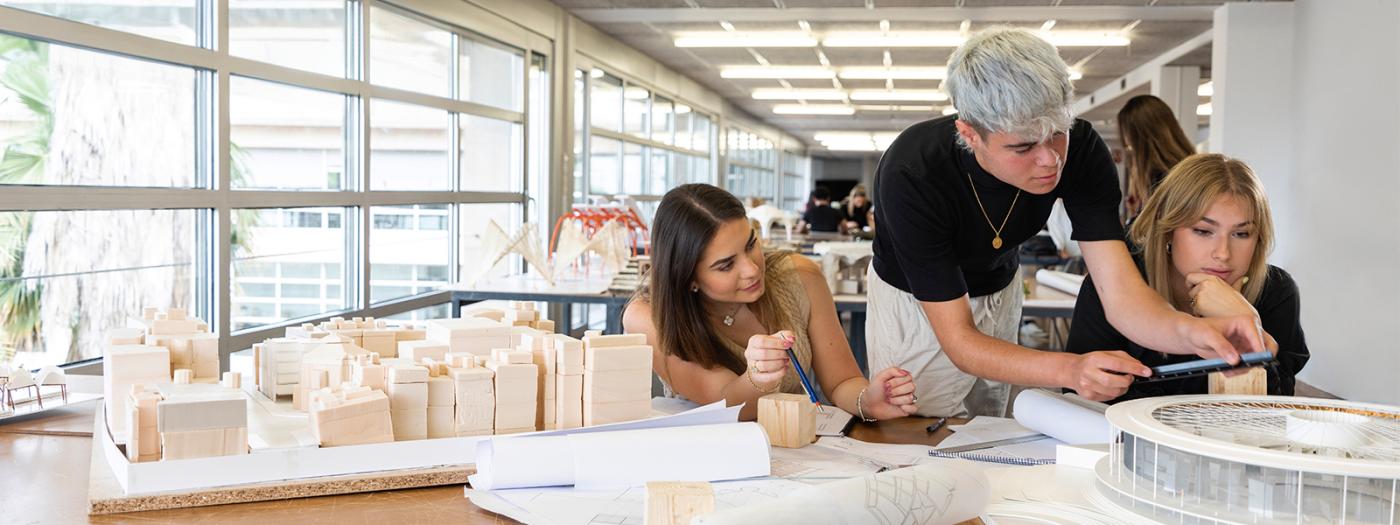
This course introduces the History of Architecture and the Arts in the Mediterranean, from Classical Greece to the end of the Middle Ages. It explores the fundamental cultural origins of contemporary Mediterranean society. Course content is delivered through lectures held both on the School’s campus and at various sites, buildings, and museums throughout the city of Barcelona. In parallel, students engage with contemporary texts related to the works studied, scholarly essays on the different historical periods, as well as works of narrative and poetry. The course serves as the foundation of the theoretical and humanistic component of the Bachelor's Degree in Architecture.
Titular Professors
Professors
Secondary education, whether completed through grade levels, upper secondary school (high school), or other international secondary education pathways.
The main objectives are to teach students how to observe, to strengthen the perspective from which works should be analyzed, to acquire the knowledge associated with the subject, to understand the historical, cultural, and geographical context of the works, and to encourage, through knowledge, a critical and pluralistic outlook among students. The course aims to provide an understanding of the cultural and formal heritage, recognizing that historical processes constitute the foundation of transformations and changes throughout history. Developing a solid foundation will enable students to cultivate a critical spirit in relation to art, architecture, and the city.
Understanding Time, Space, and Context
The Foundations of Classical Culture
Myth and Form: Beauty in Classical Greece
The Polis and the Acropolis
From the Roman Republic to the Roman Empire: City and Architecture
Rome: Caput Mundi
Christianity: Early Christian and Byzantine Architecture
Islam: Recurring Landscapes
The Medieval World: Monasteries
The Medieval World: Romanesque Architecture
The Medieval World: Gothic Architecture
This is a year-long course consisting of three hours of instruction per week. Classes combine theoretical content with a range of individual and group-based projects.
I. Classroom lectures (35%)
II. Lectures conducted in architectural and urban settings throughout Barcelona (35%)
III. Individual and group projects based on assigned readings (30%)
The teaching methodology is based on an inclusive approach to education and promotes an open, participatory, and respectful learning environment that values the diversity of the student body. Equal opportunities, a gender-sensitive perspective, active participation, and the exchange of diverse viewpoints are encouraged, with the classroom understood as a space for critical reflection and collaborative learning.
This methodological approach is designed to foster students' active engagement by combining observation, analysis, discussion, and knowledge production through a continuous interaction between theory and practice.
In addition, throughout the academic year, the course includes five lecture sessions shared across the entire Theory Area, featuring invited professionals and scholars who will address topics related to architecture, the city, and critical thought from a range of disciplinary perspectives. These sessions complement the course content and provide students with exposure to contemporary approaches and current debates in the field.
Assessment is continuous and evaluates students’ understanding and progress throughout the academic year. Semester averages and the final annual grade will not be calculated if the mark obtained in any assessed component is below 4.0.
- Written examination (30% of the final grade)
- Individual and group practical assignments (40% of the final grade)
- Attendance and active participation in lectures, practical sessions, site visits, and cross-disciplinary activities (15% of the final grade)
- Continuous assessment of individual work and progress throughout the course (15% of the final grade)
Special Grades
- 0.0: This grade is reserved for cases resulting from the application of disciplinary sanctions.
- Not Presented (NP): This grade is awarded when a student has not participated in a sufficient number of assessed activities. As a general criterion, participation is considered sufficient when the student has completed assessment activities representing at least 50% of the total weight of the most significant assessment components.
- Honours Distinction (Matrícula de Honor, MH): This distinction may be awarded to students who obtain a final grade of 9.0 or higher, at the discretion of the course instructor(s) or the Assessment Board.
Assessment will take the following criteria into account:
- Ability to understand, analyze, and interpret the course content.
- Ability to establish relationships between and contextualize urban, architectural, historical, and artistic processes.
- Development of well-founded critical thinking and the ability to articulate arguments clearly.
- Quality and coherence of graphic representation, as well as oral and written communication.
- Active participation, engagement in both individual and group work, and attendance at lectures, including classroom sessions, activities in external locations, and site visits.
Resit Examination
Students who do not achieve the required learning outcomes during the regular course period may sit the resit examination, in which they must demonstrate that they have acquired the fundamental theoretical and practical knowledge and competencies of the course.
Pérez Oyarzun, F, A. Aravena i José Quintanilla. (2002). Los hechos de la arquitectura. Santiago de Chile: Ediciones ARQ /Escuela de Arquitectura pontificia Universidad Católica de Chile
Roth, L. M. (1993). Understanding, Architecture. Its Elements, History and Meaning. London: Harper-Collins Publishers
Dictionaries and Reference Works
- John Berger (2015). Portraits: John Berger on Artist. London: Verso
- Giorgio Vasari (2006). Lives of the Most Excellent Painters, Sculptors and Architects, from Cimabue to Our Times. London: Random House
Bibliography
- Pedro Azara (2024). La ciudad de los días lejanos. Un imaginario proscrito. Madrid: Ediciones Asimétricas.
- Bruno Buonomo, Francesco Cesarano & Maria Cristina Lapenna (2015). Mausoleo d’Augusto, Pantheon, Piazza Navona. Dinamiche di trasformazione. Rome: De Luca Editori d’Arte.
- Alain Corbin & Hervé Mazurel (2026). Historia de las sensibilidades. Barcelona: Acantilado.
- Jie Li, Belén Arias & Lola Sanz (2026). The Cult of Beauty. Barcelona: CCCB & Diputació de Barcelona.
- Juhani Pallasmaa (2020). Inseminations. Seeds for Architectural Thought. Chichester: John Wiley & Sons Limited.
- Luis Martínez Santa-María (2018). Superposiciones. Madrid: Conarquitectura Ediciones.
- François Vallotton & François Metzger (2009). L’historien, L’historienne dans la cité. Paris: Éditions Antipodes.