
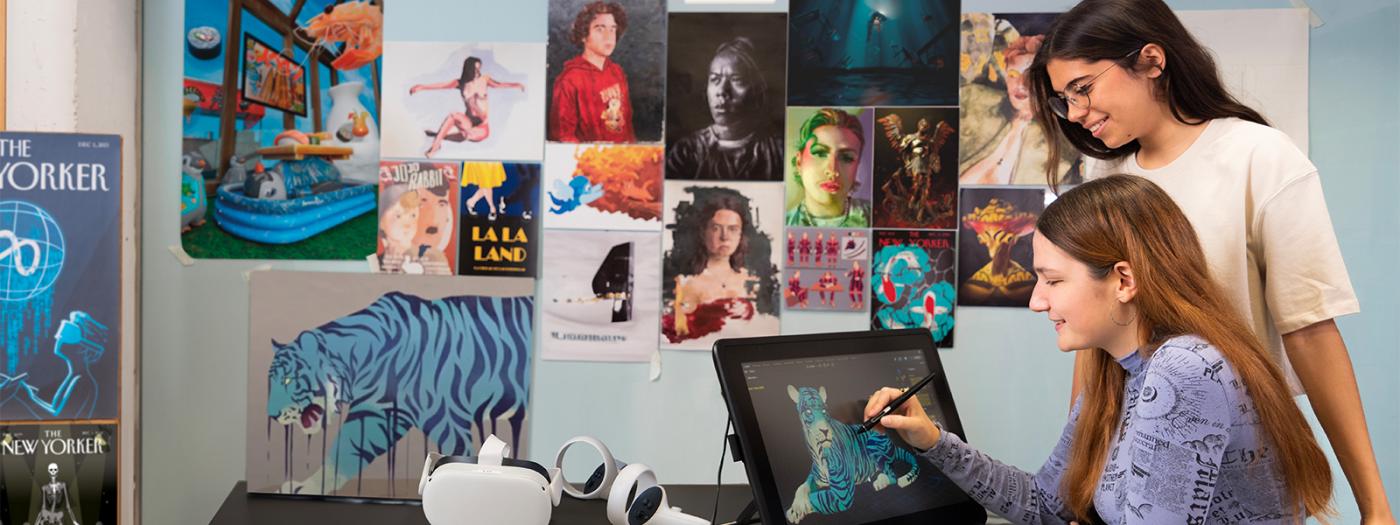
This course enables students to integrate and apply the knowledge acquired in other subjects of the program, such as character design, environment design, visual narrative, and digital techniques. Through the development of an individual project, students learn to conceive, plan, and produce a coherent visual proposal that effectively communicates an idea, universe, or story. The course structures the creative process from research and conceptualization to the final presentation of the project. Students will work with a schedule of partial submissions that allows for reviewing the project’s progress at different stages. They must demonstrate a deep understanding of visual language and the practical application of the technical and artistic knowledge acquired throughout the degree. Additionally, the course strengthens communication, presentation, and justification skills related to creative decision?making.
Titular Professors
Professors
Having completed Project I and II.
The objectives of Project III are for the student to integrate the technical and artistic learning acquired throughout the degree in order to develop an original visual project, supported by prior research and a written report that articulates the idea, universe, or story they aim to communicate. The course seeks to strengthen mastery of visual language, planning skills, and professional project presentation, while also preparing students to confidently undertake their Final Degree Project.
Phase 1: Briefing structure, presentation of moodboards, stages in the research of an artistic project, character design based on silhouettes, and presentation of an individual project.
Phase 2: Composition and narrative work using thumbnails, study of references, environment design, and creation of final keys.
Phase 3: Project analysis and color work as the emotional backbone of the story.
Phase 4: Color script, written project report, and development of props and remaining concepts.
The course will be taught through a variety of instructional methodologies. At the beginning of the academic year, the general objectives of the project will be presented, and students will receive guidance on the development phases, delivery planning, and evaluation criteria. Throughout the sessions, theoretical and technical guidance will be combined with personalized tutorials, where each student can present the progress of their project and receive both individual and group feedback. The main work of the course will consist of developing a concept art project that integrates the knowledge acquired in other subjects (character design, environment design, visual narrative, etc.). The process will be structured into different phases—research, conceptualization, visual development, and final presentation—with partial submissions that allow for continuous monitoring. Learning will be complemented by collective review sessions and oral presentations during the project weeks, encouraging reflection on the creative process and the justification of artistic decisions.
MD 4: Seminar
MD 5: Self-Paced Learning
MD 6: Project-Based Learning
Assessment focuses on the process of creating and developing the project, with particular attention to the student’s ability to research, conceptualize, plan, and materialize a coherent visual proposal. The evolution of the work throughout the course is valued, along with the quality of creative solutions, the strength of the visual discourse, and the student’s ability to justify the decisions made during the process.
To pass the course, students must submit all phases of the project and achieve a minimum grade of 5 out of 10 across all assessed activities. Extraordinary evaluation: Only in exceptional cases (accident, illness, etc.) may a student who does not pass the ordinary assessment attempt to pass the course in the extraordinary assessment period. Evaluation criteria for all calls: If the conditions for passing are not met, the maximum possible grade will be a 4. Students have the right to request a grade review on the date set by the instructor, and during this review the grade may be raised or lowered.
Bancroft, T. (2017). Creating Characters with Personality. Watson-Guptill. Gurney, J. (2010). Color and Light: A Guide for the Realist Painter. Andrews McMeel Publishing. Jones, S. (2019). The Art of Game Design: A Book of Lenses. CRC Press. Mateu-Mestre, M. (2010). Framed Ink: Drawing and Composition for Visual Storytellers. Design Studio Press. Robertson, S., & Bertling, T. (2013). How to Draw: Drawing and Sketching Objects and Environments from Your Imagination. Design Studio Press. Vilppu, G. (1994). Vilppu Drawing Manual. Vilppu Studio. Birn, J. (2014). Digital Lighting and Rendering. New Riders.
Supplementary material will be provided in class.