
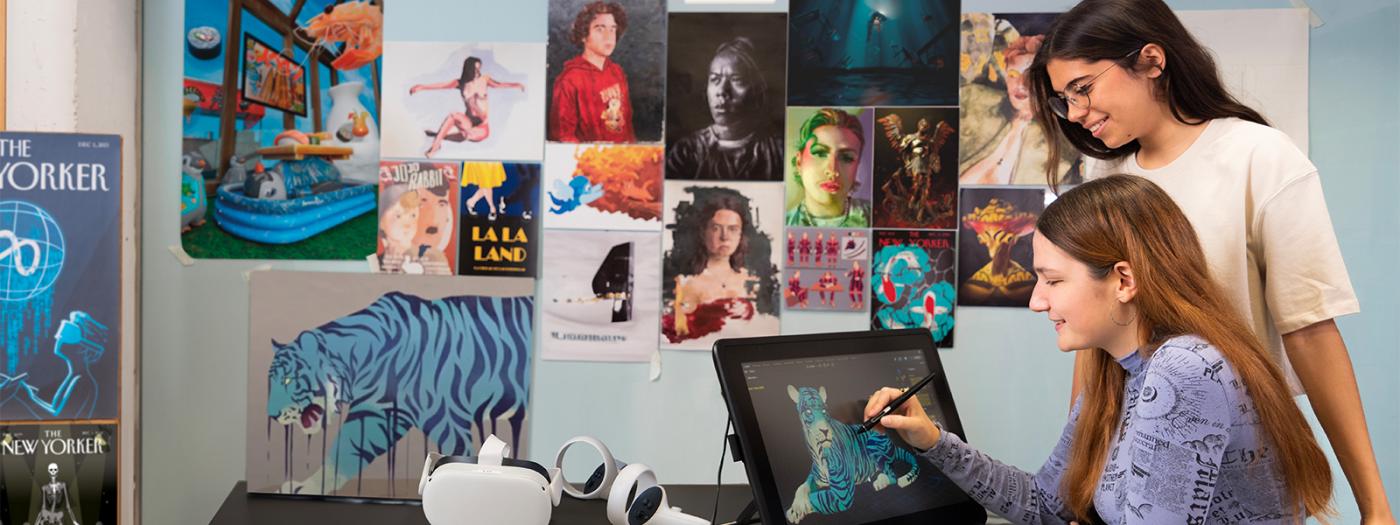
The Visual Narrative course introduces students to the fundamental principles of visual and audiovisual language, exploring the theoretical and historical foundations that have shaped the ways in which stories are told through images. Through an overview of the key movements and trends that have influenced the evolution of cinema—from the Soviet avant?garde and montage, to Italian Neorealism, the French Nouvelle Vague, experimental cinema, music videos, and new digital media—students will learn to interpret and analyse different narrative forms within artistic and audiovisual contexts. The course combines theory and practice, allowing students to develop skills in creative ideation, narrative structuring, and project presentation, as well as to acquire the essential foundations of dramaturgy, screenwriting, and production required to conceive their own audiovisual projects.
Titular Professors
No prior knowledge is required.
The objectives of the course are to provide students with a solid understanding of visual and audiovisual language, as well as the creative processes involved in the development of artistic and narrative works. The course aims for students to internalise the foundations of narrative and dramaturgy, exploring both classical and non?conventional structures, and to be capable of critically analysing audiovisual productions of diverse nature. Another objective of the course is to develop the students’ ability to communicate and present ideas clearly, effectively, and professionally—both orally and visually—through pitching sessions and narrative creation exercises.
Module 1
- The “language” of cinema: discussions on the audiovisual code.
- The Soviet avant?garde and the origins of montage.
- The rhetoric of surrealist cinema. Umberto Eco’s lecture on the language of cinema (Eco, 1971).
- Post-war European cinema. New forms and modern cinema: Italian Neorealism and the French Nouvelle Vague.
- The ontology of cinema according to André Bazin (Bazin, 2004).
- General film criticism (Mitry, 2002a, 2002b).
- The semiology of the cinematographic image by Roland Barthes (Barthes, 1986).
Module 2
- Experimental cinema and “pure cinema” in the West.
- Cinéma du look and visual cinema.
- North American independent cinema.
- Dogma ’95 and new codes of realism.
- Music video: the fusion of music and image.
- The emergence of video art (Fifer, 1990).
- The “language” of new media.
Module 3
- Documentary cinema.
- Reality TV.
- Animated cinema.
- Kinship between painting and animation.
- Narrative seminar.
- The Hero’s Journey.
- Classical narrative structure; non?traditional narrative structures.
- Logline, synopsis, narrative treatment, screenplay.
Module 4
- Audiovisual production and its four stages: development, pre?production, shooting, and post?production.
- Screenwriting techniques (theme/problem/conflict of a project).
- Literary script, technical script, and storyboard.
- Organisation of the production stages (pre?, pro? and post?production).
- Techniques for organising production teams.
- The role and technique of editing in audiovisual production.
- The role of distribution and audiovisual dissemination policies.
In this course, a variety of teaching methodologies will be employed. There will be, on the one hand, lecture-based sessions in which the instructor will introduce the foundations of audiovisual language and production — presentations supported by practical references and bibliography. To consolidate the knowledge acquired in this section, students will develop targeted exercises during the initial phase of the course. Midway through the semester, they will progressively channel their efforts towards a final project in which they will apply the knowledge gained throughout the academic term.
MD 1: Lecture session supported by audiovisual material.
MD 2: Seminar.
MD 3: Flipped classroom.
MD 4: Project-based learning.
Ordinary Assessment
The assessment process will be carried out based on the following practical activities, which must be submitted in chronological order, within the deadline set by the instructor and according to the specific guidelines provided on the e?study platform. The percentage indicated below corresponds to the weight of each activity (interpret 10% as moderately significant and 50% as highly significant).
Essay on audiovisual language — 10%
Presentation of the pre?project — 10%
Presentation of the project script — 10%
Style exercise (presentation of a scene from the final project) — 10%
Editing (presentation of the editing draft of the final project) — 10%
Final project — 50%
Extraordinary Assessment
Students who do not pass the ordinary assessment have the option to pass the course in the extraordinary assessment session, provided that they submit all exercises and projects completed during the semester.
If the exams, exercises, or assignments submitted by the student do not demonstrate correct written expression, grammar, and spelling, the maximum possible grade will be 4.
If the necessary conditions to pass the assessment are not met, the maximum possible grade will be 4.
The student has the right to request a grade review on the date set by the instructor. During this review, the grade may increase or decrease.
Aub, M. (1985). Conversaciones con Buñuel. Madrid: Aguilar.
Barthes, R. (1986). Lo obvio y lo obtuso: Imágenes, gestos, voces (C. F. Medrano, Trans.). Barcelona: Paidos.
Bazin, A. (2004). ¿Qué es el cine? (J. L. L. Muñoz, Trans.). Madrid: Ediciones Rialp.
Buñuel, L. (1983). Luis Buñuel: Mi último suspiro (A. M. d. l. Fuente, Trans.). Barcelona: Plaza Janes.
Eco, U. (1971). Sobre las articulaciones del código cinematográfico (A. M. Torres, Trans.). In M. P. Estremera (Ed.), Problemas del nuevo cine (pp. 78-108). Madrid: Alianza Editorial.
Eisenstein, S. (1961).Eisenstein Dessins Drawings. Moscú: Tocydacmbehhoe uzdamerbcmbo.
Eisenstein, S. (2010). Sergei Eisenstein: Selected Works (Writings, 1922- 1934) (R. Taylor, Trans. R. Taylor Ed. Vol. 1). London: I. B. TAURI .
Fifer Jo S. & Hall D. Eds. (1990) Illuminating Video: An Essential Guide to Video Art. London: Aperture Foundation.
Flusser, V. (2001). Una filosofía de la fotografía (T. Schilling, Trans.). Madrid: Síntesis.
Flusser, V. (2002). Filosofía del diseño: La forma de las cosas (P. Marinas, Trans.). Madrid: Editorial Síntesis.
Machado, A. (2002). Pré-cinemas & pós-Cinemas. Sao Paulo: Papirus ditora.
Manovich, L. (2002). Language of New Media. Cambridge: MIT Press.
Mitry, J. (2002a). Estética y psicología del cine 1: Las estructuras (R. P. Mores, Trans.). Madrid: Siglo Veintiuno de España Editores.
Pasolini, P. P., & Romer, E. (1970). Cine de poesía contra cine de prosa (J. Jordá, Trans.). Barcelona: Anagrama.
Shklovski, V. (1994 [1927]). Poetry and Prose in Cinema (R. Taylor, Trans.). In R. Taylor (Ed.), The Film Factory: Russian and Soviet Cinema in Documents 1896-1939 (pp. 176-178). Londres: Routledge.
Tretiakov, S. (2006a). Our Cinema. October (118), 27-44.
Tretiakov, S. (2006b). The Theater of Attractions. October (118), 19-26.
Youngblood, G. (1970). Expanded Cinema. E.P. Dutton; 1st edition.
If necessary, additional bibliography and supplementary material will be provided for each topic.