
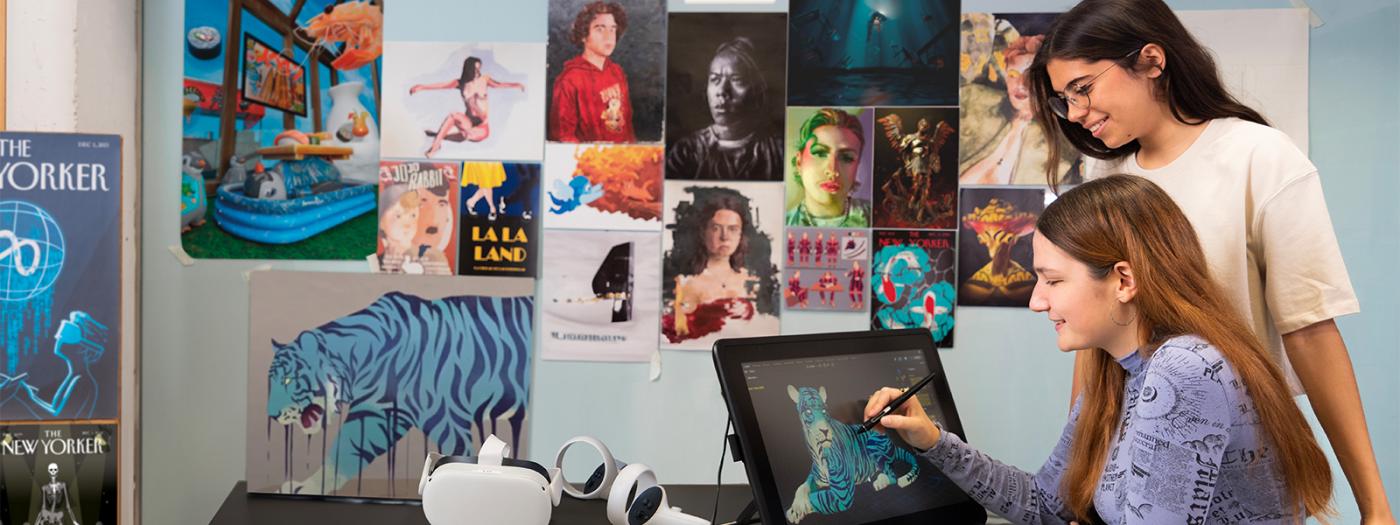
In Bachelor final thesis, the student must develop a personal project during the last year of the degree, going through the conceptualization, development and final oral presentation of the work.
With the TFG the student must demonstrate the knowledge and skills acquired during the years studied in the degree. The student will have a tutor who will guide him/her during the course. The culmination of this work will be the defense of the work before a panel of experts
Titular Professors
Professors
Having completed the digital arts courses
To develop a personal project by applying in an integrated way the knowledge and skills acquired throughout the degree.
To plan and manage all phases of the creative process: definition, development, submission, and defense.
To create a digital artwork or artistic proposal using techniques and methodologies appropriate to the project.
To solve problems creatively, demonstrating analytical, synthetic, and decision?making skills.
1. Course introduction
The operation of the course and the procedure to be followed in order to present the Bachelor Final thesis will be explained.
2. Sample of reference TFG
Different reference final projects will be shown from other years or from other careers.
3. How to Conduct Research in the Artistic Field
Various methodologies for conducting research in the artistic field will be presented, which can help identify the project's theme and establish a solid work structure to develop the Final Degree Project.
4. How to register the final dissertation with the secretary
The procedure to follow to register the Bachelor Final thesis through esecretary will be explained.
5. How to draft the dissertation
Some writing resources will be explained to help properly develop the written report for the Final Degree Project.
6. How to present it orally
Different resources and mechanisms will be taught to make a good oral defense of the Bachelor Final thesis.
The Bachelor's thesis is composed of four phases: Definition, development, submission, and defense.
In the first phase, definition, the student must define the TFG. He/she will receive guidance for the creation of the idea, it will be validated and a tutor will be assigned. This phase will end with the registration in the eSecretary.
In the definition phase there will be a small part of lectures in which professors will introduce certain concepts and resources related to research methodology, in order to properly develop the dissertation and its memory.
The second phase, development, the student will carry out the work and partial deliveries will be made where the student will receive feedback from his/her tutor. This follow-up will be evaluated by means of a grade that will correspond to the follow-up part of the work.
There will also be workshops so that students can put into practice what has been explained in the definition phase, in their own project. All this will be combined with the student's autonomous work, which will be guided by individual tutorials.
In the third phase, delivery, the student will finalize the work and finish writing the report. Once accepted by the tutor, the report will be deposited in the eSecretary.
In the fourth phase, defends, the student will prepare the presentation, to defend the work and submit it to the evaluation of the tribunal.
MD0: Master Class with the support of audiovisual material.
MD1: Exercise classes.
MD4: Seminars
MD9: Peer Instruction
MD13: Just-In-time teaching
Artistic production (outcome, concept, research/experimentation, originality/risk, techniques/media, and production volume): 50%
Supervion with the tutor (Planning, submissions, and follow?up committee): 10%
Written report (Thesis): 30%
Oral presentation: 10%
Check the general regulations and delivery dates at:
https://www.salleurl.edu/en/studies/bachelor-degrees/academic-information/academic-regulations/bachelor-thesis-bt
If the thesis does not show correct written expression, grammar and spelling, and if the bibliography is not properly cited following APA7, the tutor will not allow the defence.
The assessment criteria will be based on the originality, coherence and quality of the results according to the rubrics of the academic guide.
Rasch, M., Staal, H., & Gijsen, J. (2026). Hands on research for artists, designers and educators (Second). Set Margins.
A bibliography will be provided as the course progresses. Tutors will also provide specific bibliography for each TFG.
-