
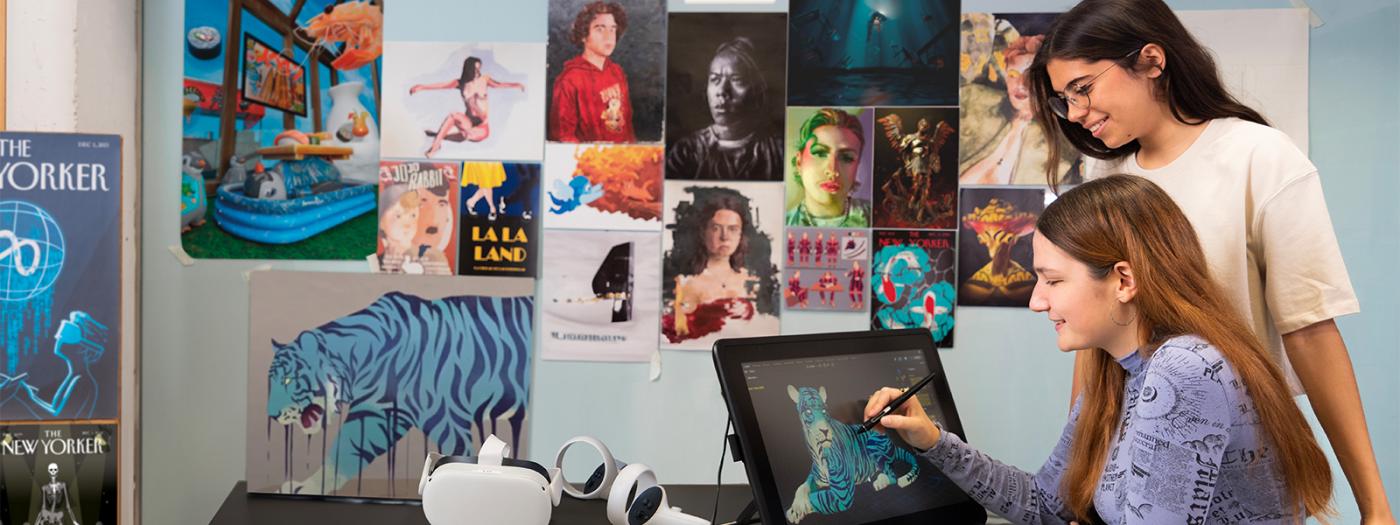
The course offers a comprehensive overview of the history of art, from Antiquity to contemporary art. It will address key themes and fundamental concepts such as beauty, originality, authenticity, the figure of the artist, the role of the audience, the relationship between the artwork and space-time, as well as its materiality. The aim is to provide students with a solid and in-depth understanding that enables them to recognise and contextualise the main artistic movements and currents throughout history. In addition, the course includes seminars and lectures delivered by guest lecturers and subject specialists, exploring non-European artistic expressions in order to offer a broader and more diverse perspective on the artistic phenomenon.
Titular Professors
No previous knowledge is required
Students will develop the ability to recognize artistic works and situate them within their chronological and cultural context. They will learn to observe art critically, deepening their understanding of the act of “looking” and conducting rigorous iconographic analyses. Critical thinking, visual interpretation, and argumentative skills will be fostered throughout the course. Additionally, students will acquire the ability to search for specialized bibliography and identify relevant artistic references that enrich their analyses and projects.
Topic 1. Introduction. Understanding Art and Artists. Genealogies, Discourses, and the Construction of the Discipline. Introduction to the history of art through the creation of the discipline, presenting common concepts as well as general and introductory questions to the syllabus.
Topic 2. Representing Life. Prehistoric and “Primitive” Peoples. Study of prehistoric art from a historiographical and ontological perspective, reflecting on the artistic significance of its representations
Topic 3. Eternity and Art. Mesopotamia and Egypt. Examination of Mesopotamian and Egyptian art, considering their artistic manifestations through the conceptions of spirituality, life, and death in both civilizations.
Topic 4. Beauty in Art. Greece. Analysis of how art was understood in Greece and how it was structured within its cosmology, forming the basis of Western art and aesthetics.
Topic 5. Artistic Syncretism: Rome. Rome as conqueror of the known world and as an appropriator of the art of other cultures, adapting them into an artistic language that reflected its hegemony and political power.
Topic 6. In Search of Light: Dismantling Myths of the Middle Ages. Romanesque art in Spain: first steps towards major medieval constructions. The birth of religiosity and the role of churches. Gothic art in a changing world: new societies and new constructive approaches.
Topic 7. The Rebirth of Ancient Art: The Renaissance. The flourishing of the Italian Renaissance and its influence across the West. The Renaissance movement beyond Italian borders.
Topic 8. Everyday Life Reflected in the Artistic Genres of the Baroque. The creation of new artistic genres, shaped by the Counter-Reformation and the perspectives of both the Old and the New World.
Topic 9. The Search for New Paths. Nineteenth-Century Art. Exploration of how new technologies and materials affected the vision and perception of the world, and consequently, of art. The nineteenth century as the period when the traditional artistic foundations established during the Renaissance began to break apart, paving the way for the transformations of the twentieth century.
Topic 10. The Reinvention of Art in the Avant-Gardes of the Early Twentieth Century. The rupture with traditional art and the emergence of the multiple new artistic proposals characteristic of the early avant-garde movements.
Topic 11. The Reassertion of the Artist and of the Art of Life. The Second Half of the Twentieth Century. The prominence of the artist’s role in the creation of the artwork and its connection with life itself through new artistic trends.
In the subject will work through different teaching methodologies. At the beginning of each unit there will be a master class where the teacher will introduce certain basic concepts and contextualize the student in the historical-artistic moment. From here, the student will have a series of audiovisual material and didactic activities based on the active methodologies with which he will acquire the knowledge of the different stylistic periods and the specific vocabulary of the discipline. From the beginning of the course the student will be presented with a individually project to develop throughout the course and to present orally and in writing at the end of the course. MD 1: Master Class with the support of audiovisual material. MD 2: Seminar. MD 3: Flipped classroom. MD 4: Real events. MD 5: Project-based learning. MD 6: Peer Instruction
Standard evaluation:
Theoretical basis: 50% Evaluation of the theoretical basis of the subject through: a test of each subject. a written test of open response at the end of each semester.
Highly significant test Minimum grade required to arise average >4/10 Individual note.
Seminars/Workshops: 15% Evaluation of the seminars made during the course. Minimum grade required to arise average >4/10. Individual note. Written and oral presentation of the course project. 25%.
Highly significant test Evaluation of the written work of the course project and in the oral presentation of the final project of the course. Minimum grade required to arise average >4/10.
Continuous evaluation: 10% Involvement of the student in the classes, oral expression and criteria of the teacher.
Special evaluation: In case standard evaluation is failed, students have the option to pass the subject by passing a special evaluation exam.
Criteria for standard and special evaluation: In the event that the exams, exercises or works to be delivered by the student do not present a correct written, grammatical and orthographic expression, the maximum grade will be a 4. If the conditions are not fulfilled for passing the convocation, the maximum grade will be a 4.
Baxandall, M. (2019). Pintura y vida cotidiana en el renacimiento. Arte y experiencia en el quattrocento. Ed. Ampersand.
Benjamin, W. (2021). La obra de arte en la época de su reproductibilidad técnica. Alianza Editorial.
Gombrich, E.H. (2008). La historia del arte. Londres: Phaidon Press Limited.
Crespo Fajardo, J. L. (Coord.) (2012). Discursos sobre arte digital. Málaga: Universidad Málaga.
(2012) coord. José Luis Crespo Fajardo, Univ. Málaga. http://www.eumed.net/libros-gratis/ciencia/2012/7/7.pdf
Lieser, W. (2009). El arte digital, Ullman Publishing.
Panofsky, E. (2001). Estudios sobre iconología. Alianza Editorial.
Panofsky, E. (1989). El significado de las artes visuales. Madrid: Alianza Editorial.
Sulzer, J.G. (1774). Teoría general de las bellas artes.
Tatarkiewicz, W. (2000). Historia de la estètica, Madrid: Ed. Akal.
Winckelmann, J.J. (2023). Historia del arte de la antigüedad. Ed. La Esfera de los libros.
More specific bibliography will be provided for each topic.