
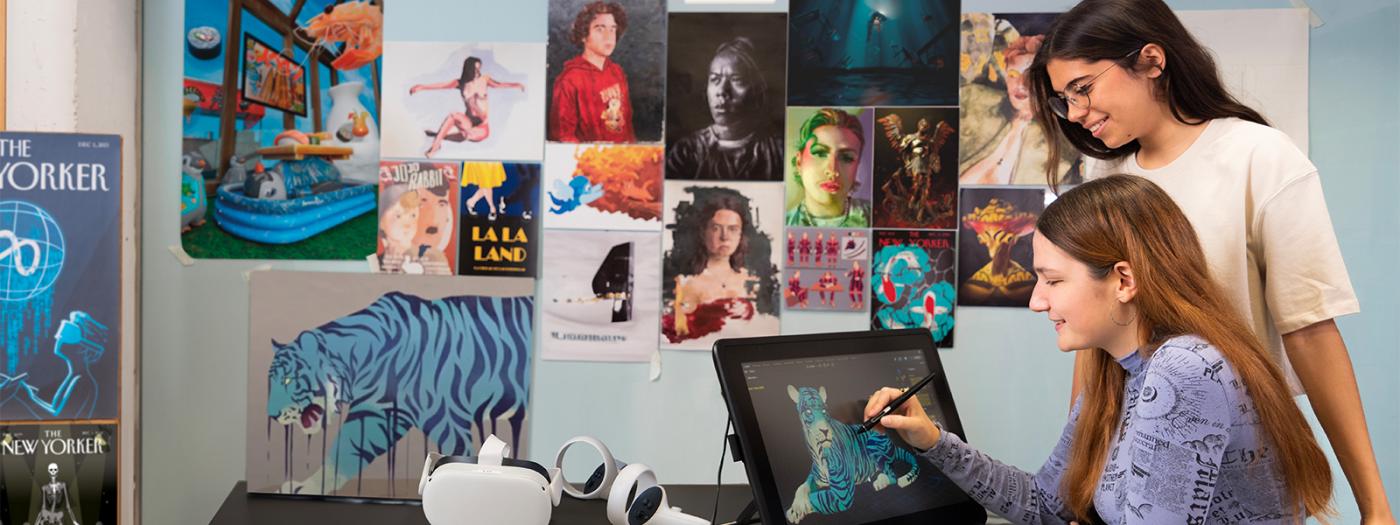
Character design subject focuses on teaching students the skills and techniques needed to create characters for various media such as animation, comics, video games, and films. This course typically covers fundamental topics such as anatomy, expression, personality, and costume design.
Titular Professors
Basic knowledge of Blender and Photoshop is required.
The goal of the Character Design course is to provide students with the skills and techniques required to design high-quality characters for any type of visual project (video games, series, films, theme parks, etc.). Students will learn to design characters in different styles (cartoon, semi-realism, or realism), understand the fundamentals of human anatomy for character application, and develop their creativity, visual communication skills, and understanding of the basic principles of character design.
Week 1: Course syllabus introduction. Importance of character design within a project. Explanation of the different fields where character design is used. Analysis of the fundamentals of character design that will be covered during the course.
Task: Initial placement test (non-graded) to assess the initial abilities of the group as a whole and each student individually: design two aesthetically coherent characters based on two descriptions given in class.
Week 2: Style: learning to maintain a specific style throughout the creation of the different characters in a project. Learning to analyze and distinguish different visual styles.
Task: Create a self-portrait in the style of a specific series or film.
Week 3: Anatomy. Basic proportions of the human body. Anatomy of the torso. Simplification of major muscle groups. Exaggeration and synthesis.
Task: Full-body anatomy study. Exaggeration of realistic anatomy to create a stylized, yet anatomically correct, character.
Week 4: Anatomy of the limbs (legs and arms).
Task: Create a realistic character for a fighting video game.
Week 5: Turnaround: How to create an accurate turnaround depending on the design objective and the type of project it will be used for (T-pose, A-pose, gestural pose).
Task: Create a turnaround of 3 poses (front, back, side) of the character designed in the previous exercise.
Week 6: Poses/Gesture. How to use references to draw interesting poses.
Task: Draw 5 poses of the character designed in the previous exercise.
Week 7: Expressions: Analysis of head structure, detailed analysis of expressions, how to create expressions.
Task: Create 5 expressions of the character from the previous exercise.
Week 8: Tonal values. Understanding the fundamentals of lighting and the importance of correctly working with tonal values ??when painting a character.
Task: Paint a previously designed character using tonal values.
Week 9: Color. Learn the different color scales to paint characters with proper color harmony. Techniques for painting characters quickly and effectively.
Task: Color the character painted using tonal values.
Week 10: Clothing Design. Work on clothing. Folds, textures, etc.
Task: Design a character with loose clothing and develop the garment correctly.
Week 11: Textures. Learn to apply textures to characters using different digital techniques.
Task: Design an alien character, paint it, and apply textures.
Week 12: Introduction to Creature and Monster Design.
Task: Design a creature by combining two real animals.
Week 13: Final Project. Workshop-style classes with individual follow-up and feedback.
Week 14: Final Project Presentations.
The course methodology will combine theoretical sessions, practical demonstrations, analysis of reference character designs, and supervised practical exercises during class, which can be adapted to the students’ different skill levels. Teamwork and peer feedback will be encouraged to enrich the creative process. Each class will include practical exercises so students can apply the knowledge and techniques acquired. Small independent practical exercises will also be conducted during class. Special attention will be given to feedback and corrections on student work.
First project submission: 25%
Final project: 50%
Weekly exercises submission: 10% (all exercises must be submitted on time to be graded)
Continuous assessment: 15% – Student involvement in class, attendance, behavior, commitment, and professionalism
Criteris davaluació per a totes les convocatòries: Si no es compleixen les condicions per aprovar la convocatòria, la nota màxima serà un 4. Lalumne tindrà dret a revisió de la nota durant el dia estipulat pel professor. A la revisió la nota de l'estudiant es pot veure incrementada o reduïda.
3dtotal Publishing. (2016). Character Design Quarterly 1: Visual Development. 3dtotal Publishing.
Mattesi, M. (2006). Force: Dynamic Life Drawing for Animators. Focal Press.
3dtotal Publishing. (2014). Sketching from the Imagination: Characters. 3dtotal Publishing.
Gurney, J. (2010). Color and Light: A Guide for the Realist Painter. Andrews McMeel Publishing.
Whitlatch, T. (2015). Creature Design: Creating Imaginary Animals. Design Studio Press.
Colman, D. (2017). The Art of Animal Character Design. Ginkgo Press.
3dtotal Publishing. (2022). Character Design Quarterly 10: Visual Development. 3dtotal Publishing.
3dtotal Publishing. (2017). Creating Characters for the Entertainment Industry. 3dtotal Publishing.
Robertson, S., Yamada, M., & Le, K. (2005). The Skillful Huntsman: Visual Development of a Grimm Tale at Art Center College of Design. Design Studio Press.
Julius, J. (2016). The Art of Moana. Chronicle Books.
Miller-Zarneke, T. (2010). The Art of How to Train Your Dragon. Titan Books.
Solomon, C. (2013). The Art of Frozen. Chronicle Books.
Miller-Zarneke, T. (2008). The Art of Kung Fu Panda. Insight Editions.