
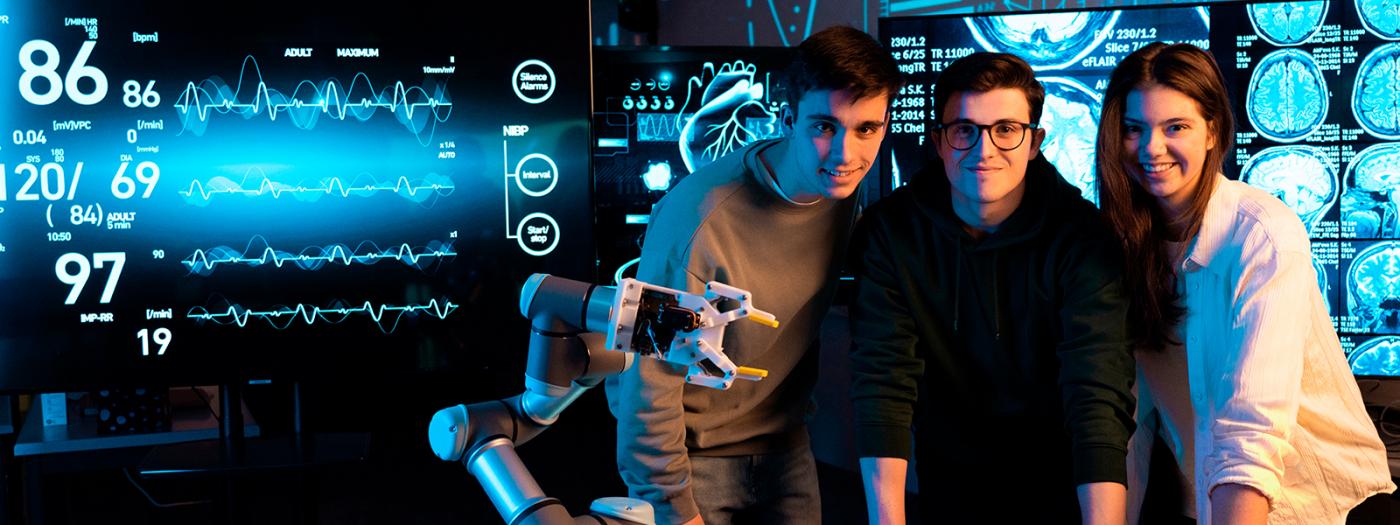
This course aims to specialize students by offering diverse content on topics of interest in the fields of Health Engineering, Biomedical Engineering, or other related disciplines. It seeks to integrate students into the participation of tasks and projects (research, innovation, community service, cooperation, teaching support, or others) related to Health Engineering. It is an excellent complement to the curriculum. The work the student develops will depend on the specific Health Engineering subject in which they collaborate. It is important to choose the subject that aligns with the student's particular interests. The course fosters teamwork, collaboration, and the application of creativity. It has an essentially practical approach; students develop an applied academic/research project, integrating documentary research methodologies, problem-solving, and communication through technical deliverables and presentations
Titular Professors
Professors
It is advisable to have taken all the subjects of the subject in which the collaboration is taking place. The subjects of the Health Engineering degree (GES) are: Mathematics, Computer Science, Physics, Biochemistry, Electronics, Communications, Medical Signals and Images, Medical Informatics, Biostatistics, Clinical Fundamentals, Management and Research.
The objectives of the subject are:
• Apply the knowledge from the degree in an integrated way to participate in real projects and tasks in the field of Health Engineering, providing technically sound solutions.
• Develop applied projects with rigor and a critical perspective, incorporating sex and gender variables where appropriate, and communicating the results through professional deliverables and presentations.
• To promote collaborative work and creativity in multidisciplinary environments, assuming diverse roles, co-responsibility and methodologies for joint problem solving.
• Gain practical experience in real academic and professional contexts, through project-based work, laboratory practices, short seminars and formative tutorials that reinforce the student's autonomy and execution capacity.
The content for each student can vary depending on the purpose of the project or task, focusing on a health-related application. Examples include the development of hardware prototypes, algorithms, software tools, and theoretical-practical teaching materials; research into anatomical, physiological, and pathophysiological processes; the design of experiments; signal and data acquisition/recording; signal and image processing; database management; 3D modeling/printing; biomaterial characterization; and computational simulation, among others. The course also provides an opportunity to integrate new content from related subjects within Health Engineering that are not included in the curriculum, allowing students to explore these topics during academic exchanges at national and international institutions.
This course has a strong practical component and aims to prepare students to collaborate in professional settings, addressing real-world challenges in the healthcare sector. It is developed by combining guidance and support from the instructor with practical activities to solve challenges presented to groups of 2 to 4 students. The following teaching methodologies are used:
- Project-Based Learning (PBL): each team develops a realistic project with verifiable results (hardware and/or software prototype, experiment, model, etc.).
- Hands-on laboratory learning: experimental sessions focused on learning by doing.
- Short seminars and micro-lessons to cover key concepts just in time ("just-in-time teaching") to facilitate progress.
- Academic and technical tutoring: formative follow-up with actionable feedback geared towards improvement.
- Cooperative learning: rotating roles (by week and/or by type of assessment), co-responsibility (each role has its own and shared tasks: "the result belongs to everyone"), collaborative problem-solving (use of group thinking and decision-making techniques: brainwriting, brainstorming, etc.), and peer assessment (anonymous evaluation of each presentation, both individually and by peers).
- Continuous assessment through monitoring of individual and group performance.
Use of AI in learning: allowed with explicit declaration of its use and prompts included in annexes of deliverables. Work must be original, traceable, and understandable by its author(s).
Each student's work is evaluated based on their ability to respond to the problems presented, considering their capacity to define how to guide the work, its development, and the results. Personal involvement and attitude are also valued. The evaluation will be carried out by the person responsible for supervising the student groups. This person will monitor and provide ongoing individual assessment of each student's contribution.
It will be assessed whether the student:
•Applies the knowledge from the degree in an appropriate and integrated manner to analyze and solve the assigned problem.
•It proposes technically sound, viable and well-founded solutions.
•Integrate, where appropriate, the sex and gender perspective into the design, analysis or interpretation of the project.
•Plan the project realistically and rigorously, conducting relevant documentary research and applying a clear work methodology.
•Develop and present the project professionally, with clear, structured, and technically justified deliverables and presentations.
•Works collaboratively and responsibly, actively contributing to the group, communicating well, and assuming co-responsibility for the results.
•Contributes creativity and initiative, generating innovative ideas and solutions and actively participating in team decision-making.
1. Creswell, J.W., & Creswell, J.D. (2023). Research design: Qualitative, quantitative, and mixed methods approach (6th ed.). SAGE.
2. Hernández-Sampieri, R., & Mendoza, C. (2018). Research Methodology: The quantitative, qualitative and mixed routes. McGraw-Hill.
3. Browner, WS, Newman, TB, Cummings, SR, & Grady, DG (2022). Designing clinical research (5th ed.). Wolters Kluwer.
1. Ng, SI, Xu, L., Siegert, I., Cummins, N., Benway, NR, Liss, J., & Berisha, V. (2024). A tutorial on developing clinical speech AI: from data collection to model validation. arXiv preprint arXiv : 2410.21640.
2. Ahluwalia, A., De Maria, C., & Díaz Lantada, A. (eds.) (2022). Engineering Open-Source Medical Devices: A Reliable Approach for Safe, Sustainable and Accessible Healthcare. Springer Cham. SpringerLink
3. Tranquillo, J., Goldberg, J., & Allen, R. (2022). Biomedical Engineering Design. Elsevier.
4. Bajaj, V., Sinha, G.R., & Chakraborty, C. (eds.) (2022). Biomedical Signal Processing for Healthcare Applications. CRC Press,
5. Biomedical signals (EEG, EMG, ECG), machine learning applied to health, data processing.
6. Obeid, I., Selesnick, I., & Picone, J. (eds.) (2021). Biomedical Signal Processing: Innovation and Applications. Springer.
7. Sahin, F., & Pérez-Castillejos, P. (2023). Instrumentation Handbook for Biomedical Engineers. Routledge.
8. Kunal Pal, Bala Chakravarthy Neelapu, J. Sivaraman (2024). Advances in Artificial Intelligence: Biomedical Engineering Applications in Signals and Imaging. Elsevier.