
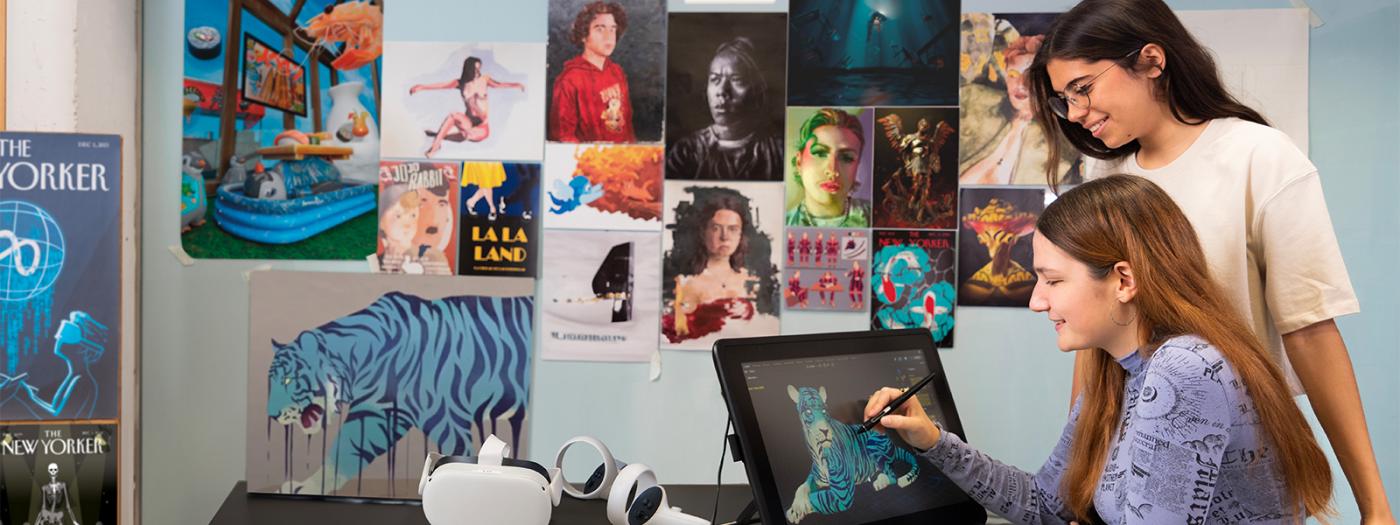
Digital 2D Animation introduces students to the study and practice of 2D animation and drawing applied to animation. Through theoretical sessions and hands-on exercises, students acquire the technical and artistic skills needed to create characters, compositions, and animations in digital 2D environments, integrating both digital animation tools and the principles of traditional animation.
.
Digital 2D Animation introduces students to the study and practice of 2D animation and drawing applied to animation. Through theoretical sessions and hands-on exercises, students acquire the technical and artistic skills needed to create characters, compositions, and animations in digital 2D environments, integrating both digital animation tools and the principles of traditional animation.
Objectives
- Learn the basic principles of 2D animation
- Master the specific tools of a digital 2D software
- Create characters and compositions using drawing and digital 2D programs
- Gain practical experience in creating 2D animations across different styles: cut-out, puppet, and drawn animation
- Establish the foundational knowledge to create a character with its hierarchies, libraries, and deformers (rigging)
- Understand the render and export processes for both film and image sequence formats
- Learn and practice traditional animation techniques implemented within a digital 2D environment
- Program interface
- 2D drawing tools
- Timeline and keyframe creation
- Easing and morphing
- Camera work
- Character setup creation with deformers
- Working with libraries and import/export of formats
- Character animation with setup
- Introduction to and practice of traditional animation
- Turnarounds with traditional animation
- Node view: layer organization and preferences
- Scene composition with effects
- Effects creation with traditional animation: animated effects
- Effects created with the node library
The course combines lecture-based introductions to key concepts with hands-on practical exercises carried out directly in class. Collective viewing and analysis of exercises helps reinforce knowledge and progressively improve results. Learning is cumulative: theoretical content is immediately applied in practice, and the final project is developed throughout the entire course with ongoing corrections and feedback.
- ractical exercises (40%) — Compilation of all exercises completed during the course, delivered as an edited film published on an internet channel
- Final project (50%) — Animation project developed throughout the course, delivered as a film via an internet link
- Continuous assessment (10%) — Engagement and work demonstrated during class sessions
.
John Halas y Roger Manvell. La tècnica de los dibujos animados. Ediciones Omega, Barcelona, 1980. Frank Thomas and Ollie Johnston. The Illusion of life. Disney Animation. New York,1981. Shamus Culhane. Animation. From the script to screen. St Martins Griffin. New York, 1988. Norman McLaren. On The Creative Process. National Library of Canada. Compiled and edited by Donald McWilliams. National Film Board of Canada, 1991. Harold Whitaker and John Halas. Timing for animation. Focal Press. London, 1981.AN028? Animació digital 2D Pàgina 3 de 3 Preston Blair. How to animate filkm cartoons. Walter T. Foster. California, 1990. Richard Williams. The animator's survival Kit. Faber and Faber Limited. London, 2001 Tony White. The animator's workbook. Phaidon Press. London, 1986,1995. Giannalberto Bendazzi. Cartoons. 110 años de Cine de Animación. Ocho Y Medio. Madrid, 2003. Donald Crafton. Before Mickey. The Animated Film 1898 ´´ 1928. The University of chicago Press. 1982 Tom Sito. Moving Innovation. A History of Computer animation. Massachusetts Institute of Technology. 2013. Noël Burch. El tragaluz del infinito. Catedra.Signo e imagen. Madrid, 1995. Santos Zunzunegui. Pensar la imagen. Catedra / Universidad Del Pais Vasco.Madrid. 1989,2003. Sergei Eisenstein. La forma del cine. Siglo Veintiuno Editores.1986,1998. Donald Crafton. Emile Cohl, Caricature, and Film. Princeton University Press. 1990 Adam Phillips. Animate to Harmony. Focal Press, 2015
.