
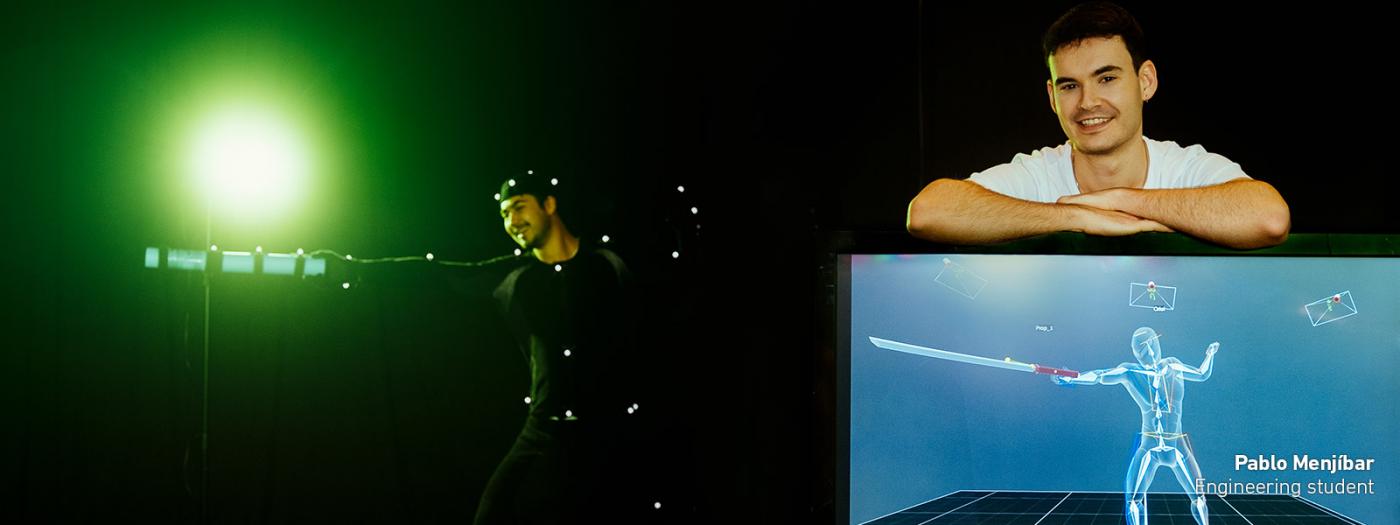
Virtual Production is a practical subject that introduces students to the tools and workflows used in contemporary digital production environments. Through Unreal Engine 5, students explore real-time rendering, shading, VFX, procedural generation, animation, and virtual production techniques including green screen integration. The course emphasises hands-on project work, culminating in a collaborative short film that integrates all acquired skills.
Titular Professors
Students are recommended to have basic familiarity with 3D software and real-time engines. Previous experience with any DCC tool (Blender, Maya, Cinema 4D) is an advantage, as is a basic understanding of digital image composition and colour theory.
- Acquire practical proficiency in Unreal Engine 5 for real-time scene creation and rendering.
- Understand and apply shading, lighting, and post-processing techniques.
- Create visual effects using Niagara particle systems.
- Use Procedural Content Generation (PCG) tools to build complex environments efficiently.
- Integrate animation, sequencer, and camera workflows into a coherent production pipeline.
- Produce a short virtual production piece combining green screen footage with a fully designed digital environment.
Block 1 — Environment & Scene Building Introduction to Unreal Engine 5 editor navigation, Fab asset library and Megascans, landscape and foliage tools, lighting and HDRI backdrops, fog systems, camera setup and scene configuration.
Block 2 — Shading Basic surface materials (plastic, metallic, semi-transparent), texture control, distortion shaders, projection-based materials (mossy rocks), layer/vertex painting, decals, light functions, contact blending, water materials, and post-processing effects (toon shader, cel shading, outline, multi-coloured fog).
Block 3 — Animation, Cameras & Sequencer FBX and ABC animation files, free animation packs, Mixamo integration, sequencer basics, blending animations, camera and post-process settings, rendering output, and an introduction to Motion Design.
Block 4 — Visual Effects (VFX) Introduction to Niagara: GPU sprite, mesh renderer, ribbon renderer, impact hit effects, and flame thrower systems.
Block 5 — Procedural Content Generation (PCG) Point distribution, forest and road generation, spline-based fences, object stacking, simple interiors, landscape material integration with PCG, backrooms generation, and single building creation.
Block 6 — Audio Introduction to MetaSounds: sound management and implementation within Unreal Engine.
Block 7 — Virtual Production Traditional green screen workflows, introduction to the VP lab, compositing digital environments with live-action footage. Final collaborative short film project integrating all previous skills.
The course is structured around practical studio sessions in which each class introduces a new tool or technique through direct demonstration followed by guided hands-on exercises. Students are expected to replicate and expand on in-class examples autonomously. The final project is developed collaboratively in groups of 3–4, simulating a real production environment. Materials and reference exercises are made available via Google Drive after each session. Feedback is provided individually and collectively throughout the process.
| Activity | Weight | Type |
| Class 1 — Landscape scene (PNG) | 10% | Moderately significant |
| Class 3 — Shading corridor scene (PNG) | 25% | Highly significant |
| Class 4 — Animation shot (MP4) | 10% | Moderately significant |
| Class 5 — Niagara VFX (MP4 + PNG) | 10% | Moderately significant |
| Class 7 — PCG forest (MP4 OBS) | 10% | Moderately significant |
| Final project — Virtual Production short film (MP4 + Showcase MP4) | 35% | Highly significant |
- RA.01: Evaluated through the Landscape exercise. Assessed on correct use of terrain tools, asset placement, lighting coherence, and overall compositional quality.
- RA.02: Evaluated through the Shading/Corridor exercise. Assessed on material variety, technical correctness of shader nodes, and visual integration within the scene.
- RA.03: Evaluated through the Animation exercise. Assessed on sequencer structure, animation blending quality, camera work, and rendering output.
- RA.04: Evaluated through the Niagara VFX exercise. Assessed on the use of at least two distinct emitters, visual cohesion of the effect, and technical documentation via screenshots.
- RA.05: Evaluated through the PCG exercise. Assessed on system complexity, correct use of PCG nodes, and clarity of explanation in the OBS recording.
- RA.06 & RA.07: Evaluated through the final Virtual Production project. Assessed across all six compulsory categories, group coordination, technical execution, and quality of the showcase recording.
- Epic Games. (2024). Unreal Engine 5 Documentation. https://docs.unrealengine.com
- Landreneau, E. (2022). Unreal Engine 5: The Complete Beginner's Course. Packt Publishing.
- Fab.com — Official Unreal Engine asset marketplace: https://www.fab.com
- Quixel Megascans Library: https://quixel.com/megascans
- Mixamo (Adobe) — Free character animations: https://www.mixamo.com
- Epic Games YouTube channel — official tutorials: https://www.youtube.com/@UnrealEngine
- Reallusion ActorCore — additional animation resources: https://actorcore.reallusion.com