
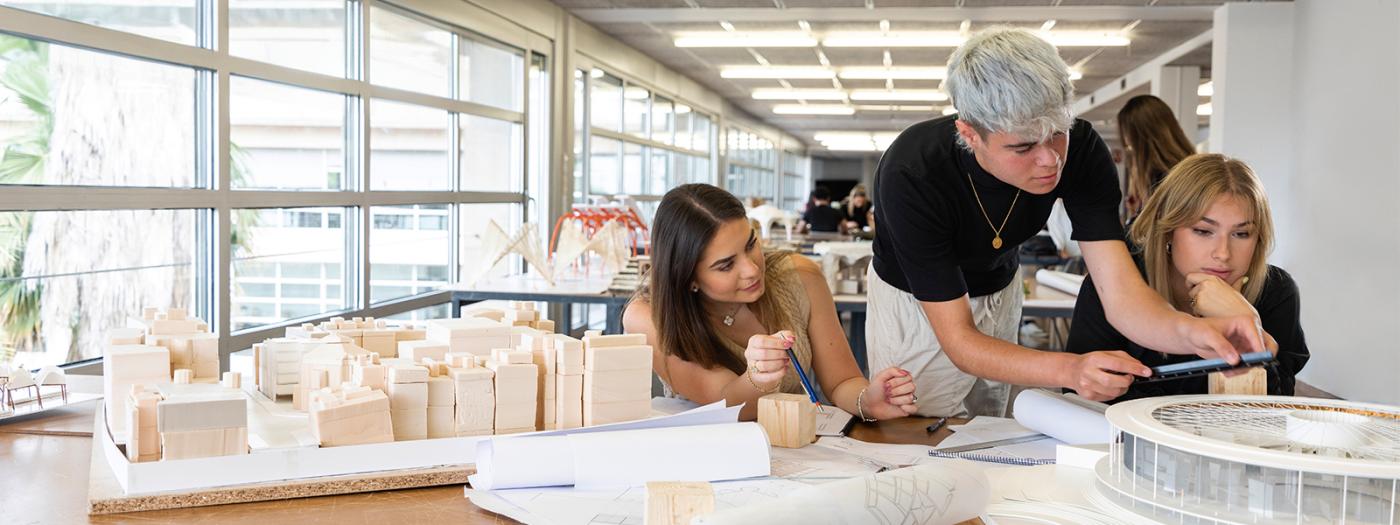
This Design Unit develops tectonic architectural projects in which technical and design considerations are articulated as interdependent aspects of the design process. The course consolidates the competencies acquired in previous courses and directs them towards a design practice that combines technical-constructive rigour, precision in developing details, and an approach to design at the 1:1 scale.
Projects explore the application of a specific technique, approach, or construction system, incorporating it as a generative and structuring principle of the architectural proposal.
The course promotes research by design as a methodology that integrates critical reflection, conceptual exploration, and technical-constructive experimentation throughout the project development process.
The course offers four thematic alternatives for project development, each with a specific technical focus—Matter, Fab, Sustainability, and Rehab. These Units address materiality, digital fabrication, sustainability, and rehabilitation/re-inhabitation, respectively. Each of these areas is conceived both as a field of technical research and as a conceptual framework for architectural project development.
Unit-specific information
Please refer to the appendix corresponding to the specific syllabus for each Unit—Matter, Fab, Sustainability, or Rehab—which contains detailed information on the thematic approaches, learning activities, submissions, specific assessment criteria, scheduling, and the bibliography for each Unit.
The specific syllabi for each Unit do not replace this syllabus; rather, they complement and further develop it at an operational level. In all cases, consistency with the learning outcomes and assessment criteria defined for the course is guaranteed.
Students will find the specific syllabus for each Unit on the course website.
Professors
Knowledge of the conception and development of architectural projects, grounded in a technical, constructive, and material understanding of architecture, as well as a design approach based on the 1:1 scale.
Knowledge of the graphic and technical representation of construction and structural systems, materiality, sustainability, and environmental design strategies.
The course aims to enable students to:
- Integrate technical aspects from the conception to the development of the architectural project, producing coherent, sustainable, and context-responsive solutions.
- Incorporate research as an active tool within the design process, deepening technical and construction knowledge and approaching the project at the 1:1 scale.
- Consolidate rigorous methods for the representation and communication of the architectural project, from the conceptual dimension to the technical and construction definition, including detailing.
1. Conceptual framework of the tectonic project
- Relationship between project, context, technique, and form
- Principles of constructive honesty and essentiality
- Technique and detail as generators of the project
2. Design research methodologies
- Research by design strategies
- Definition of design criteria derived from research and references
- Formulation and development of the project through the integration of the researched technique
3. Technical development of the project
- Development of technical solutions incorporating sustainability criteria
- Technical and constructive definition
- Detailing
4. Experimentation and validation of design solutions
- Production of digital models and/or physical models and prototypes (mock-ups)
- Verification, evaluation, and adjustment of solutions
- Iteration and refinement of design solutions
5. Representation and communication of the project
- Representation of the design concept
- Graphic representation of the technical and constructive definition
- Comprehensive communication of the project
6. Specific technical topics for project development
Each Unit explores a specific technique or approach in depth and integrates it into project development:
Matter Unit
- Principles of materiality and construction techniques
- Properties, behaviour, and technical performance of materials as design drivers
- Application of specific construction systems in the architectural project
Fab Unit
- Principles of digital fabrication and innovative production processes
- Physical computing and interactive systems
- Application of prototyping, experimentation, and the integration of environmental forces in the architectural project
Sustainability Unit
- Principles of sustainability and energy efficiency
- Energy and digital infrastructures as open, metabolic, and resilient territorial systems
- Application of energy, water, and resource flow management in the architectural project
Rehab Unit
- Principles of rehabilitation and re-inhabitation of existing buildings
- Techniques for analysing materials, construction conditions, and energy performance of the existing building
- Application of rehabilitation, reuse, and efficiency improvement strategies in the architectural project
Unit-specific information
Please refer to the appendix corresponding to the specific syllabus for each Unit—Matter, Fab, Sustainability, or Rehab—which further develops these topics.
The course is structured around a project-based learning methodology that promotes research by design. Throughout the semester, students develop a project linked to a specific thematic Unit, through which they acquire and apply knowledge related to a particular technique, approach, or construction system.
The learning activities are organised around theoretical seminars, project-based activities, reviews, and guided studio work, combined with independent student work. This structure supports a progressive and continuous learning process focused on the development of the design process and the gradual achievement of the learning outcomes defined for the course. Activities combine collaborative group work with individual work.
Within this methodological framework, students engage with this Unit with the aim of transferring, adapting, and applying previously acquired knowledge to new contexts, fostering versatility, autonomy, and critical thinking.
As a result, the course promotes the cross-disciplinary integration of technical, construction-related, and design knowledge, while broadening the competencies developed throughout the programme.
In this way, the course ensures that, by the end of the cycle, students will have engaged with more than one technical and design approach associated with Tectonic Design, developing advanced competencies in architectural project development from this disciplinary perspective.
The course will follow a continuous assessment system based on regular review of the work done throughout the semester, culminating in a final submission. Assessment will address both the development of the design process and the quality and coherence of the outcome.
Assessment will be based on the partial submissions (including the Mid-Term) and the final submission, and will take into account project progress, in-class work and participation, presentations, research quality, graphic and written documentation at each stage of the project, and physical and/or digital models. Project progress, in-class work and participation will be assessed across all weighted components.
Both individual and collaborative contributions will be assessed, as detailed in each Unit’s specific syllabus.
The assessment criteria are aligned with the defined learning outcomes, ensuring their progressive assessment through partial submissions and the final submission. These criteria consider both the working process —progress, active participation, and the ability to integrate feedback from the teaching staff— and the final outcome of the project, and include the assessment of both individual and collaborative work.
Special attention will be given to students’ ability to develop complex project proposals integrating design research, conceptual, technical, contextual and environmental criteria, as well as critical positioning and design autonomy.
The following aspects will be assessed:
- Rigour in the analysis of the context and the ability to translate it into clear and well-founded project criteria.
- Conceptual clarity of the project and soundness in the relationship between idea, materiality, and technique, as well as the rigorous and relevant integration of research and references within the design process.
- Alignment between form, materiality, and technical and constructive resolution, as well as the effective integration of passive strategies and sustainability criteria.
- Precision and clarity in representation across digital and/or physical models (scale models and/or mock-ups), together with rigour in graphic representation, technical and construction definition, and detailing.
- Ability to communicate and defend the project clearly, through a well-structured presentation that integrates the different forms of representation.
Frampton, K. (1995). Studies in tectonic culture: The poetics of construction in nineteenth and twentieth century architecture (J. Cava, Ed.). MIT Press.
Frascari, M. (1984). The tell-the-tale detail. VIA: The Building of Architecture, 7, 22–37.
Frascari, M. (2001). El detalle delator. In A. Crispiani (Ed.), Aproximaciones: De la arquitectura al detalle (pp. 12–18). Ediciones ARQ. (Original work published 1984)
Hegger, M., Fuchs, M., Stark, T., & Zeumer, M. (2008). Energy manual: Sustainable architecture. Birkhäuser.
Pallasmaa, J. (2009). The thinking hand: Existential and embodied wisdom in architecture. Wiley.
Pallasmaa, J. (2012). La mano que piensa: Sabiduría existencial y corporal en la arquitectura (M. Puente, Trans.). Gustavo Gili. (Original work published 2009)
Zumthor, P. (2006). Thinking architecture (M. Oberli-Turner & C. Schelbert, Trans.; 2nd ed.). Birkhäuser. (Original work published 1998)
Zumthor, P. (2014). Pensar la arquitectura (P. Madrigal, Trans.; 3rd ed.). Gustavo Gili. (Original work published 1998)
Unit-Specific Information:
Please refer to the appendix corresponding to the specific syllabus for each Unit—Matter, Fab, Sustainability, or Rehab—which details the bibliography for each Unit.