
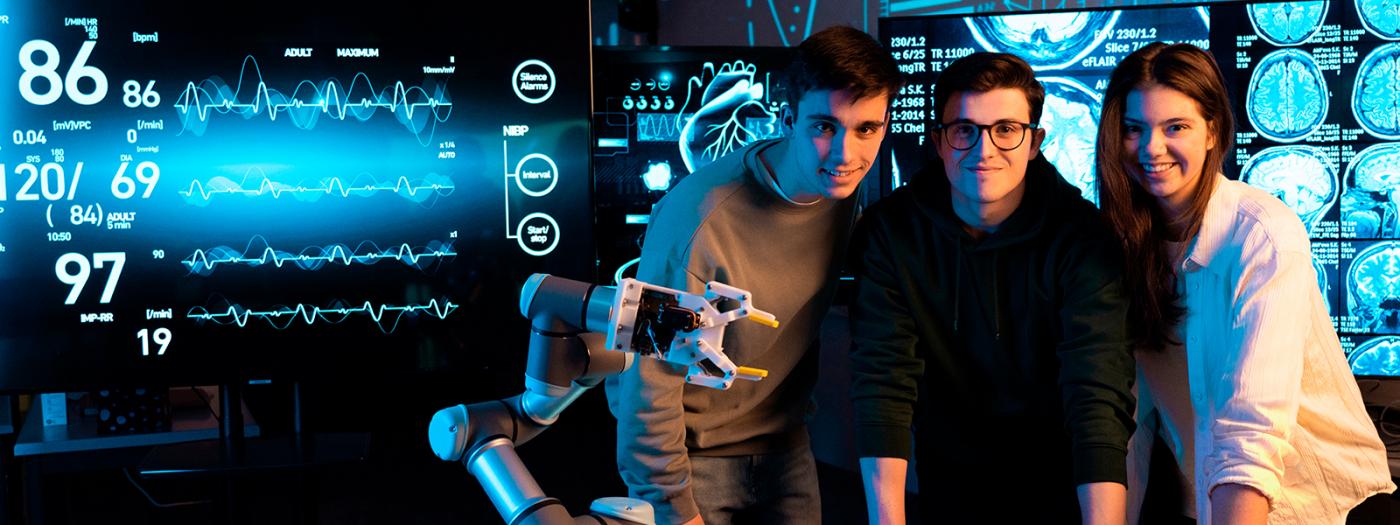
The Signal and Systems Analysis subject represents, for the student, an introduction to the methods of processing analog and digital information in one dimension, contextualized in the acquisition and processing of signals from the human body.
The objective of the subject is to provide an introductory and fundamental view of the mathematical tools that allow the analysis of analog and digital signals, the conversion from the analog world to the digital, and the modeling and representation of signal processing systems, whether in their digital or analog version.
Thus, the student will be able to learn how to process analog and digital signals using linear and time-invariant systems, and the processing is shown using techniques in the time domain and the frequency domain, both at an analytical and numerical level. It also offers a view of the Z transform, another very useful tool when designing filters and analyzing the behavior of digital systems. Finally, a brief introduction is given to the main methods for the design of different filters used in the processing of linear and time-invariant systems.
Despite being a subject with a strong mathematical component, the concepts studied have clear real and practical application in the field of Health Engineering. To make this clear, from a practical point of view, some of the concepts studied will be applied to the processing of biomedical signals acquired with a BIOPAC system.
Titular Professors
Single variable integral and differential calculus.
Students acquire the learning outcomes and develop the skills indicated below:
1. They know the basic signals from biological systems
2. They acquire quality biomedical signals
3. They understand the basic principles of biomedical signal processing
4. They acquire general knowledge of signal processing and transmission
Unit 1: Introduction to signals
Unit 2: Introduction to systems
Unit 3: Convolution and correlation
Unit 4: Fourier transform
Unit 5: Z transform and filter design
The subject is taught in 5 weekly teaching sessions of 50 minutes each. The usual dynamics of each class will consist of a combination of theoretical explanations always followed by the performance of exercises that exemplify what has just been explained. Applied methodologies: lecture, recorded class, problem class and exercises. Finally, and with the aim of achieving an applied vision of the concepts presented in class, practical sessions will be held using the BIOPAC signal acquisition systems and the Matlab software. Applied methodology: laboratory practices.
The assessment elements of the subject are:
- exams: midterm, final (ordinary and extraordinary seasons)
- continuous assessment exercises carried out in class
- laboratory sessions
The following will be assessed:
- Rigor in the application of signal analysis methods: the correct use of signal representation techniques in the time and frequency domains, and the appropriate justification of the procedures used in transforms (Fourier, Z).
- Precision in the characterization of systems: the ability to determine temporal and frequency responses with mathematical coherence, and the correct identification of system properties.
- Capacity for conceptual modeling and interpretation: the deep understanding of the behavior of linear systems, both analog and digital, and the ability to relate mathematical models to real physical and technological behavior.
- Competence in the use of software and hardware tools for the acquisition and processing of biomedical signals: the appropriate use of analysis software (MATLAB) and signal acquisition hardware (BIOPAC) to validate results, and correctly analyze the coherence between analytical and real results.
- Quality in reasoning and technical communication: the clear and structured organization of the procedures and solutions provided, and the ability to interpret and communicate results with precision and terminological correctness.
- Practical application in technical situations: the ability to select or design signal processing strategies appropriate to basic engineering problems, and the functional interpretation of filters, converters, and typical elements of signal processing systems.
- K. Najarian, R. Splinter, Biomedical signal and image processing, CRC Press
- T.K. Rawat, Signals and systems, Oxford University Press
- A.V. Oppenheim, A.S. Willsky, Señales y sistemas, Prentice Hall
- A.V. Oppehheim, R.W Schafer, Discrete-time signal processing, Prentice Hall
The essential documentation for following the subject is the material that the teachers will make available to the students through eStudy:
- Lecture slides
- Recorded lectures
- Collection of solved problems
- Lab sessions documentation