
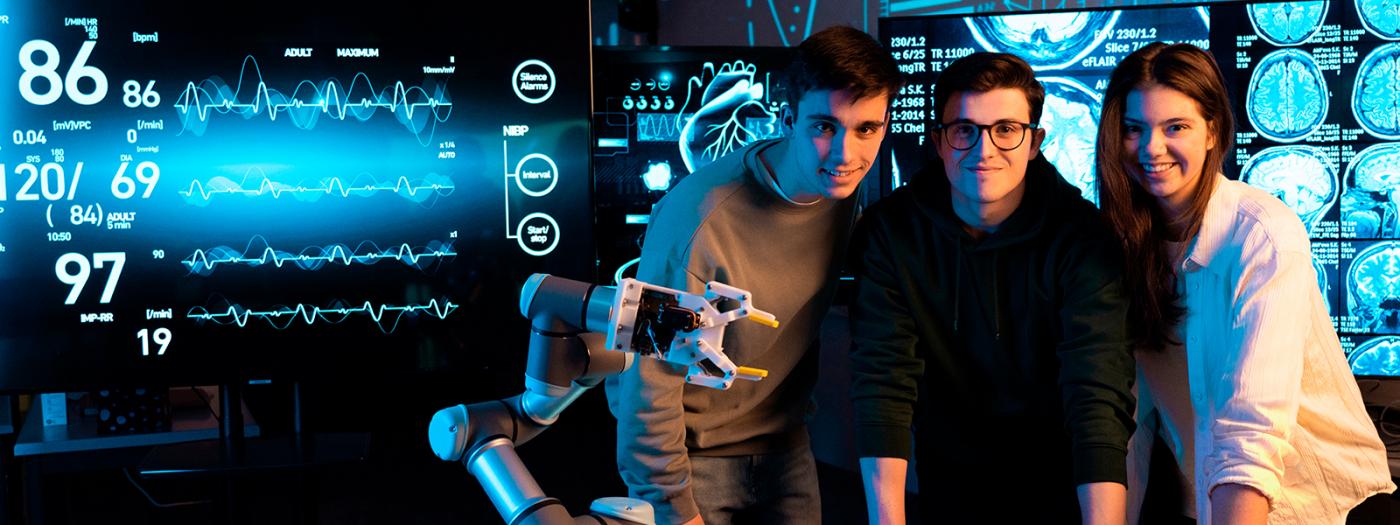
The Bio-orthopedics course provides students with the foundational knowledge and practical tools in biomechanics and orthoprosthetic devices. It introduces the principles underlying the design, development, and manufacture of orthotic and prosthetic solutions. The course also explores the mechanisms and applications of advanced technologies, including robotic, bionic, and exoskeletal systems, aimed at enhancing patient functionality and quality of life. In addition, it addresses the growing role of 3D printing, both in rapid prototyping and in the production of final, patient-specific devices.
Titular Professors
It is advisable to have previous knowledge of anatomy, biomechanics and materials.
Bio-Orthopedics is a subject that includes these 3 core aspects simultaneously.
The objectives of the course are:
1. Demonstrate the ability to evaluate and analyze physical problems that require the application of prostheses, orthoses, exoskeletons and bionic devices.
2. Know how to design, develop and evaluate new models of prostheses, orthoses, exoskeletons or bionic devices specific to each person.
1. Classification and description of orthoses and prostheses.
2. Physical qualities and functional capacities: evaluation, detection of injuries, and determination of the most appropriate prostheses and orthoses for each person.
3. Analysis of prostheses and orthoses for daily life activities, both in the work environment and in recreational and sports tasks.
4. Structure and function of prostheses and orthoses for the lower limb and the upper limb.
5. Models of robotic, bionic prostheses and exoskeletons.
6. Design of prostheses and exoskeletons.
The teaching methodology is based on an active and theoretical-practical approach aimed at the progressive acquisition of the learning outcomes defined for the Bio-orthopedics subject. The subject is developed through a weekly operation of two teaching sessions of 50 minutes each, in which theoretical exposition activities, practical application and active participation of the students are combined.
The usual dynamics of the sessions are structured in three distinct phases. In the first third of the class, the teacher introduces and develops the fundamental theoretical contents of the subject through master classes, providing the necessary knowledge for the understanding of the key concepts in bio-orthopedics.
In the second third of the session, students work individually or in groups in the preparation of assignments and presentations, often based on learning from real problems or cases. This phase encourages autonomous learning, critical thinking and the ability to apply theoretical contents practically.
In the last third of the class, students present their work and share it with the rest of the group. This phase includes the resolution of doubts, collective debate and, in certain sessions, practical activities with devices specific to the field of bio-orthopedics, thus promoting the consolidation of learning and the development of professional skills.
The methodology therefore integrates theoretical exposition, autonomous and collaborative work, as well as practical application through real cases and the use of devices, ensuring coherence between the training activities, the evaluation system and the expected learning outcomes.
Students will be assessed through a continuous and global evaluation of knowledge and competencies in Bio-orthopaedics, including progress quizzes, active participation, and a final integrative exam, with defined weightings between continuous assessment and the final exam, requiring a minimum grade in continuous assessment to calculate the overall mark, and with a single theoretical exam accounting for 100% of the grade in the resit examination.
Assessment will consider participation in practical activities, acquisition of theoretical knowledge, and the ability to apply it in real bio-orthopedic situations, including configuration and selection of prostheses and orthoses, materials analysis, use of robotic and myoelectric devices, with a final integrative exam and a minimum continuous assessment required for the final grade.
1) AAOS Atlas of Orthoses and Assistive Devices. 4th Edition - June 24, 2008
Authors: John D. Hsu, John Michael, John Fisk.
2) Atlas of Orthoses and Assistive Devices. 5th Edition - January 25, 2018
Authors: Joseph B. Webster, Douglas P. Murphyhang, Raymond. Química. 11ª ed. McGraw-Hill; 2013.
3) Amputación de extremidad inferior y discapacidad. Prótesis y rehabilitación, M.A. González Viejo, O. Cohí Riambau, F. Salinas Castro. Masson S.A.,
Barcelona (2005).
4) The Journal of Prosthetics and Orthotics.
5) Prosthetics and Orthotics International Journal. ISSN: 0309-3646. ISSN en línea: 1746-1553. Frequency: 6 times/year. Impact Factor: 1.4
In eStudy, students have:
- Recorded classes.
- Class presentations.
- Documents and/or attachments.