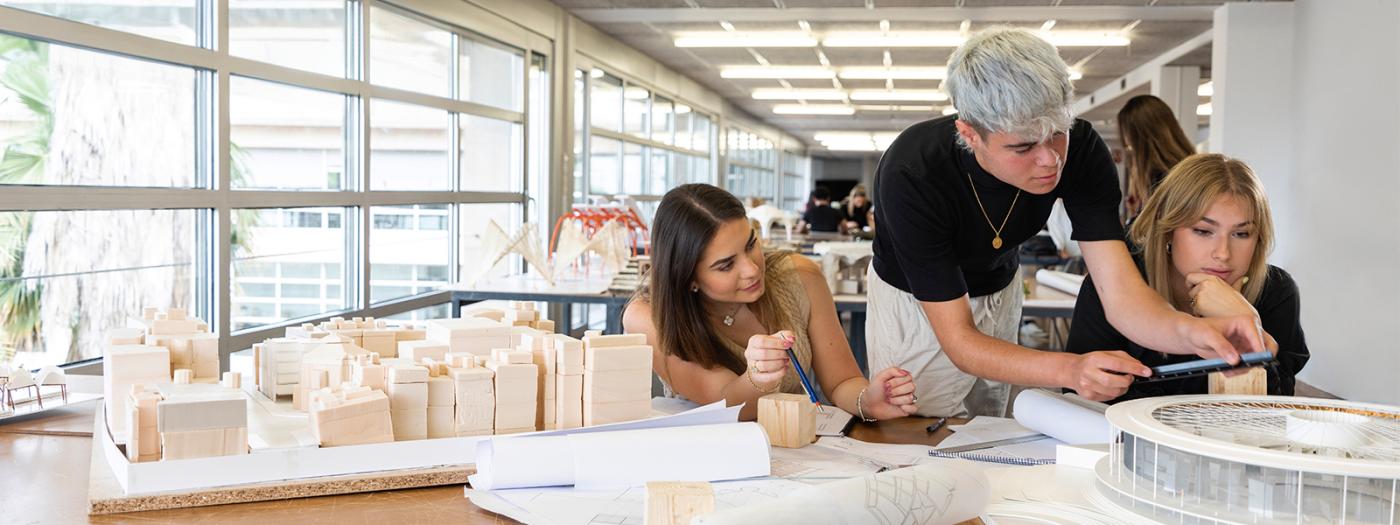
The Project Unit —Unit— develops tectonic architectural projects in which technical and design considerations are articulated as interdependent aspects of the design process. The course consolidates the competencies acquired in previous courses and directs them towards a design practice that combines technical-constructive rigour, precision in the development of details, and a project-based approach at the 1:1 scale.
Projects explore the application of a specific technique, approach, or construction system, incorporating it as a generative and structuring principle of the architectural proposal.
The course promotes research by design as a methodology that integrates critical reflection, conceptual exploration, and technical-constructive experimentation throughout the project development process.
The Matter Unit approaches materiality as both a field of technical research and a project tool, in which material properties, construction techniques, and construction systems become the conceptual framework for the development of the architectural project.
Unit-Specific Information
Please refer to the appendix corresponding to the Unit-specific syllabus, which further develops the thematic approach and provides detailed information on learning activities, submissions, assessment criteria and methods, scheduling, and bibliography.
The specific syllabus for the Unit does not replace this syllabus; rather, it complements and further develops it at an operational level.
Students will find the Unit-specific syllabus on the course website.
Knowledge of the conception and development of architectural projects grounded in a technical, constructive, and material understanding of architecture, as well as a project-based approach at the 1:1 scale.
Knowledge of the graphic and technical representation of construction and structural systems, materiality, sustainability, and environmental design strategies.
The course aims to enable students to:
- Integrate technical aspects from the conception to the development of the architectural project, producing coherent, sustainable, and context-responsive solutions.
- Incorporate research as an active tool within the design process, deepening technical-constructive knowledge and approaching the project at the 1:1 scale.
- Consolidate rigorous methods for the representation and communication of the architectural project, from the conceptual dimension to the technical-constructive definition, including the development of detail.
1. Conceptual Framework of the Tectonic Project
- Relationship between project, technique, and form
- Principles of constructive honesty and essentiality
- Technique and detail as generators of the project
2. Design Research Methodologies
- Research-through-design strategies (research by design)
- Definition of conceptual criteria derived from research
- Formulation and development of the project through the integration of the investigated technique
3. Technical Development of the Project
- Development of technical solutions
- Technical and constructive definition
- Detail development
4. Experimentation and Validation of Design Solutions
- Production of digital models and/or physical models and prototypes (mock-ups)
- Verification, evaluation, and adjustment of solutions
- Iteration and refinement of design solutions
5. Representation and Communication of the Project
- Representation of the design concept
- Graphic development and technical-constructive definition
- Comprehensive communication of the project
6. Specific Technical Topics for Project Development
- Principles of materiality and earth-based construction techniques
- Properties, behaviour, and performance of earth as a project material
- Application of earth-based construction systems in the architectural project
Unit-Specific Information
Please refer to the appendix corresponding to the Unit-specific syllabus, in which these topics are further developed.
The course is structured around a project-based learning methodology that promotes research by design. Throughout the semester, students develop a project focused on materiality, aimed at acquiring and applying the technical knowledge associated with this field.
The learning activities are organised around theoretical seminars, project-based activities, reviews and guided studio work, combined with independent student work. This structure supports a progressive and continuous learning process focused on the development of the design process and the gradual achievement of the learning outcomes defined for the course. Activities include both collaborative work, undertaken partially in groups, and individual work.
Within this methodological framework, students engage with this Unit with the aim of transferring, adapting, and applying previously acquired knowledge to new contexts, fostering versatility, autonomy, and critical thinking.
As a result, the course promotes the cross-disciplinary integration of technical, construction-related, and design knowledge, while broadening the competencies developed throughout the programme.
In this way, the course ensures that, by the end of the cycle, students will have engaged with more than one technical and design approach associated with the Tectonic Project, developing advanced competencies in architectural project development from this disciplinary perspective.
Assessment for this course is based on a continuous assessment system that reviews students’ work throughout the semester and culminates in a final submission.
Assessment will take into account both the development of the design process and the quality and coherence of the outcome. It will also combine the evaluation of collaborative and individual work.
Assessment instruments consist of three partial submissions (including the Mid-Term) and one final submission. Assessment will be based on the work undertaken and active participation in class sessions, project development and progress, presentations and discussions, the quality of the research, the graphic and written documentation produced throughout the development of the project, and the development of physical and/or digital models related to the subject matter under study.
The assessment criteria are aligned with the defined learning outcomes, ensuring their progressive assessment through partial submissions and the final submission. These criteria consider both the working process —development, active participation, and the ability to integrate feedback from the teaching staff— and the outcome of the project.
Special attention will be given to students’ ability to develop complex project proposals integrating project-based research, conceptual, technical, contextual and environmental criteria, as well as critical positioning and design autonomy.
The following aspects will be assessed:
- Rigour in the analysis of the context and the ability to translate it into clear and well-founded project criteria.
- Conceptual clarity of the project and consistency in the relationship between idea, materiality, and technique, as well as the rigorous and relevant integration of research and references within the design process.
- Coherence between form, materiality, and technical and constructive resolution, as well as the effective integration of passive strategies and sustainability criteria.
- Precision and clarity in representation, both in digital and physical models (models and/or mock-ups), together with rigour in graphic representation, technical and constructive definition, and detail development.
- Zumthor, P. (2006). Thinking Architecture (2nd ed.). Birkhäuser.
- Zumthor, P. (2002). Pensar la arquitectura (J. Pérez, Trad.). Gustavo Gili.
- Frascari, M. (1984). The tell-the-tale detail. VIA: The Building of Architecture, 7, 22–37.
- Frascari, M. (2001). El detalle delator. En A. Crispiani (Ed.), Aproximaciones: De la arquitectura al detalle (Arte–Arquitectura, Vol. 10). Ediciones ARQ, Facultad de Arquitectura, Pontificia Universidad Católica de Chile.
- Pallasmaa, J. (2009). The Thinking Hand: Existential and Embodied Wisdom in Architecture. Wiley.
- Pallasmaa, J. (2022). La mà que pensa: Saviesa existencial i corporal en l’arquitectura. Gustavo Gili.
- Hegger, M., Fuchs, M., Stark, T., & Zeumer, M. (2008). Energy Manual: Sustainable Architecture. Birkhäuser.
- Frampton, K. (1995). Studies in Tectonic Culture: The Poetics of Construction in Nineteenth and Twentieth Century Architecture. MIT Press.
Unit-Specific Information
Please refer to the appendix corresponding to the Unit-specific syllabus, which details the bibliography for the course.