
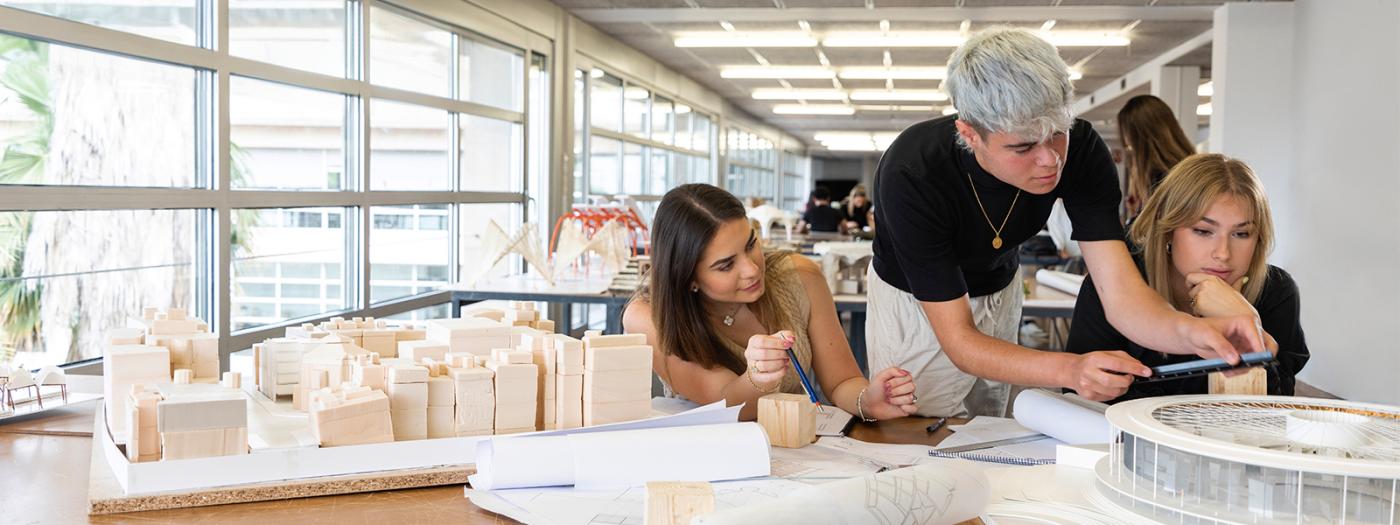
Architectural Design II is a research laboratory, which continues from Architectural Design I, and whose aim is to give content and form to different eco-social trends in continuous transformation. The studio is structured incrementally, in both scale and complexity, and through different FORMATS of reflection-representation, it positions the student as responsible for their own research line.
Titular Professors
Professors
It is required that the student has drawing skills to express his/her ideas and to explain them graphically.
The Objectives of this subject are based on the idea of acquiring the foundations to: understand project-based research as a methodological process; integrate eco-social, technical, material, and cultural conditions into the proposal; use reflection-representation formats; develop projects with increasing scale and complexity; and demonstrate autonomy, critical capacity, and communication skills in defining a personal line of research.
Architectural Design II is a research laboratory aimed at giving content and form to different eco-social trends in continuous transformation. The studio is structured incrementally, in both scale and complexity, and through various formats of reflection it places the student as responsible for their own line of research.
The laboratory puts forward, as a hypothesis, a future altered by socio-climatic conditions, where alternatives to dwelling are proposed in connection with proximity-based leisure, considered both as a fundamental right and as a response to a context of crisis.
It is therefore proposed to reimagine temporary and semi-permanent collective organizations that are respectful of the environment in which they are situated, and that simultaneously define the architectures necessary for the celebration of a FESTIVAL, which each student must choose.
The course follows a cumulative and incremental structure, both in scale and complexity, with the aim of defining, through different partial and complementary exercises, the proposal of the FESTIVAL. Each semester (Architectural Design I and II) presents 5 complementary and incremental exercises, which must be understood as 10 consecutive exercises that will ultimately define a single proposal. Since they are complementary, each new submission may lead to the redefinition of previous ones, culminating in the final submission of each semester.
The course follows a cumulative and incremental structure, both in scale and complexity, with the aim of defining a single proposal built from the sum of partial and complementary approaches. In this way, each new submission may lead to the redefinition of previous ones, culminating in the final submission of each semester.
The course fosters collective debate to encourage critical thinking and, in doing so, provide students with autonomy in defining their own line of research. The role of the professors, therefore, is to work alongside the students to help refine questions and answers related to each proposal. In this sense, and in order to deepen knowledge of project-related conditions — social, energetic, technical, environmental, and morphological — the course includes a series of lectures connected to the topics and exercises, as well as a site visit at the beginning of each semester.
To stimulate debate, all proposals generated in the studio are made visible by displaying them on the walls, thus creating a large mosaic of A2 sheets. This format allows for an easy identification of themes and formats, while also encouraging discussion among studio students, invited guests, other students of the school, and professors.
Submissions take place on a weekly or biweekly basis and are preceded by a theoretical session delivered by the professors themselves. Deadlines will be announced throughout the semester, thereby avoiding a “photo finish” effect. On submission days, exercises must be uploaded to eStudy within the stated deadline and in PDF format.
Studios are organized in pairs, each with two professors and approximately 20 students assigned. Depending on the exercise, students will work individually or in pairs.
Class attendance is mandatory; missing more than 20% of sessions, even with justification, will result in a “not presented” (fail to appear) grade for the course.
The evaluation of the student’s work is based on their ability to respond to the proposed assignments, their reflection on the problem, their capacity to define how the work should be oriented, and its overall development. Personal engagement and the presentation of the project are also valued.
Professors will consider the student’s ability to give form and content to their line of research, their ability to reflect on the initial data, and their organizational, management, and development skills, as well as their communication. Class attendance is essential for the proper follow-up of the course.
Evaluation criteria for project assignments:
- ANALYSIS AND APPROACH (20%): context, objectives/approach
- PROJECT DEVELOPMENT (40%): concept evolution, program adequacy, structure/definition/construction
- PRESENTATION (30%): graphic presentation, model presentation.
- ENGAGEMENT (10%): defense, participation/attendance
The assessment of each activity in the course is:
- Exercise 1 (10%)
- Exercise 2 (15%)
- Exercise 3 (15%)
- Exercise 4 (20%)
- Exercise 5 (25%)
- Evolution (15%)
Abalos, Iñaki. Palacios comunales atemporales. Puente Editores, 2020. ISBN 9788412198119
Banham, Reyner. Los ángeles, la arquitectura de cuatro ecologías. Puente editores, 2016. ISBN: 9788494527401
Bow Wow. Made in Tokio. Kajima Institute Publishing, 2001. ISBN 4306044211
Herrero, Yayo. Toma de tierra. Caniche, 2023. ISBN: 978-84-125833-0-4
Hertzberger, Herman. Lessons for students, NAI, 2016. ISBN: 978-94-620-8319-6
Koolhaas,Rem . Elements of Architecture. TASCHEN, 2017. ISBN: 978-3-8365-5614-9
Latour, Bruno . Habitar la tierra. ARCADIA / ATMARCADIA, 2023. ISBN: 9788412592658
Perec, Georges. La Vida, instrucciones de uso. Anagrama, cop. 1992. ISBN 8433920588.
Sennett, Richard. Juntos:Rituales, placeres y política de cooperación. Anagrama. ISBN 9788433963482
Venturi, Robert. Complejidad y contradicción en arquitectura. Gustavo Gili, cop. 2021.ISBN/EAN: 9788425228285
Walker, Enrique. Lo Ordinario. Gustavo Gili, cop. 2010. ISBN 9788425223303.
-