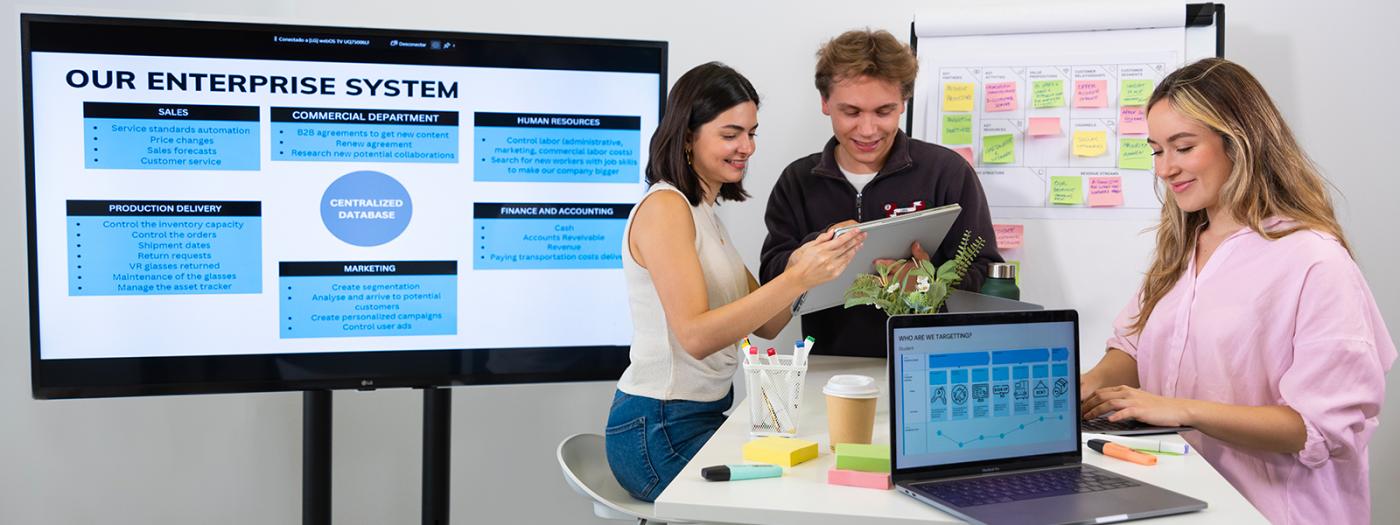
Technology is an essential part of any modern business nowadays, and amongst all new technologies, the Internet is clearly the most powerful, omnipresent, and the one which has the biggest potential to help make any business a successful one. Most of the most renowned young companies such as Google and Facebook have built their success around the Internet and the right multimedia technologies that have allowed them to reach all kind of users around the world, may it be through a computer, a handheld device, or any other interactive interface.
Titular Professors
Professors
None
Learning Outcomes of this subject are: To know the most relevant, state-of-the-art multimedia technologies especially those focused on online business. To acquire a general technological background which allows the students to decide which technologies are best suitable, and why, for supporting the success of a specific business. To increase the ability and skills necessary to use the Internet and multimedia technologies to work collaboratively and find solutions to arising challenges. To work hands-on on a software project related to the Internet and multimedia technologies, in order to better understand the process and costs of general software development. To obtain a general understanding on the difference in terms of internal technology and development between web applications and mobile native applications. To be able to develop web application interfaces and mobile apps using the appropriate software tools available. By the end of this course, students should be able to have achieved the objectives set up for this course and have developed the competencies listed above. In summary, they will have gained a broad knowledge from a technical point of view about current multimedia technologies which can be used through the Internet to boost any business. This will be especially useful to help to the conception of new technology-based businesses and understanding the process of any multimedia application development.
- Fundamentals of business requirements analysis and project management
a. Documentation of business needs
b. Standards that could be used to represent the desired properties of the final product
c. How to weigh business needs and balance resources to achieve the desired outcomes
d. Basic concepts of project management - Video creation
a. Learning to edit video with Adobe Premiere Pro
b. Creating simple videos with clips, music, text, and graphics
c. Aspects to consider: the script, the message, the objective of the video, and its duration - Website creation
a. Introduction to the Internet
b. Basic HTML
c. Structure of web pages / websites
d. Navigation and usability
e. Design, hosting, and publishing - App creation
a. Introduction to mobile-related issues
b. Web app frameworks for mobile devices
c. How to enhance the user experience in mobile applications
d. How to manage multiple platforms - Use of Artificial Intelligence tools in the execution of all the previous activities.
1 weekly session in which master classes and individual and group activities are combined. Homework will be assigned individually, and group work progresses throughout the semester. 1. Lectures: The teacher presents theoretical concepts while showing examples and answering to students' questions. 2. Laboratory practices: The teacher proposes some topics to research, experiment or to work on, and the students use the lab computers to perform the requested tasks, individually or collaboratively, depending on each case. 3. Individual exercises: These will be short assignments which will be proposed periodically during lectures or laboratory classes. 4. Learning based in projects/challenges - Group project: A final project will be developed through the course. It will involve the proposal and development of a webpage (including a mobile version). Video content is a must in the final delivery. The teams will also propose a planning and development schedule, assign and distribute tasks, coordinate the different roles, analyze and evaluate the process, and propose recommendations. The teams will present their projects at the end of the semester.
40% Individual activities and deliverables.
10% Attendance and participation.
20% Midterm Group Project presentation.
30% Final Group Project.
Criteria | Accomplished 90-100% | Proficient 80-89% | Partially Proficient 60-79% | Marginal Fail 50-59% | Fail < 50% |
Knowledge 20% | Excellent understanding of the topic area with significant links made relevant to the proposed plan.
Extensive research and analysis for the proposed solution. | Demonstrates reasonable evidence of knowledge and understanding of key concepts discussed in the module. Good analysis for the proposed solution. | Fair evidence of topic knowledge from the module, although some significant gaps for the analysis. Limited evidence of research and reading. | Very limited evidence of understanding of applications of the topic elements in the context of the proposed plan. | No evidence of understanding of applications of the topic elements in the context of the proposed plan.
No evidence of research and reading. |
Clarity. Appropriate introduction, body, and conclusions; logical ordering of ideas. 20% | Ideas are presented in logical order with effective transitions between major ideas; presentation is clear and concise. | Most ideas are in logical order with adequate transitions between most Major ideas; presentation is generally clear and understandable. | Some ideas not presented in proper order; transitions are needed between some ideas; some parts of presentation may be wordy or unclear. | Ideas are not presented in proper order; transition are lacking between major ideas. Several parts of presentation are wordy or unclear. | No evidence of proper ideas. Most parts of presentation are unclear and under developed. |
Completeness. Level of detail, depth, appropriate length, adequate background of information 15% | Presentation provides good depth and detail; ideas well developed; facts have adequate background; deep understanding of the topic and proposed solution. | Presentation provides adequate depth; few needed details are omitted; major ideas adequately developed; fair understanding of the topic and proposed solution.
| Additional depth needed in places; important information omitted or not fully developed; gaps shown in proposed solution.
| Presentation does not provide adequate depth; key details are omitted or undeveloped; poor evidence of topic understanding.
| Presentation does not provide adequate depth, or details are omitted or undeveloped. No evidence of topic understanding.
|
Visuals 10% | Professionally designed. Attractive, relevant and add to understanding. Support the development of the presentation | Professionally designed but there are too many (some irrelevant) or are missing. Support the development of the presentation | Visuals are well designed. Generally support the argument, but some are irrelevant or unclear | Visuals are mundane and not always relevant to the presentation development. Fewer than 5 spelling mistakes | Visuals are poorly designed, containing only words and are used as notes. More than 5 spelling mistakes. Relevance is not clear |
Content 20% | The content is clear, well developed and interesting. Conclusions are clearly justified. Appropriate language style and shows thorough, in-depth understanding of the subject area | Competent development of content showing in-depth knowledge of subject area. | The content is clear showing knowledge of the area. Improvements would help to justify conclusions | The content is generally clear but there are gaps in the development or information which is not relevant is given too much importance | The content is a simple repetition of written work with no amendments to language or style. The development is confusing and does not justify conclusions |
Questions and answers 15% | The student showed in-depth knowledge, was well-prepared for the questions and expanded answers in-depth showing ownership of the subject area. | The student was well prepared to answer questions and showed in-depth knowledge of the subject area. Expanded on answers | The student was able to answer the questions, but did not expand on question areas | The student attempted to answer the questions but not always appropriately | The student was unprepared and unable to answer pertinent questions |
None
None