
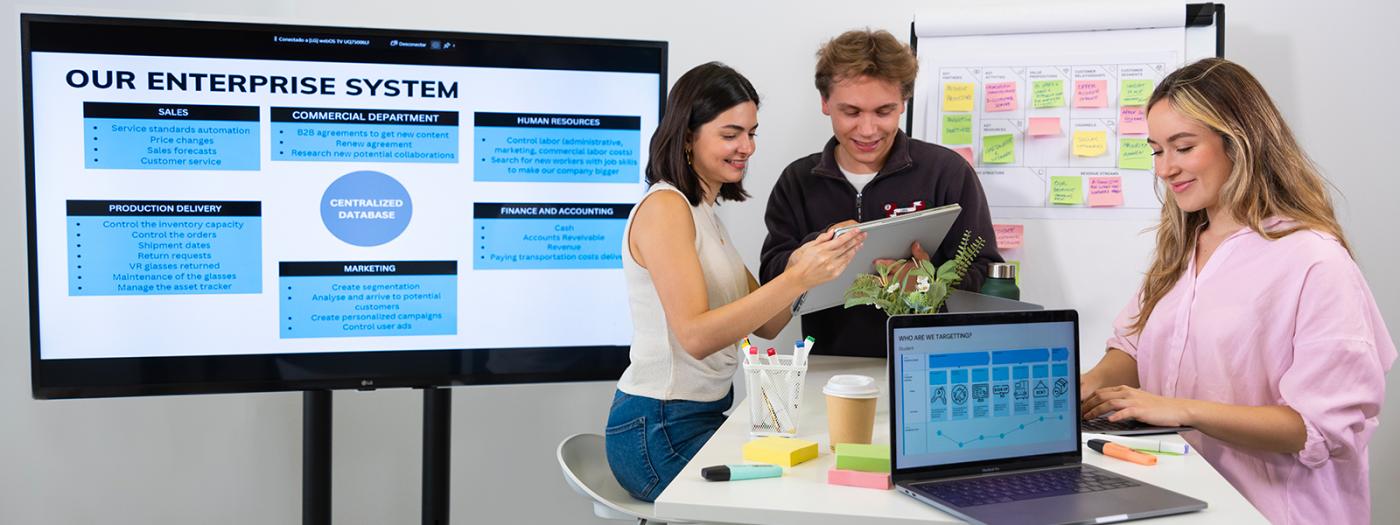
This course is an introduction to creating social impact through entrepreneurship. Several social and environmental challenges can be resolved using business models, that are often easier to scale up and address the problem in its entire dimension. You will explore the concept of social entrepreneurship through examples and cases. You will then engage in a journey to create a venture that addresses a social problem with a team. You will start by selecting and analysing a social issue and its levers of change to make sure a relevant problem is addressed. Then, you and your team will design one or more business models that could be tested with real potential customers and stakeholders, and review it accordingly. The course will combine the actual work on designing a social venture, with the analysis of practical real-world cases and the learning of a few useful tools that are essential for social entrepreneurs. A final presentation of social ventures will be made to real impact investors.
Titular Professors
Professors
The course will explore topics that students have encountered in courses on entrepreneurship and innovation.
The goal of this course is to equip students with the mindset, knowledge, and practical approach needed to address social and environmental challenges through entrepreneurship. It aims to foster critical thinking, creativity, and a strong sense of social responsibility, while guiding students in transforming ideas into viable and impactful solutions. Through experiential learning, the course encourages students to engage with real-world problems and develop initiatives that generate sustainable social value.
Main topics covered in the course:
- Introduction to the Course
- Systemic Thinking
- Starting to Think About Solutions
- Design Thinking
- About the Solution
- Midterm
- Theory of Change (ToC)
- Value Proposition, Mission, Vision and Values
- Benchmark
- Financial and Challenge Explanation
- Final Pitch
- Special Guest
- Final Exam
A. Reading assignments: read text assignments prior to class and be prepared to discuss the text material, work on the cases and answer instructor questions orally with well-organized thoughts and ideas.
B. Class attendance: you are expected to attend each class period, be on time and stay the full class period or be counted absent. You are responsible for all course material missed due to absence.
C. Case studies: we will work around some case studies, reproducing the complexity of real-world projects, and invite you to debate and co-design the best solutions to them. Case studies will invite you to reflect and consolidate learning based on action-oriented challenges combined with essential knowledge and lessons learnt.
D. The main project we will work on throughout the course is making some initial steps in designing a social impact venture, from analyzing an issue, to generating ideas, developing its impact and business models, collecting information from potential stakeholders, evaluating impact, and planning scale. Each team of 3-5 students will work on a project and make a final presentation on the last day of the course.
E. Some classes will include instruction from the professor on specific tools that should help students approach the case studies in a structured manner and with rigor. These tools must be used in the design of the main project. All tools will be illustrated through case study and real-world examples.
F. Speaking practice, listening comprehension exercises, grammar exercises, writing, reading, and interactive exercises.
The final grade is composed of:
a) Attendance and class participation (10%)
b) Continuous assessment (30%)
c) Challenge (15%)
d) Midterm (15%)
e) Final presentation (30%)
Please take this level into account when using artificial intelligence tools, as it defines the expectations and requirements you will need to meet throughout the semester.
Level 3
AI for Editing
The use of AI is allowed to improve writing, clarity, grammar, punctuation, or wording, but not to generate new content.
Students must submit original work and include the initial version, prior to the use of AI, as evidence of the editing process.
RULES AND DISCIPLINARY ACTIONS FOR CHEATING
There are different types of cheating and each has its own protocol and disciplinary procedures.
Premeditated cheating: cheating which involves a premeditated action in the assessment activity or exam. Forexample:
- in an exam: take written materials to the exam (“crib sheets”), communicate with someone outside the examhall, pretend to be someone else, use an electronic device which is forbidden (mobile phone, tablet, laptop...) which enables the Student to store information or make contact with someone outside the exam hall, etc.
- submission of assignments or practical work: submit work (programmes, codes, audio-visual material ordesigns) which has been partly or completely undertaken by another person, etc.
- any type of plagiarism in an assessment activity, etc.
Unpremeditated cheating: cheating which occurs in the course of an assessment activity which has not beenpreviously prepared. For example:
- Talking in an exam or test
- Look at the exam of another person
- Give another student information, etc.
Type of activity
Highly important academic activity: assessments whose type (importance in marking system, obligatory nature, workload, etc.) are very important in the marking system. Examples of highly important academic activities: exams(mid-term exams, semester exams, final exam sessions and re-takes), compulsory coursework, assignments or practicals which count for a significant percentage of the final mark, etc.
Moderately important academic activity: assessments whose type (importance in marking system, obligatory nature, workload, etc.) are not very important in the marking system. Examples of moderately important academic activities: activities with continuous assessment tests, optional coursework which count for a moderate percentage of the final mark, etc.
| PREMEDITATED CHEATING | UNPREMEDITATED CHEATING |
Highly important academic activity | Serious misconduct | Serious misconduct |
Moderately important academic activity | Serious misconduct | Minor misconduct |
The sanctions associated with the severity of cheating are as follows:
- Very serious misconduct: the student is awarded a mark of 0 as the final course mark of that official examination session, the student cannot take the following official examination session (No Presentat/Noshow) and a disciplinary file is included student’s academic records.
- Serious misconduct: the student is awarded a mark of 0 as the final course mark of that official examinationsession and the student cannot take the following official examination session (No Presentat/No show.
- Minor misconduct: qualification of 0 for the continuous assessment activity in question.
If considered appropriate, sanctions for minor misconduct can be substituted by education sanctions. In order to do this, a disciplinary procedure will be opened.
THE USE OF ARTIFICIAL INTELLIGENCE TOOLS
Artificial Intelligence (AI) can help in the learning process, but we must make a proper use of it. Students who opt touse an AI in their work are required to include a paragraph at the end of the task or activity in which they have used said tool and explain why they decided to use it and the results obtained from it. Failure to include this informationwill be considered as an attempt at fraud or cheating as it deceives the Evaluation System. In such cases, the penalites set out in Salle Campus Barcelona Copies Regulations will be applied.
1. Hidalgo, G., Monticelli, J. M., & Vargas Bortolaso, I. (2024). Social capital as a driver of social entrepreneurship. Journal of Social Entrepreneurship, 15(1), 182-205.
2. Hossain, M. U., Arefin, M. S., & Yukongdi, V. (2024). Personality traits, social self-efficacy, social support, and social entrepreneurial intention: The moderating role of gender. Journal of Social Entrepreneurship, 15(1), 119-139.
3. Méndez-Picazo, M.-T., Domingo Ribeiro-Soriano, D., & Galindo-Martín, M.-Á. (2015). Drivers of social entrepreneurship. European Journal of International Management, 9(6), 766-779.
4. Phillips, W., Lee, H., Ghobadian, A., O’Regan, N., & James, P. (2015). Social innovation and social entrepreneurship: A systematic review. Group & Organization Management, 40(3), 428-461.
5. Weerakoon, C. (2024). A decade of research published in the journal of social entrepreneurship: A review and a research agenda. Journal of Social Entrepreneurship, 15(2), 377-399.
6. Joshi, K., & Khare, P. (2024). The role of local connections in network configuration: A case of social enterprise in India. Journal of Social Entrepreneurship, 15(1), 50-76.
7. Pham, L. X., Phan, L. T., Le, A. N. H., & Bui Ngoc Tuan, A. (2024). Factors affecting social entrepreneurial intention: An application of social cognitive career theory. Entrepreneurship Research Journal, 14(2), 5