
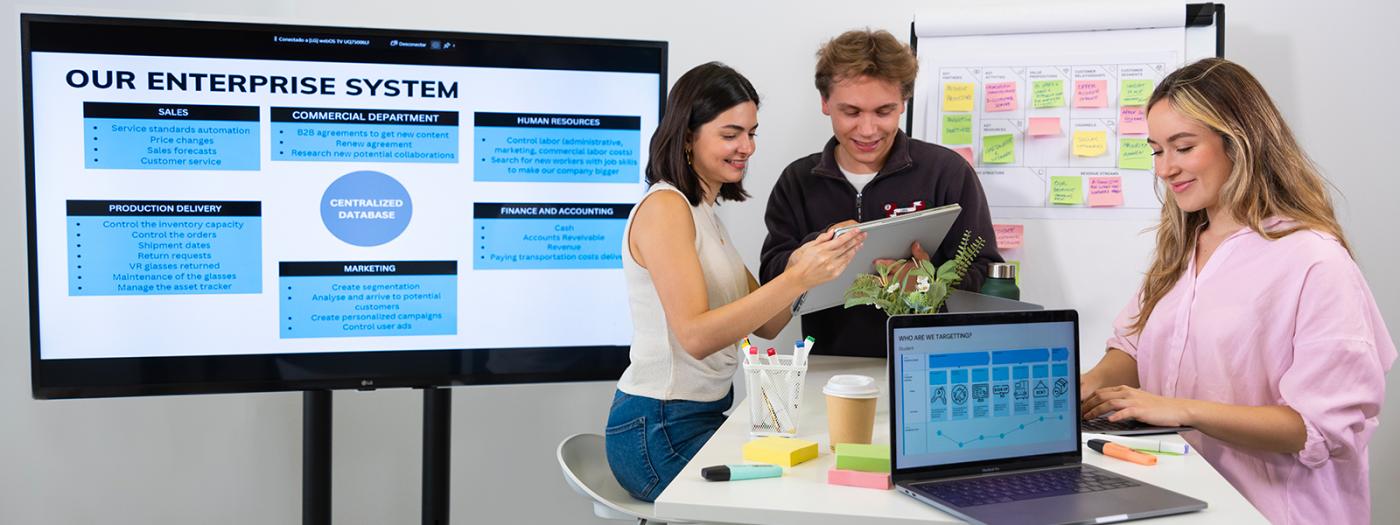
The Change Management subject gives a practical hands-on perspective of the Change Manager role, showing the most well-known strategies (as ADKAR and Kotter) for managing change initiatives in Organizations. Typically useful in Digital Transformation initiatives, the Change management discipline covers also other common scenarios like the implementation of a new software or management system in an organization (CRM, SAP, ERP…), the automation of processes, the implementation of AI or companies merge & Acquisition initiatives. Topics related to leadership and people management applied to change management are specially highlighted to focus on the management of the human side of this kind of special projects.
Students will act as change managers and, in class, will develop change management plans (which will be run in parallel with the project's technical management plans - part of the project manager role). AI tools will be used to bring key insights that complement these plans.
Titular Professors
Professors
None
- Understand the fundamentals, models, and methodologies of change management as applied to organizational and digital transformation processes.
- Analyze the impact of change on individuals, teams, and the organization, identifying factors that facilitate or hinder its adoption.
- Design change management strategies and plans that are aligned with project management and adapted to various organizational contexts.
- Develop leadership, communication, and stakeholder management competencies to facilitate the success of change initiatives.
- Utilize artificial intelligence tools to support analysis, planning, and decision-making in change management projects.
1. Course overview. Introduction to change management.
2. Change at the individual level.
3. Change management strategies: ADKAR.
4. Change management strategies: Kotter.
5. Leadership in change management.
6. Change management plans enhanced by AI tools.
7. Other change management strategies.
The teaching methodology used in the on-campus modality is based in learning by doing:
• The class dynamic consists of continuous iterations of knowledge pills (the teacher explains concepts related to the theme of the day) and exercises: debate, individual and group exercises on a real change initiative on projects. In this way, the concepts covered during the session are taken to a practical environment to strengthen the student's learning.
• In the end of the session, students do a wrap-up “take home message” exercise to share the main insights learned.
• The slides also include external links with complementary an in-depth information regarding the considered topics in the session.
[A] Attendance, Classwork, and Participation – 30% (Individual Work)
[B] Exams – 30% (10% Midterm and 20% Final)
[C] Group Case Studies – 40% (Team Project)
USE OF ARTIFICIAL INTELLIGENCE (AI) TOOLS
Level: Level 2
Category: AI for Idea Generation and Structure
Students may use AI tools for brainstorming, creating outlines, obtaining initial guidance, or receiving suggestions for organizing their work, but not for drafting the final content.
AI may only be used as preliminary support. The final submission must be entirely the student's own work and must not include AI-generated text.
In courses or learning activities where the use of AI tools is explicitly prohibited, any use of such tools will be considered academic misconduct and the sanctions established in the (https://www.salleurl.edu/en/copies-regulation).
1. Hiatt, J. (2006). ADKAR.
2. Kotter, J. P. (2012). Leading Change.
3. Bridges, W. (2019). Managing Transitions.
4. Burnes, B. (2017). Managing Change.
5. Cameron, E., & Green, M. (2024). Making Sense of Change Management.
6. Kotter, J. P., & Cohen, D. S. (2012). The Heart of Change.
1. Burke, W. W. (2018). Organization Change.
2. Cummings, T. G., & Worley, C. G. (2019). Organization Development and Change.
3. Heifetz, R. et al. (2009). The Practice of Adaptive Leadership.
4. Schein, E. H., & Schein, P. (2017). Organizational Culture and Leadership.