
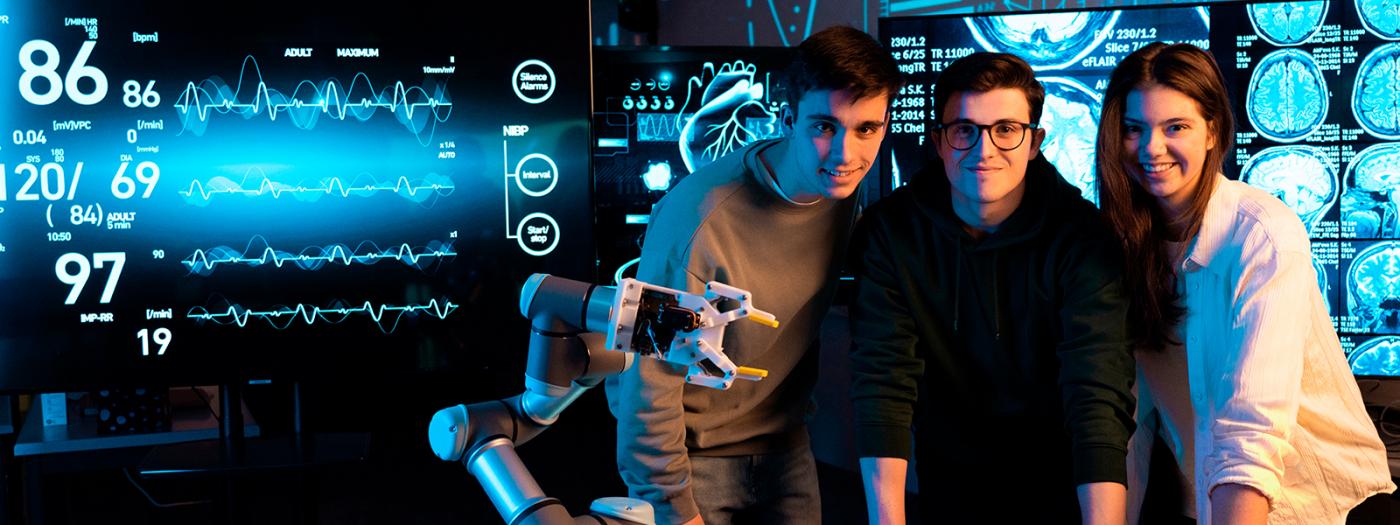
This course introduces the fundamental principles of omics sciences (genomics, transcriptomics, proteomics, and metabolomics) from an engineering perspective, integrating bioinformatics, data analysis, modelling, and computing. The course focuses on the computational processing of real omics data, the design of bioinformatics pipelines, and the quantitative interpretation of results, preparing students to work in biotechnology, healthcare, biomedical research, and the biodigital industry.
Object-Oriented Programming, Biostatistics, Databases, Chemistry and Biochemistry, Human Anatomy, Human Physiology, Pathophysiology, Medical Image Processing, Personalized Medicine.
The objectives of the course are:
- Explain the biological foundations of the main omics technologies.
- Analyze genomic, transcriptomic, and proteomic data using bioinformatics tools.
- Design and execute reproducible omics analysis pipelines.
- Interpret omics results from an engineering and systems biology perspective.
- Work with real data, biological databases, and scientific software.
- Block 1 – Introduction to omics sciences
Concept of omics biology and precision medicine.
Types of technologies: genomics, transcriptomics, proteomics, and metabolomics.
Differences between clinical data and experimental omics data.
Structure of typical file formats: FASTQ, BAM, VCF, GTF/GFF, MGF, and mzML.
- Block 2 – Genomic data analysis (DNA-seq)
Quality control (FastQC).
Alignment (BWA, STAR).
Variant calling (GATK).
Association analysis.
Filtering and annotation (ANNOVAR, VEP).
Variant interpretation and connection with Personalized Medicine.
- Block 3 – Transcriptomic data analysis (RNA-seq)
Alignment/pseudo-alignment (STAR, Salmon).
Expression quantification.
Normalization and batch correction.
Differential expression analysis (DESeq2, edgeR).
Clustering and dimensionality reduction.
- Block 4 – Computational proteomics and metabolomics
Mass spectrometry data structure.
Identification and quantification of peptides and proteins.
Sources of variation in proteomics.
Proteomics–metabolomics integration (PCA, PLS-DA).
- Block 5 – Reproducibility and pipelines
Workflow concepts (Snakemake, Nextflow).
Computational documentation (RMarkdown, Jupyter).
Good practices for biomedical data science.
Ethics and responsible management of biomolecular data.
The course on Omics Data Analysis will combine theoretical sessions with continuous assessment, consisting of various knowledge integration activities. These activities will include guided problem-solving and practical case studies, computational exercises using real omics data, and project-based learning. Activities will be proposed both for classroom work and independent study, with the aim of encouraging active student participation. The final group project will consist of the design and implementation of an omics data analysis pipeline, including result interpretation and the preparation of a technical report.
The assessment will be carried out continuously and globally through bioinformatics practical sessions, the development of an applied group project, and a final conceptual and applied examination. Both the progressive acquisition of knowledge and competencies and the ability to analyze and interpret omics data using bioinformatics and computational tools will be assessed.
In the extraordinary examination period, the activities that have already been passed will be retained, and the recovery of the learning outcomes not achieved will be assessed.
The student’s ability to analyze, process, and interpret omics data using bioinformatics, statistical, and computational tools will be assessed, applying appropriate methodologies in genomics, transcriptomics, proteomics, and metabolomics. The design of reproducible pipelines, the integration of biomedical data, the technical quality of reports, and the ability to communicate results with scientific rigor will also be evaluated, as well as collaborative work and the responsible use of biomolecular data.
- Pevsner, J. Bioinformatics and Functional Genomics. Wiley.
- Kappelmann-Fenzl, M. (2021). Next Generation Sequencing and Data Analysis. Springer.
- Rodríguez-Ezpeleta, N., Hackenberg, M., Aransay, A. M. (Eds.). (2012). Bioinformatics for High Throughput Sequencing. Springer.
- Arivaradarajan, P., Misra, G. (Eds.). (2019). Omics Approaches, Technologies and Applications: Integrative Approaches for Understanding OMICS Data. Springer.
- Lin, S., Scholtens, D., Datta, S. (2023). Bioinformatics Methods: From Omics to Next Generation Sequencing. Chapman & Hall/CRC.
- Mandoiu, I., Zelikovsky, A. (Eds.). (2016). Computational Methods for Next Generation Sequencing Data Analysis. Wiley.