
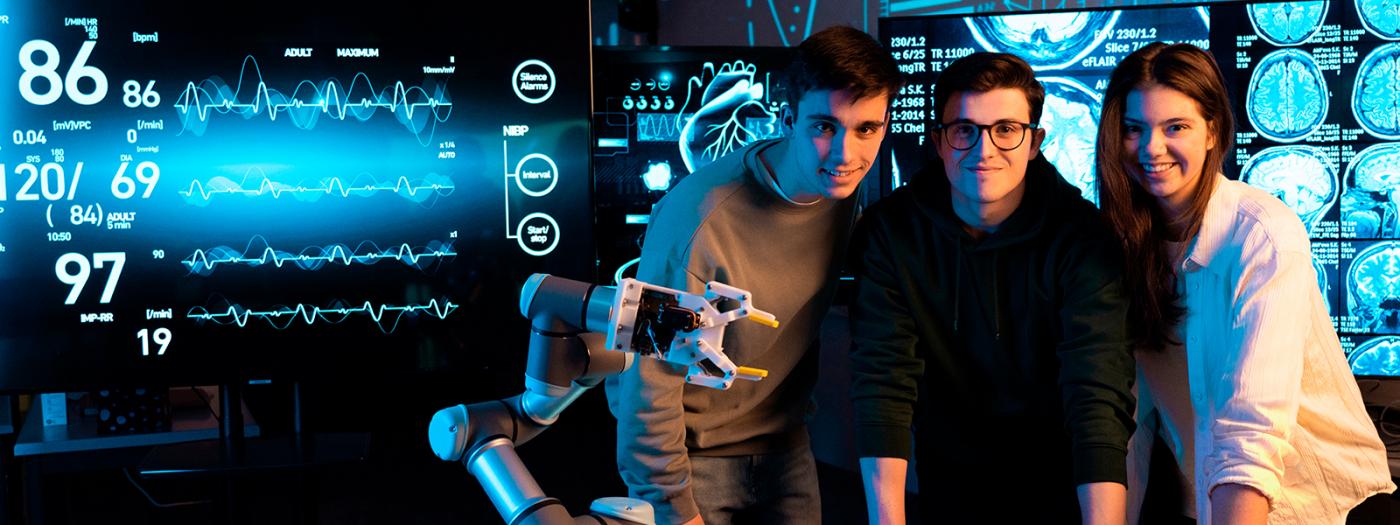
Biomedical sensors are those electronic devices capable of measuring relevant magnitudes about the health status of a patient. Due to the latest advances in manufacturing technology and materials science, sensors play a key role in all aspects of medicine and care, such as prevention, diagnosis, monitoring and treatment. This subject, therefore, is aimed at knowledge of the different types of biomedical sensors and signal conditioning techniques.
Titular Professors
It is recommended to have prior knowledge of analog electronics.
Students acquire the knowledge and develop the skills indicated below: 1. Learn about the latest technologies in biomedical sensors . 2. Design analog and digital electronic circuits for sensors and medical instrumentation. 3. Implement technological solutions related to medical sensors .
Lesson 1. Introduction to Biomedical Sensors
Lesson 2. Operation principles of biomedical sensors
Lesson 3. Measurement of basic magnitudes: amplifiers and signal conditioners
Lesson 4. Interference, noise and isolation
Lesson 5. Frequency response - filters
Lesson 6. ADC – Analog-to-Digital Conversion
Lesson 7. UX/UI – Data presentation
Lesson 8. Digital sensors, RFID, GPS
The methodology used in the Biomedical Sensors subject combines lectures with the solution of practical problems and continuous assessment exercises that the student must solve alone or with the help of classmates or the teaching team of the subject. The content acquired in face-to-face classes is reinforced with group practices, case studies and collaborative projects where they must design, analyze, integrate and/or evaluate sensors in specific health applications, thus promoting critical thinking, problem solving and the connection between theory and practice. This mixed approach ensures a deep understanding of the role of sensors in the field of health engineering.
Overall qualification of the subject
The grade of the subject is made up of three well-differentiated parts that must be passed independently with a minimum grade of 3.5 for the exams and 5 for the practical grade (with the exception of the Participation Grade):
Subject Grade: 70% Exam Grade + 25% Practical Grade + 5% Participation Grade
Both the Assessment tests and the lab exercises are evaluated based on the correctness of the answers provided or obtained.
- Togawa, Tatsuo; Tamura, Toshiyo; Öberg, P. Ake. Biomedical sensors and instruments [online]. 2nd ed. Boca Raton: CRC Press, 2011.
- Webster, John G. Medical instrumentation : application and design. 4th ed. Hoboken: Wiley, 2009. ISBN 9780471676003.
- Sensors and Signal Conditioning. Second Edition. Ramon Pallàs-Areny, John G. Webster, John Wiley & Sons, 2001, Cap. 7, pp. 403-421.
- Pallás Areny, Ramón. Sensores y acondicionadores de señal. 4ª ed. Barcelona: Marcombo Boixareu, 2003. ISBN 8426713440.
It is not required