
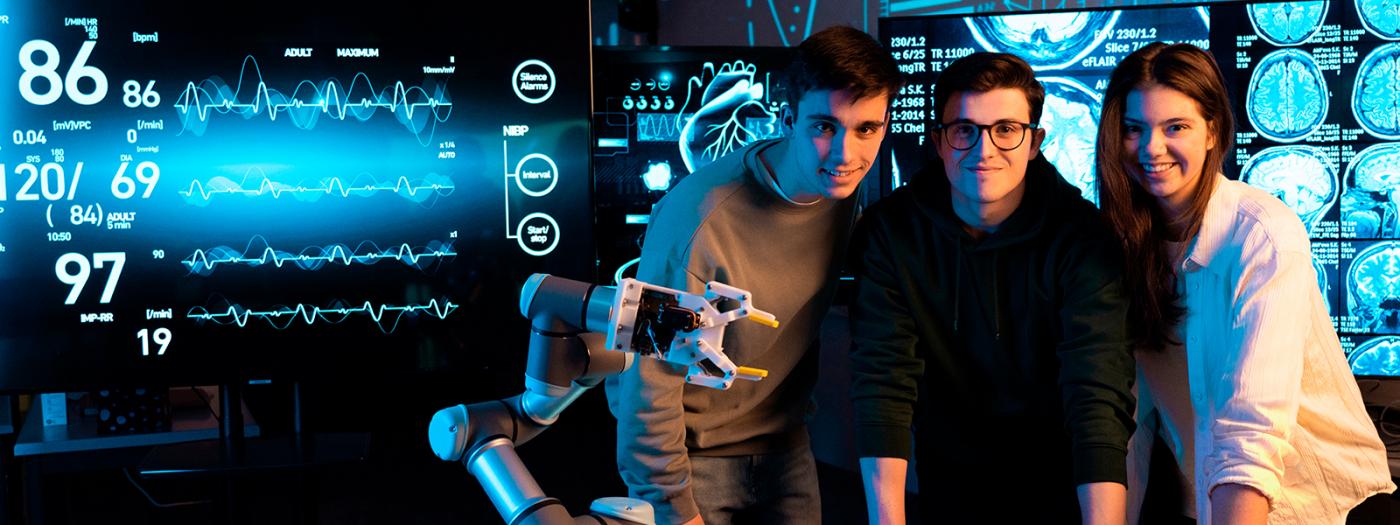
The Biomedical Signals and Instrumentation course focuses on equipping students with the essential knowledge to understand, acquire, and process biomedical signals. Through the study of analog and digital signals, as well as the exploration of electronic transducers, students will become familiar with the specific characteristics of biomedical signals from diagnostic systems. The course also covers principles of biomedical instrumentation, recording techniques, and the use of oscilloscopes. Through practical examples in areas such as electromyography and other applications, students will apply their knowledge, focusing on solving real-world problems in the acquisition and processing of biomedical signals.
Titular Professors
Human Anatomy, Human Physiology, Biomedical Sensors, Electronics.
The objectives of the course are:
1- To develop the ability to understand, analyze, and interpret biomedical signals, as well as to foster critical thinking and teamwork skills.
2- To understand basic signals from biological systems and acquire them with sufficient quality for proper analysis.
3- To understand and apply the basic principles of biomedical signal processing using software tools with a practical approach.
The course is divided into 5 modules, each containing several topics. These are described below:
1) MODULE 1: Fundamentals of Biomedical Instrumentation (Origin of Biopotentials, Human Biopotentials, Physiological Signals, Transducers, Temperature Measurements)
2) MODULE 2: Measurement of Non-Electrical Parameters and Diagnosis (Cardiac Measurements, Pulmonary Function Measurements, Blood Gas Analysis)
3) MODULE 3: Measurement of Electrical Parameters and Analysis (Electrical Devices, Sensors, Amplifiers, Signal Filtering, ECG, EMG, EEG, Typical Waveforms, Safety)
4) MODULE 4: Imaging and Analysis (CT Scan, MRI, Ultrasound)
5) MODULE 5: Therapeutic Devices (Defibrillator, Transcranial Magnetic Stimulation, Ultrasound, Hemodiafiltration, Mechanical Ventilation)
The methodology used in this subject will divide the classes into two types: theoretical and laboratory. The theoretical classes will be taught in a masterly way with the description of the theoretical content of the subject with user cases that will serve to deepen and establish the theoretical content. User cases will be proposed for various topics for the students to carry out and solve at home in order to carry out a continuous evaluation. Likewise, during some lectures, problems/mini-tests will be proposed so that the student can participate actively. The practical laboratories will be based on the content taught during the year and specific hardware and software tools will be used. All classes and laboratories are face-to-face and are always done with the teacher at the side to advise on what is necessary.
Students will be assessed through a continuous and global evaluation of their performance by combining exam results and continuous assessment components, including in-class activities, laboratory practicals, and coursework, with defined weightings and minimum requirements in theoretical exams to integrate the remaining components and pass the course, as well as opportunities for resit in the extraordinary examination period.
Assessment will consider the understanding and interpretation of biomedical signals, the ability to analyze and process them using software tools, methodological rigor, signal acquisition quality, and clarity in presenting results.
- J. G. Webster and A. J. Nimunkar, Medical Instrumentation: Application and Design, 5th ed. Newark: John Wiley & Sons, Incorporated, 2020. - L. A. Geddes and L. E. Baker, Principles of applied biomedical instrumentation, 2. ed. in A Wiley-Interscience publication. New York: Wiley, 1975.
- D. V. Knudson, Fundamentals of Biomechanics, 3rd ed. Cham: Springer International Publishing AG, 2021. - J. J. Carr and J. M. Brown, Introduction to biomedical equipment technology, 4. ed. Upper Saddle River, NJ: Prentice Hall, 2001. - L. Cromwell, F. J. Weibell, and E. A. Pfeiffer, Biomedical instrumentation and measurements, 2nd ed. Englewood Cliffs, N.J: Prentice-Hall, 1980.