
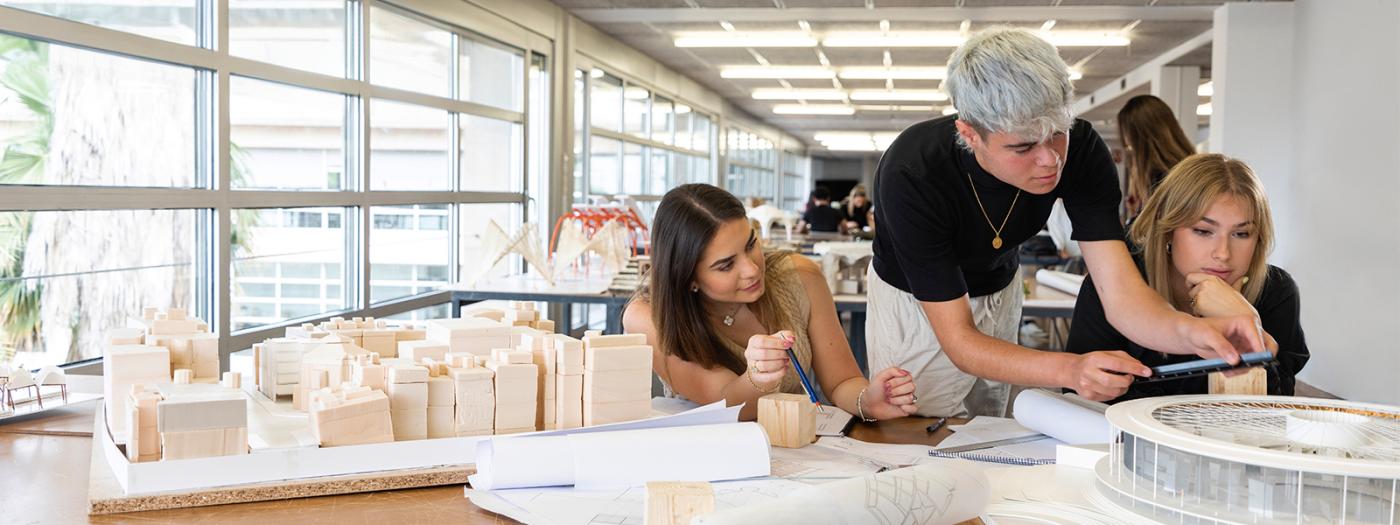
The primary objective of this introductory course is to introduce students to drawing as a means of analyzing architectural space. Through the progressive study of the object, the building, and the city, students develop an attentive, critical, and structured approach. Far from a digital approach, the course proposes a return to manual drawing as a fundamental tool for thought, expression, and learning. In line with the artistic and architectural practices, drawing is understood here as the place where observation, reason, and imagination intersect.
Titular Professors
Professors
Knowledge of basic concepts of drawing and other systems of representation.
RA.01 Imagine, translate languages, composition, logic and graphic tools. Draw action. Abstraction.
RA.02 Knowledge of perspective. Work time in architecture through changing spaces. Distorting is space to accommodate it in your interests. Act on the idea of drawing and thinking in motion, as in projecting. Work on the representation of the built space (volumes).
RA.03 Knowledge of the fine arts as a factor that can influence the quality of architectural design.
RA.04 Practice of perspective and mastery of drawing. Expressiveness. Color. let go, learn from your own mistakes and limitations, see space and architecture in action, find your personal graphic language. Work on the representation of living space (atmospheres)
RA.05 Be able to imagine and feel space from a 2D drawing, move it to 3D, and create an ecosystem that is not only volumetric but also sound. Abstraction with strokes and impulses (drawing action) and sound.
RA.06 Reflect on new forms of domesticity and the dimension of photography and performance as means of expression.
RA.07 Architectural communication. Architectural language. Dihedral. 2D. The floor.
RA.08 Architectural communication. Architectural language. Dihedral. 2D. The section. Materials. Construction.
RA.09 Project communication in architecture. Diagrams. Abstraction. Communication. Architectural language for the action of projecting
The course is structured into three progressive thematic units that allow students to develop an analytical perspective and a well-founded graphic practice, from observing simple objects to reading the complex urban fabric. Each of these units integrates technical, conceptual, and methodological content specific to architectural drawing as a tool for analysis, representation, and thinking.
Unit 1. The Object
Contents:
Direct observation of simple objects, still lifes, and found elements.
Representation systems: orthographic projection, conical perspective, and freehand sketches.
Introduction to texture, light, and line as expressive means.
Graphic analysis based on form, proportion, and geometry.
Intensive hand-eye coordination work as the foundation of drawing as a mode of thinking.
Specific Objective: Achieve basic mastery of representation systems and develop a structured capacity to observe simple forms.
Unit 2. The Building
Contents:
Graphic analysis of buildings through plans, elevations, sections, and perspectives.
References to Modern Movement works and architects such as Le Corbusier, Aalto, and Scarpa.
Fieldwork: visits to significant buildings in the city.
Optional transversal collaboration with the Architectural Design course.
Representation of architectural character: scale, structure, materiality.
Specific Objective: Understand drawing as a critical tool to decipher and communicate built architecture, as well as to establish spatial and conceptual relationships.
Unit 3. The City
Contents:
On-site drawing and urban reading from the mountain to the sea.
Graphic representation at an urban scale: territorial section, skyline, visual sequences.
Collaborative large-format composition (Kraft paper): collage of learned techniques.
Development of synthesis, selection, and graphic narrative skills.
Introduction to sensitive cartography, urban atmospheres, and density.
Specific Objective: Apply all learned techniques in an integrated way to produce a complex and shared representation of the territory, emphasizing a critical architectural perspective.
The course is structured around active methodologies focused on experiential learning and the progressive development of graphic skills applied to architectural analysis. The teaching approach aims to foster the acquisition of competencies through the constant practice of hand drawing as a fundamental tool for observation, reflection, and expression in architecture.
Practice-based learning: The in-person sessions are primarily focused on practical drawing exercises, guided by the teaching staff, which allow students to develop skills in representing architectural space.
Theory-practice classes: The classes combine brief conceptual content with directly related practical activities, facilitating the immediate application of knowledge and promoting an integrated understanding of drawing as a tool for análisis.
Continuous critical review: Collective and individual review sessions are held at the beginning of each class, promoting formative assessment, critical thinking, and the continuous improvement of students? work.
Collaborative Learning: Especially during the final phase of the course, group work dynamics are incorporated, promoting cooperation, the exchange of ideas, and the integration of diverse skills.
Direct Observation and Geometric Representation Exercises: Assignments focused on the graphic analysis of real objects, using representation systems such as orthographic projection, axonometry, and conical perspective.
Graphic Study of Buildings: Development of plans, elevations, sections, and perspectives of selected architectural works
On-site Urban Readings: Field trips in the urban environment aimed at interpreting and graphically representing complex spatial structures using sketching techniques, graphic annotation, and manual survey methods.
Work Dossier: Individual preparation of a notebook or dossier compiling all exercises completed during the course, integrating technical precision and graphic sensitivity.
Final Collective Project: A group synthesis exercise developed on a continuous medium (Kraft paper), representing an urban section from the mountain to the sea, using mixed techniques and diverse graphic resources.
The assessment of the course is carried out continuously and takes into account all learning activities developed both inside and outside the classroom, in line with the progressive and practical nature of the course.
Activities subject to evaluation include:
?Completion of the graphic exercises corresponding to each of the three course levels (object, building, city).
?Active participation in classroom dynamics and critical reviews.
?Mandatory class attendance (minimum 70% of sessions).
?Participation in the transversal activity Aula BCN.
?Final exam at the end of the semester.
Evaluation Criteria by Topic: Each topic (Object, Building, City) is graded as follows:
?80%: learning activities and graphic production (studio exercises, on-site drawing, individual and collaborative assignments).
?20%: attendance, attitude, and participation in sessions (minimum 70%).
All learning and assessment activities are individual, except for those exercises specifically designated as collaborative (such as the final project of Topic 3 ? City). In these cases, group work will be evaluated collectively, but individual performance within the group may also be assessed.
Any evidence of copying, plagiarism, or misuse of third-party materials without citation in individual activities may result in a grade of 0 (zero) and/or the application of the University?s current disciplinary regulations.
Collaborative activities must ensure an equitable distribution of tasks and include shared authorship in the submissions.
Evaluation Criteria for Aula BCN ? Transversal Activity Aula BCN is a common activity for all first-, second-, and third-year courses, consisting of a transversal action of recognition and interpretation of the metropolitan territory. Active and reflective participation in this activity will account for 5% of the final grade of the course.
Evaluation Criteria for the Final Exam The final exam will take place between January 19 and 23, 2026, and will consist of a practical representation exercise that integrates the contents covered during the semester. This exam is mandatory for all students and represents 15% of the final grade.
Evaluation Criteria for the Resit Exam In the event of not passing continuous assessment, the student must take an extraordinary resit examination.
If the attendance or participation requirements have not been met, the student will also be required to submit a complementary graphic assignment, which will be announced at the end of the course and delivered on the same day as the exam.
-Campo Baeza, A. Pensar con las manos. Ed. Nobuko, Argentina (2009)
-Campo Baeza, A. El Bisturí en la línea. Ed. Universidad de Alicante (2018)
-Berger, J. Modos de ver. Ed. Gustavo Gili, Barcelona (2016)
-Pallasma, J. Los Ojos de la piel. Ed. Gustavo Gili, Barcelona (2005)
-Ministerio del Poder Popular para la Cultura. Instituto de las Artes de la Imagen y el Espacio, La Luz y la Sombra en el Dibujo, Ed. Parramon, Barcelona (2005)
-VVAA, Arquitectura: Más por menos. Ed. Fundación Arquitectura y Sociedad, Madrid (2010)
-Cezanne Site/Non-Site. Ed. Museo Thyssen-Bornemisza, Madrid (2014)
-Ortega y Gasset, J. La Deshumanización del Arte. Ed. Austral, Barcelona (2016)
-Kandinsky, W. De lo espiritual en el arte. Ed. Premia, México (1989)
-Luis Trillo de Leyva, J.L y Martinez García Posada, A. La Palabra y el Dibujo. Ed. Lampreave , Madrid (2012)
About general drawing knowledge:
Ching, Frank. 'Manual del dibujo arquitectónico'. 3a ed. rev. amp. México D.F: Gustavo Gili, 1992.
Ching, Frank. 'Dibujo y proyecto'. Barcelona: Gustavo Gili, 1999.
Schaarwachter, Georg. Perspectiva para arquitectos'. Barcelona: Gustavo Gili, 1969.
Magali Delgado, Ernest Redondo. Dibujo a mano alzada para arquitectos'. Barcelona: Parramón, 2004.
Nicolaides, Kimon. The natural way to draw'. Boston: Houghton Miflin Company, 1969.
Eissen, Koos. Presenting architectural designs'. London: Architecture Design and technology press, 1990.
Crowe, Norman and Paul Laseau. Visual notes'. Melbourne: Van Nostrand Reinold Company, 1984.
Heuser, Karl Christian. Freehand drawing and sketching'. Melbourne: Van Nostrand Reinold Company, 1980.
Berger, John. Sobre el dibujo'. Editorial Gustavo Gili, SL, 2011.
Berger, John. Berger on Drawing'. Occasional Press, Cork, en 2005.
Pallasma, Juhani. La mano que piensa. Editorial Gustavo Gili, SL, 2012
On other issues:
Ruskin, John. Les tècniques del dibuix'. Barcelona: Laertes 1999.
Ficacci, Luigi. Giovanni Battista PIRANESI'. Köln, London, Madrid, New York, París, Tokio: Taschen, 2006.
Cullen, Gordon. El paisaje urbano: tratado de estética urbanística'. 6a ed. Barcelona: Blume: Labor, 1974.
Mc. Luhan, Marshall & Fiore, Quentin. The medium is the massage. Ed. Penguin Books, 1967
Careri, Francesco. "Walkscapes. WALKING AS AN AESTHETIC PRACTICE", Ed. GG. 1985
Calvino, Italo. "Invisible Cities". Vintage Digital; New e. edición (14 diciembre 2010)