
| Modality | On-site |
|---|---|
| Duration | 10 Months |
| Language | English |
| Places available | 30 |
| Credits | 60-ECTS |
| Start Date | 19 October 2026 |
| Schedule | Weekday afternoons with some online sessions. |
| Location | Barcelona |
What if sound were much more than something you hear? Turn it into science, technology and impact.
Master the science of sound, audio and vibrations to tackle real-world challenges across industries such as manufacturing, construction, automotive, aerospace, transport and entertainment.
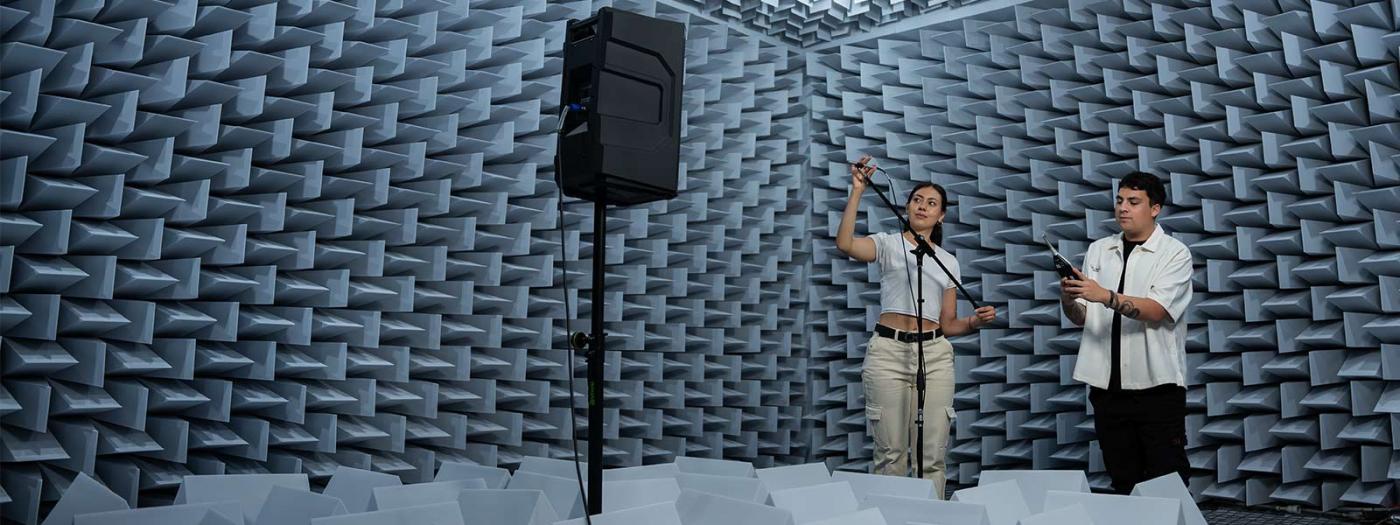
You will learn to tackle complex challenges through simulation, experimentation and artificial intelligence applied to audio. In a practical, international environment, you will have access to the Acoustics Lab and specialised spaces such as the anechoic chamber, reverberation chamber, recording studio and immersive room.
Sound has become a key dimension of technological innovation. It shapes mobility, architecture, industry, digital experience design and the creation of healthier, more efficient and more immersive environments.
With the Master's Degree in Acoustics, Audio and Vibrations at La Salle-URL, you will advance in a field that combines science, engineering and perception to tackle emerging challenges in the sector. The programme connects with trends such as spatial audio, machine listening, sound event detection, acoustic metamaterials, acoustic holography and advanced solutions for reducing noise and vibrations.
Why study at La Salle-URL?
Because the world needs professionals who can understand technology, question it and use it to create real impact.
Challenge-based learning with real-world projects
You will work on real projects and situations that bring you closer to the professional environment from day one.
A transdisciplinary ecosystem
You will collaborate with people from engineering, technology, architecture and business to learn how to solve complex challenges from different perspectives.
Technology with purpose
You will apply data, artificial intelligence and digital tools to develop solutions connected to the real needs of companies and society.
Direct connections with industry
You will engage with professionals, companies and projects that bring you closer to the job market and its real needs.
Barcelona as a living laboratory
You will study in a leading city for technology, entrepreneurship and innovation, connected to some of Europe's most dynamic digital and creative ecosystems.
Frequently Asked Questions about the Master's Degree in Acoustics, Audio and Vibrations (FAQS)
Why study a Master's Degree in Acoustics, Audio and Vibrations?
Because sound shapes how we live, move, work and experience the world. This master's degree allows you to specialise in a field that is key to designing solutions for noise, vibrations, sound quality and immersive experiences. Training that turns sound into applied innovation.
What makes this master's degree different from other master's degrees in Acoustics, Audio and Vibrations?
Its approach combines science, experimentation and advanced technology. You will work with numerical simulation, signal processing, artificial intelligence applied to audio and experimental techniques in acoustics and vibrations. You will also learn in La Salle-URL's Acoustics Lab, with spaces such as the anechoic chamber, reverberation chamber, recording studio and immersive room.
Who is it for?
It is designed for people with backgrounds in engineering, physics, mathematics or related technology fields who want to specialise in acoustics, audio and vibrations. It is ideal for those who want to apply sound to real-world challenges across sectors such as automotive, aerospace, construction, industry, transport and entertainment.
What will you learn?
You will learn to model sound and vibration propagation, apply acoustic measurement techniques, work with signal processing and artificial intelligence, and explore trends such as immersive audio, metamaterials, acoustic black holes, acoustic holography and sound quality. All through a practical, applied approach.
What career opportunities are available?
You can build your career as a noise control engineer, vibroacoustics specialist, acoustic consultant, sound engineer, aeroacoustics engineer, spatial sound designer, academic researcher or expert in psychoacoustics and sound quality. These profiles are increasingly in demand in industries seeking more efficient, sustainable and immersive environments.