
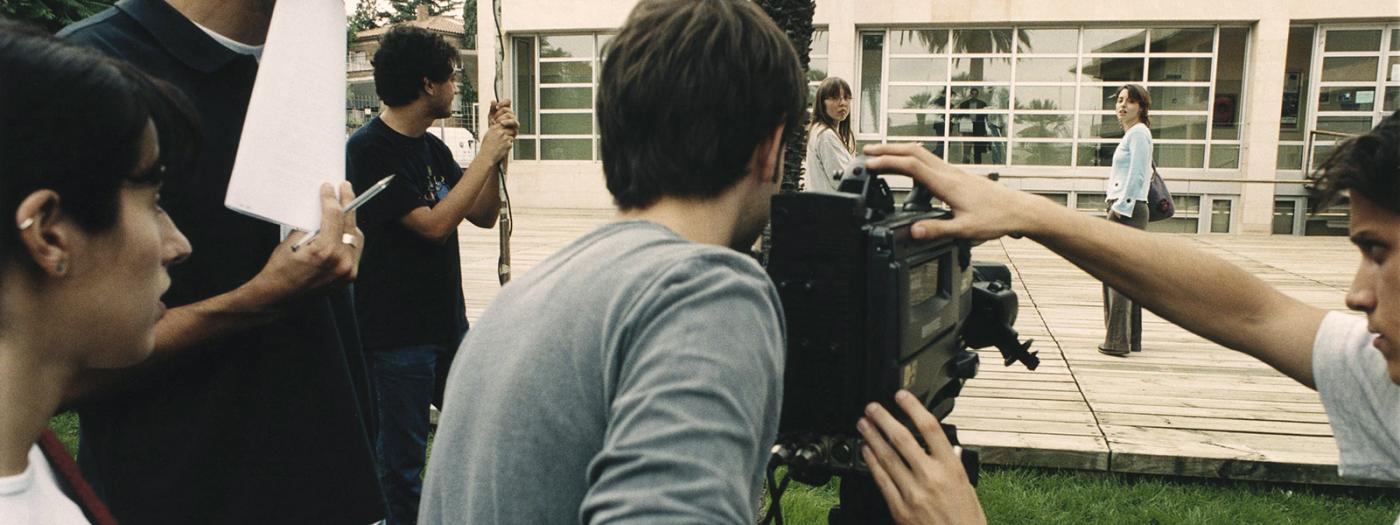
The Digital TV I subject introduces students to the world of video and television. It begins with an introduction to the concepts of visual perception and then moves on to the fundamentals of television, with a brief historical review from analog signals to digital video. The various video formats are reviewed and the concepts of video compression and the corresponding standards are introduced. Finally, the fundamentals of digital television transmission and video streaming over IP are reviewed.
Titular Professors
Basics electronics, basic mathematics and basic programming.
The objective of this subject is for the student to acquire basic knowledge of technologies related to television and video. The subject therefore achieves a double function, on the one hand, knowledge of audiovisual technologies that can be applied to various fields and, on the other, as a practical case of the use of the theory explained in other subjects, such as Signal Theory, Digital Communications, Electronics, Programming or Networks.
1. Introduction to television systems
Introduction to television systems reviewing the main parameters that will be addressed during the course.
2. Visual perception
Explanation of the visual experience and the parameters that make it possible to display moving images from discrete images. Tri-stimulus theory of color.
3. Fundamentals of the video signal
Historical review of the evolution of the television signal. Explanation of its generation, fundamental parameters and color insertion, digitization and video formats.
4. Video compression
Justification of the need for compression of the digital video signal. Types and compression techniques.
5. Introduction to TV transmission
Evaluation of the different types of methods for television transmission up to video streaming.
The methodology used in this subject combines sessions that use different methodologies. On the one hand, each main point of the syllabus is introduced through lectures. These lectures are followed by sessions that combine different active learning methodologies that allow the assumption and complement of the lecture knowledge, such as flipped classroom techniques, problem and exercise classes, small project classes or pair learning.
Within the sessions that are taught with lecture methodology, the theoretical content of the subject is explained and it is in the subsequent sessions where problems related to the theoretical content explained are raised and solved. For each block of the syllabus, model problems are proposed so that students become familiar with the theoretical concepts previously explained, and relate the different concepts explained throughout the course.
In addition to the exercise and problem classes, project or practical sessions are proposed. In order to carry out these sessions, students are structured in small groups. Throughout the course, each student must carry out 4 relevant practices. These practices will be carried out in class or in the laboratory in their introductory part where the teacher will pose the challenge, resolve doubts and the students will begin to develop the project or practice. Once the project has been started, the students must finish developing it outside of class hours. Each practice is accompanied by a statement that serves as a guide for the students. To solve the practices, the students must write a report for each of them. The practical part culminates with a group project where the students must solve a challenge on the subject matter.
On the one hand, theoretical knowledge is assessed through partial (control point) and final exams that are complemented by the continuous assessment grade. The objective of continuous assessment is for the student to consolidate the knowledge acquired through proposed problems and short controls in class. On the other hand, practical knowledge is assessed through the reports that students carry out individually through practical exercises (EPs) and group work through the final project.
The results obtained are evaluated according to the following objectives:
- The student must demonstrate that they have the necessary basic knowledge related to the subject
- The student must be able to solve and design any problem in the field of digital television that arises
- The student must have the ability to plan all the tasks related to the practice in order to be able to deliver them within the set deadlines
- The student must be accustomed to working with a computer and with programming (software development environments)
- The student must have the ability to organize in order to be able to work and promote teamwork. Likewise, this teamwork must allow them to acquire the necessary ability to apply the knowledge acquired in practice, solving any problem that may arise
- The student must have the ability, given the numerous information that is given to them to do the practical part, to know how to synthesize and apply the appropriate knowledge to resolve each problem.
L. Torres, Sistemas analógicos y digitales de televisión, Politext 4, Edicions UPC, 1993
H. Benoit, Televisión Digital, Editoral Paraninfo, 1998
Francesc Tarrés, Sistemas audiovisuales (1- Telvisión analógica y digital), Edicions UPC 2000
Haskell, Barry G. Digital video: an introduction to MPEG-2 , Ed. Chapman & Hall , 1997
Richardson, Ian E.G. H.264 and MPEG-4. Video Compression.Video coding for next-generation multimedia , Ed. Wiley, 2003