
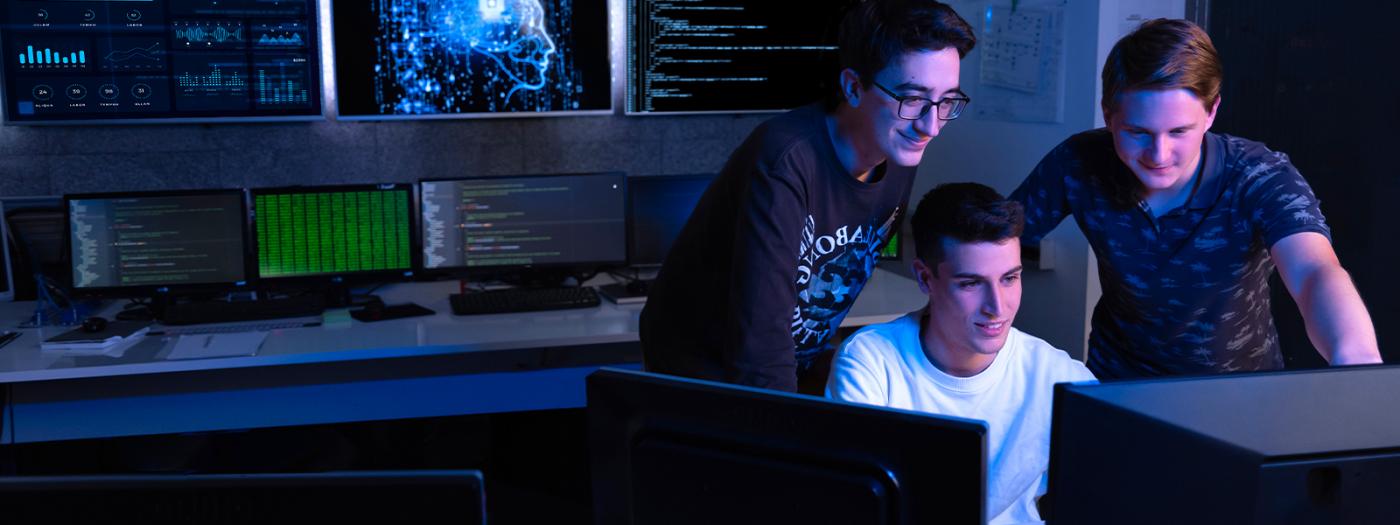
The subject of Digital Communications Laboratory is a practical course that instructs students to learn and become familiar with the elements and electronic systems involved in digital communications. Thus, the subject manages to be a link between the subjects of the telecommunications specialty and also reinforces and extends the theoretical knowledge acquired in this and other subjects in a practical way. The subject of Digital Communications Laboratory focuses specifically on the following areas:
- Optical Communication Systems.
- Simulation of RF systems.
- Radio Systems
- Systems of radio frequency and microwave
- Digital modulations
- Mobile communications
- Antennas
Titular Professors
Among basic concepts obtained in the previous courses, the student must have a basic knowledge of:
- Analog modulation.
- Transmission and reception systems.
- Superheterodyne receiver.
- The student must know and become familiar with the elements, devices, and electronic systems used in digital communications, particularly in areas such as optical systems, radio frequency, microwaves, digital modulation, mobile communications, and antennas.
- The student must be able to apply theoretical knowledge in a practical way, integrating it into the analysis and design of real communication systems.
- Develop proficiency in the use of instrumentation and measurement procedures in telecommunications, as well as the ability to correctly justify and interpret the obtained results.
- Acquire the ability to identify, configure, and parameterize commonly used components, circuits, and subsystems in telecommunications.
- Develop autonomous work and continuous learning skills through active participation in laboratory practices and effective use of available resources.
- Improve technical communication skills, both oral and written, clearly and accurately conveying results, procedures, and conclusions from laboratory activities.
The subject is a practical course that instructs students to learn and become familiar with the elements and electronic systems involved in digital communications. Thus, the subject manages to be a link between the subjects of the telecommunications specialty and also reinforces and extends the theoretical knowledge acquired in this and other subjects in a practical way. The subject of Digital Communications Laboratory focuses specifically on the following areas:
- Optical Communication Systems.
- Simulation of RF systems.
- Radio Systems
- Systems of radio frequency and microwave
- Digital modulations
- Mobile communications
- Antennas
The methodology is exposed below:
A. Theoretical and practical tables.
The course currently consists of 10 tables, 1 out every two weeks. In each of these tables one or more content items mentioned above are developed, so that the course objectives are achieved.
Students are divided into 10 groups. Every 2 weeks, each group is required to finish the table and rotated to the next table. Each group must be composed for 2 people.
Each table is self-contained and it is intended that each group works autonomously. Students must understand the theory, draw conclusions and know the basic operation of the equipment. The student has a teacher to answer questions and to guide him.
Each table includes not only the material necessary for the implementation of practices, but also with extra material so that students can experiment by themselves, going further and being able to delve deeper into the subject.
B. Virtual classroom and Forums.
Supplementary material is available for the tables. This allows a greater depth at some interesting topics for students, in addition to allowing them to discuss and collaborate with each other.
The course is assessed through oral exams.
These exams can be taken as part of continuous assessment, where the exam is conducted at the end of each practical session, or as a final exam.
Each practical counts for 10% of the final grade. It is necessary to pass each practical in order to be exempt from it in the final exam.
The use of the AIs are allowed (Level 5) during the study and conduction of the practices but absolutely not during the exam (Level 1)
- The student must demonstrate a solid understanding of the basic theory of the course and be able to apply it. This includes knowledge of the operating principles and characteristics of devices that may form part of a digital communications system. It also includes simulators and equipment related to the measurement and characterization of their most relevant parameters, which may be used later in professional practice.
- Ability to apply knowledge in practice.
- The student must be able to express themselves clearly and precisely, both orally and in writing. In the oral exam, the speed and correctness of explanations will also be assessed.
- Ability to work autonomously. The student’s use of class time, continuous engagement with the course, and acquisition of the basic knowledge corresponding to each practical activity will be assessed.
The course has documentation that covers all the subject.
- Balanis, C. A. Antenna Theory: Analysis and Design. Wiley, 2016. ISBN: 978-1-118-64206-1.
- ETSI. ETS 300 086: Radio Equipment and Systems (RES); Land Mobile Group; Technical Characteristics and Test Conditions for Radio Equipment with an Internal or External RF Connector Intended Primarily for Analogue Speech.
- Pozar, D. M. Microwave Engineering. Addison-Wesley, 2021. ISBN: 978-1-119-77061-9.
- Proakis, J. G. Digital Communications. McGraw-Hill.
- Saleh, B. E. A.; Teich, M. C. Fundamentals of Photonics, 3rd ed. Hoboken, New Jersey: John Wiley & Sons, 2019.
- Sklar, B. Digital Communications: Fundamentals and Applications. Prentice Hall.