
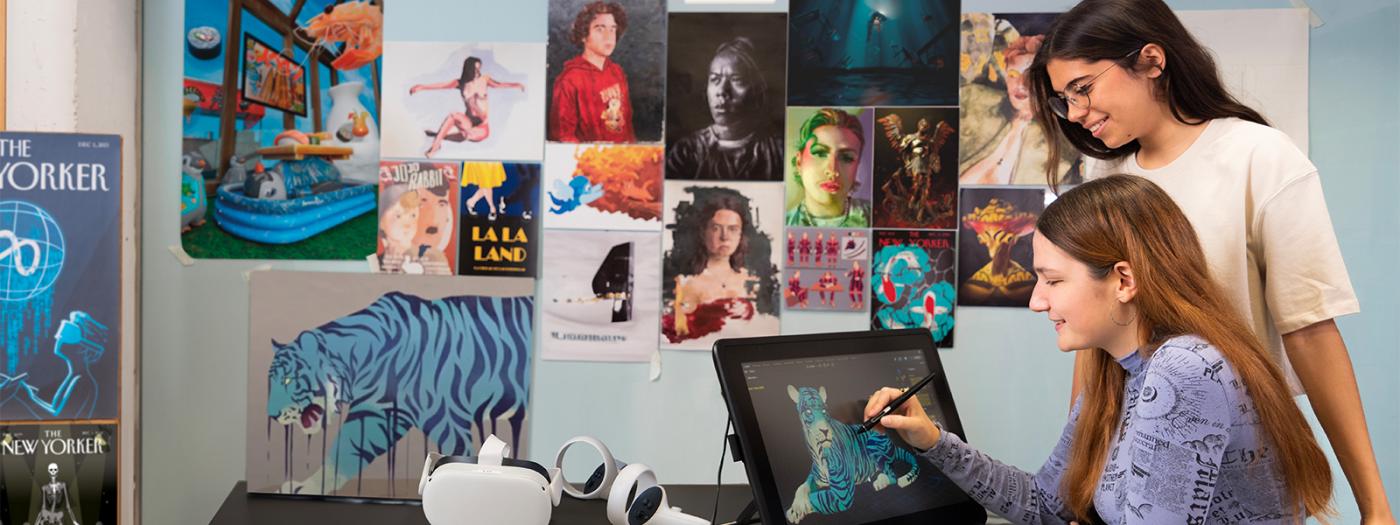
The subject will teach the student the traditional painting techniques (acrylic, oil, watercolour, coloured pencil, gouache, pastel ...) The composition and colour will be worked, with the tone and saturation, as well as the representation of volumes, the study of the light and atmospheres. Likewise, portrait painting and the human figure will be studied, as well as landscape painting.
Titular Professors
No previous knowledge is required
The Painting course aims to introduce students to the visual and technical foundations of pictorial practice, developing a basic understanding of color, its harmonies, and its expressive applications. Throughout the course, students are introduced to landscape representation, the study of the human figure, and the measurement and observation techniques required for portraiture, acquiring skills to analyze forms, proportions, and atmospheres. Through progressive exercises, students develop observational, synthetic, and technical control abilities, as well as their own artistic judgement to approach the representation of the visible world with confidence.
Topic 1. Introduction to color
Topic 2. Introduction to color and harmonies
Topic 3. Introduction to landscape
Topic 4. Study of the human figure.
Topic 5. Introduction to measurement techniques and portrait study
The subject will be worked through various active methodologies. It is a very practical subject. At the beginning of each topic the teacher will introduce certain basic concepts of the topic and will give the student exercises to work on those concepts in a practical way.
The different active methodologies to be used in the subject are the following:
MD 1: Master Class.
MD 2: Project-based learning.
MD 3: Challenge-based learning.
The assessment of the course will be based on the average of the following percentages:
First block: 50%
Color exercises, landscapes, and human figure sketches completed weekly. These sketches are assessed each week, resulting in an overall grade.
Second block: 50%
Portrait projects completed by the students.
Learning outcomes will be assessed according to the student’s ability to apply the content coherently, the technical and conceptual quality of the tasks produced, and the appropriate use of the vocabulary and procedures specific to the course. Participation, consistency, and compliance with the requirements of the activities will also be considered.
James Lord (2011) Retrato de Giacometti. Madrid: Antonio Machado.
Catálogo Antonio López García. (2013) pinturas y esculturas. Madrid: TF editores.
Catálogo Antonio López García. (2013) dibujos. Madrid: TF editores.
David Hockney (2001). El conocimiento secreto. Madrid: Destino.
Angie Cohen-Solal (2016). Mark Rothko: hacia La Luz de la capilla. Madrid: Paidos Ibérica.
Paul Cezanne, (1991) Correspondencias. Madrid: Antonio Machado.
Victor Erice (1992) El sol del membrillo (documental), Madrid.
Franck Maubert (2012) El olor a sangre humana no se me quita de los ojos. Madrid: El Acantilado.
MOREAUX, A. (1988) Anatomía artística del hombre. Madrid: Norma.
Victor Erice (1973) El espíritu de la colmena (película), Madrid.
Joseph Albers. Interacción del color. 2017. Alianza Forma.Madrid.
If necessary, complementary bibliography and materials will be provided for each unit.